Logo

Log In Sign Up |  An official publication of: American College of Emergency Physicians
Navigation
  • Home
  • Multimedia
    • Podcasts
    • Videos
  • Clinical
    • Airway Managment
    • Case Reports
    • Critical Care
    • Guidelines
    • Imaging & Ultrasound
    • Pain & Palliative Care
    • Pediatrics
    • Resuscitation
    • Trauma & Injury
  • Resource Centers
    • mTBI Resource Center
  • Career
    • Practice Management
      • Benchmarking
      • Reimbursement & Coding
      • Care Team
      • Legal
      • Operations
      • Quality & Safety
    • Awards
    • Certification
    • Compensation
    • Early Career
    • Education
    • Leadership
    • Profiles
    • Retirement
    • Work-Life Balance
  • Columns
    • ACEP4U
    • Airway
    • Benchmarking
    • Brief19
    • By the Numbers
    • Coding Wizard
    • EM Cases
    • End of the Rainbow
    • Equity Equation
    • FACEPs in the Crowd
    • Forensic Facts
    • From the College
    • Images in EM
    • Kids Korner
    • Medicolegal Mind
    • Opinion
      • Break Room
      • New Spin
      • Pro-Con
    • Pearls From EM Literature
    • Policy Rx
    • Practice Changers
    • Problem Solvers
    • Residency Spotlight
    • Resident Voice
    • Skeptics’ Guide to Emergency Medicine
    • Sound Advice
    • Special OPs
    • Toxicology Q&A
    • WorldTravelERs
  • Resources
    • ACEP.org
    • ACEP Knowledge Quiz
    • Issue Archives
    • CME Now
    • Annual Scientific Assembly
      • ACEP14
      • ACEP15
      • ACEP16
      • ACEP17
      • ACEP18
      • ACEP19
    • Annals of Emergency Medicine
    • JACEP Open
    • Emergency Medicine Foundation
  • About
    • Our Mission
    • Medical Editor in Chief
    • Editorial Advisory Board
    • Awards
    • Authors
    • Article Submission
    • Contact Us
    • Advertise
    • Subscribe
    • Privacy Policy
    • Copyright Information

How to Recognize Signs of Elder Abuse, Mistreatment

By Heather V. Rozzi, MD, FACEP | on December 17, 2014 | 0 Comment
Forensic Facts
  • Tweet
  • Click to email a link to a friend (Opens in new window) Email
Print-Friendly Version

The size, shape, color, and location of injuries should be carefully documented using either body maps or photographs. Many electronic health records allow for photographs to be uploaded directly into a patient’s chart. Each department should have a policy regarding photographing patients and storage of images.

You Might Also Like
  • Recognize the Signs That Older Children and Adolescents Are Playing the Choking Game
  • How to Recognize, Treat Victims of Sex Trafficking
  • How to Recognize and Act on Risk Factors for Domestic Violence Homicide
Explore This Issue
ACEP Now: Vol 33 – No 12 – December 2014
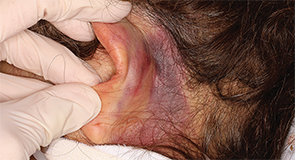
Figure 1. Injury on a 75-year-old female patient with lethargy and altered mental status.

Figure 1. Injury on a 75-year-old female patient with lethargy and altered mental status.

If there is a suspicion of elder mistreatment, the emergency provider must take appropriate steps to ensure the patient’s safety. In some cases, the involvement of other family members may be adequate. In others, hospital admission may be required.

Reporting requirements vary among jurisdictions. In most states, the Agency on Aging or Adult Protective Services receives and investigates reports of elder abuse and neglect. It is important to know the reporting requirements and procedures for the jurisdictions in which you practice.

Case Conclusion

The patient remains lethargic during her emergency department course. Urine drug screen is negative. Head CT shows an acute on chronic subdural hematoma. When told of these results, the patient’s daughter becomes tearful and admits that she had been taking her mother’s pain medication. When the patient would not provide her daughter with the patient’s most recent prescription for pain medication, the patient’s daughter struck her in the head, knocking her to the ground.

Emergency department personnel contact the police and Adult Protective Services. The patient is admitted to the hospital for medical care pending the police investigation. With the assistance of Adult Protective Services, the patient is placed in an extended care facility following discharge from the hospital.


Dr. RozziDr. Rozzi is an emergency physician; director of the Forensic Examiner Team at WellSpan York Hospital in York, Pennsylvania; and vice chair of the Forensic Section of ACEP.


Sample Screening Questions

Are you afraid of anyone where you live?
Has anyone touched you without your permission?
Are you left alone for long periods of time without adequate help?
Does anyone yell at you or threaten you?
Do you have the medications and other medical aids (wheelchairs, hearing aids, eyeglasses) that you need?
Is anyone living with you or taking your money without your permission?
(For caregivers) It can be stressful caring for an elderly person. Are you having any difficulties?

References

  1. Werner C. The older population: 2010 (Publication C2010BR-09). US Census Bureau. Nov. 2011.
  2. 2008 national population projections. US Census Bureau website. Available at: https://www.census.gov/population/projections/data/national/2008.html. Accessed November 18, 2014.
  3. Under the radar: New York State elder abuse prevalence study. May 2011. New York State Coalition on Elder Abuse website. Available at: http://www.nyselderabuse.org/prevalence-study.html. Accessed Nov. 18, 2014.
  4. Acierno R, Hernandez MA, Amstadter AB, et al. Prevalence and correlates of emotional, physical, sexual, and financial abuse and potential neglect in the United States: the national elder mistreatment study. Am J Public Health. 2010;100:292-7.
  5. What is elder abuse? National Center on Elder Abuse website. Available at: http://www.ncea.aoa.gov/faq/index.aspx. Accessed Nov. 18, 2014.
  6. Lachs MS, Williams CS, O’Brien S, et al. The mortality of elder mistreatment. JAMA. 1998;280;428-32.
  7. Mouton CP, Rodabough RJ, Rovi SL, et al. Prevalence and 3-year incidence of abuse among postmenopausal women. Am J Public Health. 2004;94:605-12.

Pages: 1 2 3 | Single Page

Topics: Abuse and NeglectElderlyEmergency DepartmentEmergency MedicineEmergency PhysicianTrauma and Injury

Related

  • Patterns of Injury in Elder Abuse

    November 6, 2025 - 0 Comment
  • EM Runs in the Family

    February 26, 2025 - 0 Comment
  • When the Patient History Does Not Fit

    October 10, 2024 - 0 Comment

Current Issue

ACEP Now: November 2025

Download PDF

Read More

No Responses to “How to Recognize Signs of Elder Abuse, Mistreatment”

Leave a Reply Cancel Reply

Your email address will not be published. Required fields are marked *


*
*


Wiley
  • Home
  • About Us
  • Contact Us
  • Privacy
  • Terms of Use
  • Advertise
  • Cookie Preferences
Copyright © 2025 by John Wiley & Sons, Inc. All rights reserved, including rights for text and data mining and training of artificial technologies or similar technologies. ISSN 2333-2603