Logo

Log In Sign Up |  An official publication of: American College of Emergency Physicians
Navigation
  • Home
  • Multimedia
    • Podcasts
    • Videos
  • Clinical
    • Airway Managment
    • Case Reports
    • Critical Care
    • Guidelines
    • Imaging & Ultrasound
    • Pain & Palliative Care
    • Pediatrics
    • Resuscitation
    • Trauma & Injury
  • Resource Centers
    • mTBI Resource Center
  • Career
    • Practice Management
      • Benchmarking
      • Reimbursement & Coding
      • Care Team
      • Legal
      • Operations
      • Quality & Safety
    • Awards
    • Certification
    • Compensation
    • Early Career
    • Education
    • Leadership
    • Profiles
    • Retirement
    • Work-Life Balance
  • Columns
    • ACEP4U
    • Airway
    • Benchmarking
    • Brief19
    • By the Numbers
    • Coding Wizard
    • EM Cases
    • End of the Rainbow
    • Equity Equation
    • FACEPs in the Crowd
    • Forensic Facts
    • From the College
    • Images in EM
    • Kids Korner
    • Medicolegal Mind
    • Opinion
      • Break Room
      • New Spin
      • Pro-Con
    • Pearls From EM Literature
    • Policy Rx
    • Practice Changers
    • Problem Solvers
    • Residency Spotlight
    • Resident Voice
    • Skeptics’ Guide to Emergency Medicine
    • Sound Advice
    • Special OPs
    • Toxicology Q&A
    • WorldTravelERs
  • Resources
    • ACEP.org
    • ACEP Knowledge Quiz
    • Issue Archives
    • CME Now
    • Annual Scientific Assembly
      • ACEP14
      • ACEP15
      • ACEP16
      • ACEP17
      • ACEP18
      • ACEP19
    • Annals of Emergency Medicine
    • JACEP Open
    • Emergency Medicine Foundation
  • About
    • Our Mission
    • Medical Editor in Chief
    • Editorial Advisory Board
    • Awards
    • Authors
    • Article Submission
    • Contact Us
    • Advertise
    • Subscribe
    • Privacy Policy
    • Copyright Information

Recognize Pediatric Toxic Epidermal Necrolysis Symptoms, Manage Disease

By Adeola Kosoko, MD, and Brent Kaziny, MD | on February 11, 2015 | 0 Comment
CME CME Now Features
  • Tweet
  • Click to email a link to a friend (Opens in new window) Email
Print-Friendly Version
Recognize Pediatric Toxic Epidermal Necrolysis Symptoms, Manage Disease

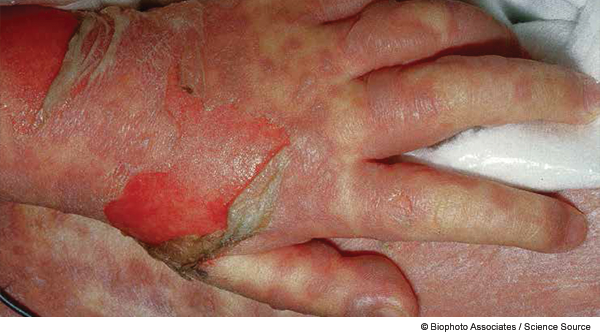
Shortly after transfer to the pediatric ICU, the patient’s respiratory status worsens. He is taken to the operating room with ENT and anesthesia for elective intubation for airway protection. Upper airway evaluation shows desquamation of the supraglottic structures without tracheal involvement. The patient is diagnosed with TEN secondary to mycoplasma infection based on positive immunoglobulin G and immunoglobulin M titers. The patient receives a three-day course of IVIG empirically. Ophthalmologic evaluation confirms a left corneal abrasion and extensive ocular involvement, also consistent with TEN. Four days into the hospital stay, the patient has a cardiac arrest. The suspected culprit is a mucous plug in the endotracheal tube. He subsequently has bilateral chest tubes placed for pneumothoraces. Throughout his hospital stay, he has several episodes of fever and is on acyclovir, azithromycin, vancomycin, and cefotaxime at varying points.

You Might Also Like
  • In Pediatric Erythema Multiforme Minor, Is Herpes a Common Cause?
  • Critical Decisions: Pediatric Sickle Cell Disease – Part Two
  • Critical Decisions: Pediatric Sickle Cell Disease – Part One
Explore This Issue
ACEP Now: Vol 34 – No 02 – February 2015

The patient is discharged after a four-week hospital stay to a pediatric rehabilitation facility. Ophthalmologic, dermal, and respiratory findings have all resolved, and the patient is back to playing video games and attending kindergarten, as he did prior to the acute illness.


Dr. Kosoko is a postdoctoral fellow in pediatric emergency medicine and global health at Baylor College of Medicine/Texas Children’s Hospital. She practices adult and pediatric emergency medicine in Houston and can be reached at aakosoko@texaschildrens.org.

Dr. Kaziny is an assistant professor of pediatrics in the section of emergency medicine at Baylor College of Medicine. He practices pediatric emergency medicine at Texas Children’s Hospital.

Objectives

After reading this article, the emergency care provider should be able to:

  • Know when to suspect toxic epidermal necrolysis (TEN) in the pediatric patient.
  • Develop a differential diagnosis for the acutely ill febrile child with mucosal change.
  • Understand the reasons a pediatric patient would develop TEN.
  • Be able to acutely manage the child in whom TEN is suspected.

Pearls

  1. Mucosal involvement often precedes skin involvement for SJS/TEN, and therefore mucosal involvement in an ill child should increase concern for SJS/TEN.
  2. The predominant cause of SJS/TEN is a drug. A careful history should be performed because the early discontinuation of the inciting drug can decrease mortality.
  3. If there is a concern for SJS/TEN on clinical exam in the ED, the physician should consider early transfer to a burn center because the condition can be rapidly progressing and specialized care is associated with improved outcomes.
  4. The greatest difference clinically between erythema multiforme and TEN/SJS is the development of systemic symptoms and the formation of bullae.

References

  1. Abood GJ, Nickoloff BJ, Gamelli RL. Treatment strategies in toxic epidermal necrolysis syndrome: where are we at? J Burn Care Res. 2008;29:269-276.
  2. Bastuji-Garin S, Rzany B, Stern RS, et al. Clinical classification of cases of toxic epidermal necrolysis, Stevens-Johnson syndrome, and erythema multiforme. Arch Dermatol. 1993;129:92-96.
  3. Spies M, Sanford AP, Aili Low JF, et al. Treatment of extensive toxic epidermal necrolysis in children. Pediatrics. 2001;108:1162-1168.
  4. Roujeau JC, Kelly JP, Naldi L, et al. Medication use and the risk of Stevens-Johnson syndrome or toxic epidermal necrolysis. N Engl J Med. 1995;333:1600-1607.
  5. Endorf FW, Cancio LC, Gibran NS. Toxic epidermal necrolysis clinical guidelines. J Burn Care Res. 2008;29:706-712.
  6. Ferrandiz-Pulido C, Garcia-Patos V. A review of causes of Stevens-Johnson syndrome and toxic epidermal necrolysis in children. Arch Dis Child. 2013;98:998-1003.

Pages: 1 2 3 4 | Single Page

Topics: Critical CareEmergency DepartmentEmergency PhysicianPatient SafetyPediatricsToxicology

Related

  • Why the Nonrebreather Should be Abandoned

    December 3, 2025 - 0 Comment
  • Q&A with ACEP President L. Anthony Cirillo

    November 5, 2025 - 0 Comment
  • FACEPs in the Crowd: Dr. John Ludlow

    November 5, 2025 - 0 Comment

Current Issue

ACEP Now: November 2025

Download PDF

Read More

No Responses to “Recognize Pediatric Toxic Epidermal Necrolysis Symptoms, Manage Disease”

Leave a Reply Cancel Reply

Your email address will not be published. Required fields are marked *


*
*


Wiley
  • Home
  • About Us
  • Contact Us
  • Privacy
  • Terms of Use
  • Advertise
  • Cookie Preferences
Copyright © 2025 by John Wiley & Sons, Inc. All rights reserved, including rights for text and data mining and training of artificial technologies or similar technologies. ISSN 2333-2603