Logo

Log In Sign Up |  An official publication of: American College of Emergency Physicians
Navigation
  • Home
  • Multimedia
    • Podcasts
    • Videos
  • Clinical
    • Airway Managment
    • Case Reports
    • Critical Care
    • Guidelines
    • Imaging & Ultrasound
    • Pain & Palliative Care
    • Pediatrics
    • Resuscitation
    • Trauma & Injury
  • Resource Centers
    • mTBI Resource Center
  • Career
    • Practice Management
      • Benchmarking
      • Reimbursement & Coding
      • Care Team
      • Legal
      • Operations
      • Quality & Safety
    • Awards
    • Certification
    • Compensation
    • Early Career
    • Education
    • Leadership
    • Profiles
    • Retirement
    • Work-Life Balance
  • Columns
    • ACEP4U
    • Airway
    • Benchmarking
    • Brief19
    • By the Numbers
    • Coding Wizard
    • EM Cases
    • End of the Rainbow
    • Equity Equation
    • FACEPs in the Crowd
    • Forensic Facts
    • From the College
    • Images in EM
    • Kids Korner
    • Medicolegal Mind
    • Opinion
      • Break Room
      • New Spin
      • Pro-Con
    • Pearls From EM Literature
    • Policy Rx
    • Practice Changers
    • Problem Solvers
    • Residency Spotlight
    • Resident Voice
    • Skeptics’ Guide to Emergency Medicine
    • Sound Advice
    • Special OPs
    • Toxicology Q&A
    • WorldTravelERs
  • Resources
    • ACEP.org
    • ACEP Knowledge Quiz
    • Issue Archives
    • CME Now
    • Annual Scientific Assembly
      • ACEP14
      • ACEP15
      • ACEP16
      • ACEP17
      • ACEP18
      • ACEP19
    • Annals of Emergency Medicine
    • JACEP Open
    • Emergency Medicine Foundation
  • About
    • Our Mission
    • Medical Editor in Chief
    • Editorial Advisory Board
    • Awards
    • Authors
    • Article Submission
    • Contact Us
    • Advertise
    • Subscribe
    • Privacy Policy
    • Copyright Information

Recognize Pediatric Toxic Epidermal Necrolysis Symptoms, Manage Disease

By Adeola Kosoko, MD, and Brent Kaziny, MD | on February 11, 2015 | 0 Comment
CME CME Now Features
  • Tweet
  • Click to email a link to a friend (Opens in new window) Email
Print-Friendly Version
Recognize Pediatric Toxic Epidermal Necrolysis Symptoms, Manage Disease
Introducing CME Now

You Might Also Like
  • In Pediatric Erythema Multiforme Minor, Is Herpes a Common Cause?
  • Critical Decisions: Pediatric Sickle Cell Disease – Part Two
  • Critical Decisions: Pediatric Sickle Cell Disease – Part One
Explore This Issue
ACEP Now: Vol 34 – No 02 – February 2015

ACEP Now features one article each issue related to an ACEP eCME CME activity.

Log on to the ACEP eCME CME site to complete the activity for this article and earn free AMA PRA Category 1 Credit.


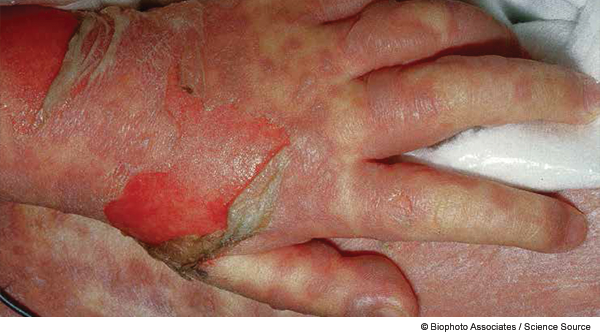
Toxic epidermal necrolysis (TEN), also known as Lyell’s syndrome, is a life-threatening dermatological condition that is frequently induced by a reaction to medications. It is characterized by the detachment of the top layer of skin (the epidermis) from the lower layers of the skin (the dermis) all over the body.

The Case

A previously healthy, fully immunized five-year-old boy presents to the pediatric emergency department with three days of fever and a progressive rash. Symptoms started with fevers to 104°F, a few “flat red spots” on his cheeks and behind his right ear, and bilateral injected eyes. The next day, he was seen by his primary doctor, who prescribed ofloxacin eyedrops for a presumed infection. That night, he developed crusting at his lips, redness and swelling of his palms and soles, and red patches on his trunk. On the morning of presentation, he had a few episodes of nonbloody, nonbilious emesis and complained of pain with urination and pain with swallowing. He was refusing to open his eyes to receive the prescribed medication.

Upon presentation to the ED, his blood pressure is 116/76, his pulse is 148, his temperature is 104.4°F, his respiratory rate is 21, and his SpO2 is 97 percent.

He is an alert, tearful boy, persistently keeping his eyes closed and clearly uncomfortable. There is left anterior cervical lymphadenopathy without a single large node and full range of motion at the neck. On ocular exam, the patient squeezes his eyelids shut and cries. Mildly edematous eyelids are pried open, and there is scant white/yellow discharge bilaterally. The pupils are equal and reactive to light, with bright red injection of the conjunctiva bilaterally. The lips are cracked and erythematous. There is a strawberry tongue and some desquamation at the buccal surfaces. There is tachycardia but no murmurs, rubs, or gallop with a brisk capillary refill. No respiratory distress is present. Abdominal and genitourinary exams are unremarkable for this circumcised male. There is mild bilateral hand swelling. There is an erythematous macular rash at the bilateral cheeks, chest, and back, as well as palmar erythema.

While in the ED, the patient is given a 40 cc/kg normal saline bolus, morphine, and acetaminophen, which make him more comfortable. He is started on maintenance IV fluids and ceftriaxone empirically. Vital signs normalize.

Background and Pathophysiology

Toxic epidermal necrolysis (TEN) is an infrequent medical emergency (0.4–1.3 cases per million per year worldwide) with high mortality.1 It is characterized by fever and widespread tender involvement of the epidermis and mucous membranes resulting in exfoliation. Stevens-Johnson syndrome (SJS) is categorized as less than 10 percent skin involvement, while TEN involves more than 30 percent of the body surface area. Both diseases are seen as a spectrum of a single process.2 Mortality is often due to systemic infection or multisystem organ failure.

Pages: 1 2 3 4 | Single Page

Topics: Critical CareEmergency DepartmentEmergency PhysicianPatient SafetyPediatricsToxicology

Related

  • Why the Nonrebreather Should be Abandoned

    December 3, 2025 - 0 Comment
  • Q&A with ACEP President L. Anthony Cirillo

    November 5, 2025 - 0 Comment
  • FACEPs in the Crowd: Dr. John Ludlow

    November 5, 2025 - 0 Comment

Current Issue

ACEP Now: November 2025

Download PDF

Read More

No Responses to “Recognize Pediatric Toxic Epidermal Necrolysis Symptoms, Manage Disease”

Leave a Reply Cancel Reply

Your email address will not be published. Required fields are marked *


*
*


Wiley
  • Home
  • About Us
  • Contact Us
  • Privacy
  • Terms of Use
  • Advertise
  • Cookie Preferences
Copyright © 2025 by John Wiley & Sons, Inc. All rights reserved, including rights for text and data mining and training of artificial technologies or similar technologies. ISSN 2333-2603