Logo

Log In Sign Up |  An official publication of: American College of Emergency Physicians
Navigation
  • Home
  • Multimedia
    • Podcasts
    • Videos
  • Clinical
    • Airway Managment
    • Case Reports
    • Critical Care
    • Guidelines
    • Imaging & Ultrasound
    • Pain & Palliative Care
    • Pediatrics
    • Resuscitation
    • Trauma & Injury
  • Resource Centers
    • mTBI Resource Center
  • Career
    • Practice Management
      • Benchmarking
      • Reimbursement & Coding
      • Care Team
      • Legal
      • Operations
      • Quality & Safety
    • Awards
    • Certification
    • Compensation
    • Early Career
    • Education
    • Leadership
    • Profiles
    • Retirement
    • Work-Life Balance
  • Columns
    • ACEP4U
    • Airway
    • Benchmarking
    • Brief19
    • By the Numbers
    • Coding Wizard
    • EM Cases
    • End of the Rainbow
    • Equity Equation
    • FACEPs in the Crowd
    • Forensic Facts
    • From the College
    • Images in EM
    • Kids Korner
    • Medicolegal Mind
    • Opinion
      • Break Room
      • New Spin
      • Pro-Con
    • Pearls From EM Literature
    • Policy Rx
    • Practice Changers
    • Problem Solvers
    • Residency Spotlight
    • Resident Voice
    • Skeptics’ Guide to Emergency Medicine
    • Sound Advice
    • Special OPs
    • Toxicology Q&A
    • WorldTravelERs
  • Resources
    • ACEP.org
    • ACEP Knowledge Quiz
    • Issue Archives
    • CME Now
    • Annual Scientific Assembly
      • ACEP14
      • ACEP15
      • ACEP16
      • ACEP17
      • ACEP18
      • ACEP19
    • Annals of Emergency Medicine
    • JACEP Open
    • Emergency Medicine Foundation
  • About
    • Our Mission
    • Medical Editor in Chief
    • Editorial Advisory Board
    • Awards
    • Authors
    • Article Submission
    • Contact Us
    • Advertise
    • Subscribe
    • Privacy Policy
    • Copyright Information

Prevent Loss of RVUs, Reduced Physician Compensation by Properly Documenting Evaluation and Management Services in the Emergency Department

By Kelly April Tyrrell | on May 9, 2014 | 0 Comment
Features
  • Tweet
  • Click to email a link to a friend (Opens in new window) Email
Print-Friendly Version

You Might Also Like
  • Critical Issues in the Initial Evaluation and Management of Patients Presenting to the Emergency Department in Early Pregnancy
  • Oxygen Insufflated Into Lungs Can Prevent Desaturation, Aid in Emergency Airway Management
  • Emergency Department Patients’ Demographics, Disposition, Composition Affect How They Pay for Services
Explore This Issue
ACEP Now: Vol 33 – No 05 – May 2014

An interview with reimbursement and coding expert Michael Granovsky, MD, CPC, FACEP


Prevent Loss of RVUs, Reduced Physician Compensation by Properly Documenting Evaluation and Management Services in the Emergency Department

When it comes to compensation, good documentation is a physician’s best friend.

Increasingly, emergency physicians find that anywhere from 30 to 50 percent of their compensation is based on RVU production. Some groups have even adopted 100 percent RVU-based compensation models, said Michael Granovsky, MD, CPC, FACEP, president of Logix Health, a national ED billing company. Without adequate and thorough documentation of evaluation and management (E/M) services, providers risk losing RVUs and having payments reduced for the care they provide.

It pays for physicians to take notice.

As much as 89 percent of the revenue in the ED comes from the E/M codes level 1 (92281) to level 5 (92285) and critical care.

An emergency physician would expect to be compensated less for seeing a patient with a simple bee sting than for seeing a patient with severe chest pain. However, the physician who does not adequately document the chest pain case may find it downcoded. A level 5 downcoded to a level 3 represents a loss of 64 percent of the RVUs and is roughly equivalent to providing a level 4 service for free.

The insurance companies will not see the patient’s chart, thus it is up to physicians to empower coders with adequate documentation to report the appropriate code for services provided. The number-one way to ensure this is to provide the documentation required by the Medicare 1995 documentation guidelines appropriate for the care delivered (see Table 1).
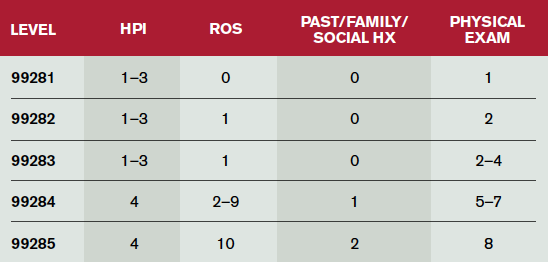
Table 1. Medicare 1995 Guidelines Typical Requirements

Table 1. Medicare 1995 Guidelines Typical Requirements

It’s important to note that doesn’t mean overdocumenting.

“You can’t take an ankle sprain and document it excessively, and it magically becomes a level 5,” said Dr. Granovsky. “We are seeing a significant increase in audit activity targeting the overuse of macros.”

Three primary elements factor into determining the E/M level of a case: history, physical exam, and medical decision making.

History is composed of chief complaint; history of present illness (HPI); review of systems (ROS); and past medical, family, and/or social history.

The minimum number of HPI elements for E/M levels 4 and 5 is four, and failure to meet this is the single most costly documentation error. Dr. Granovsky recommended that the rich clinical detail in the HPI become one of the tools physicians use to paint a clear clinical picture in what otherwise might be a bland electronic medical record (EMR) history and physical exam.

Pages: 1 2 | Single Page

Topics: BillingCost of Health CareEmergency DepartmentEmergency MedicineEmergency PhysicianEvaluation and ManagementHealth InsuranceMedical DocumentationPhysician CompensationPractice ManagementPractice TrendsReimbursement and CodingWorkforce

Related

  • Florida Emergency Department Adds Medication-Dispensing Kiosk

    November 7, 2025 - 1 Comment
  • Q&A with ACEP President L. Anthony Cirillo

    November 5, 2025 - 0 Comment
  • How Does Emergency Medicine Navigate Consolidation Trends in Health Care?

    October 29, 2025 - 0 Comment

Current Issue

ACEP Now: November 2025

Download PDF

Read More

About the Author

Kelly April Tyrrell

Kelly April Tyrrell writes about health, science and health policy. She lives in Madison, Wisconsin, where she is usually running, riding her bike, rock climbing or cross-country skiing. Follow her @kellyperil.

View this author's posts »

No Responses to “Prevent Loss of RVUs, Reduced Physician Compensation by Properly Documenting Evaluation and Management Services in the Emergency Department”

Leave a Reply Cancel Reply

Your email address will not be published. Required fields are marked *


*
*


Wiley
  • Home
  • About Us
  • Contact Us
  • Privacy
  • Terms of Use
  • Advertise
  • Cookie Preferences
Copyright © 2025 by John Wiley & Sons, Inc. All rights reserved, including rights for text and data mining and training of artificial technologies or similar technologies. ISSN 2333-2603
