
Explore This Issue
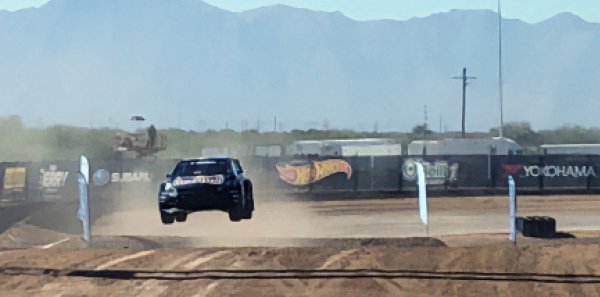
ACEP Now: Vol 41 – No 02 – February 2022Rally cars add a Z axis impact with jumps.
ACEP Now:How do you balance working with NASCAR and the Mayo Clinic?
Dr. Kozak: I’m at Mayo Clinic full time. I probably attend races six to seven weekends each year, plus trainings in Phoenix. I also attend the NASCAR safety summit, a meeting where we go over new changes to car and fire safety and medical for all teams across the United States.
ACEP Now: What’s the craziest thing you’ve ever seen, and what did you learn from it?
Dr. Kozak: The very first fatality I had was in 1997, and it was a support race for NASCAR. The driver got out of control, and his car swung around and got hit on the driver’s side, and the cement wall creased his helmet and destroyed his car. We had to do a resuscitation on the track.
That one incident was captured on video, and we learned a ton of information from it. It changed our practice on the track. For one thing, all the safety personnel are now in fire suits. At the time, I was in jeans, a polo shirt, and hat. On the long lens, you can see me in a white hat, bouncing up and down as I was administering CPR. I intubated the driver on the track and got a heartbeat. The driver died three hours later because he had crushed his head.
At that point in time, we understood our best mode of attack is to put an airway in and get off the track as fast as possible. Some would say it’s heartless to keep racing when there’s been a serious injury. The problem is if you stop a race after a fatality or issue on the track, everyone in the stands wants to go home and will clog access points for moving injured people or extra resources.
We now have code on the radio to say when there’s been a serious injury as a way of letting everybody know. This activates the administration of the track to begin interactions to make announcements on the driver’s health and get needed assistance with safety and security and making sure we have a clear shot of the freeway so we can get to the nearest hospital.
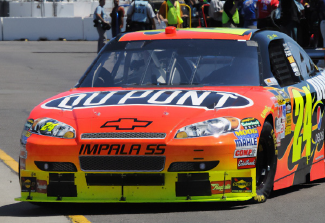
Jeff Gordon in #24 heading out to the track.
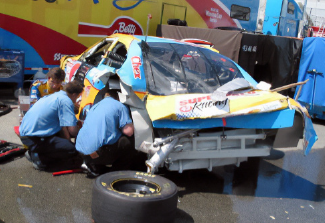
Bad day at the office for this driver. But, as you can see, he emerged uninjured … although the car did not! Safety innovations at work.
ACEP Now: How have attitudes to race car safety changed in the last few decades?
Dr. Kozak: Initially, the attitude of racing was, “If it doesn’t make my car go faster, I’m not interested in it.” That changed in the 1950s when there was a terrible crash at the 24-hour race at Le Mans. A car became airborne and fell into the stands and killed people. You have multiple drivers in a 24-hour race. One of the co-drivers was an engineer by the name of Fitch. He got interested in safety and created the Fitch barrel, which are big yellow canisters with a black top and sand at the bottom. If they’re hit, they absorb the impact.
The thing that woke NASCAR up was when Dale Earnhardt Sr. died in Daytona. They started requiring fireproof suits. They put a center bar in the cars in case the roof caved in. In the old days, the seats were flimsy—now they have padding to contain the head from bouncing around.
Probably the two biggest safety factors that have come out are the head and neck restraint known as the HANS device and the SAFER barrier, which is a steel-foam fatality barrier. So when a car hits a barrier, it absorbs 50 percent of the kinetic energy.
I did an analysis because we have records of all the drivers who crashed at the Phoenix Raceway. We had nine years of records before and 10 years after initiating the use of HANS and SAFER barriers. We did an evaluation and found that people who had a crash before these protections had a 22 percent chance of being transported to a hospital, and after they were introduced, this went down to less than 8 percent.
ACEP Now:Is it possible to make this sport safe?
Dr. Kozak: No. If it were safe, nobody would watch it. We’ve done a lot with first strikes [or injuries]. Another thing we’re working on is the second strike, when a driver loses control of the car and one of the other drivers coming around the corner at 179 mph hits you. One of the worst second strike injuries that I’ve ever heard about was in 2001 with Alex Zanardi. As he was slowly recovering from a spin, another car came around and took off the front of the car and his legs. The physician I knew who was working there as the medical director clamped his arteries, and he was able to survive.
ACEP Now: How has racing given you a new perspective on emergency medicine?
Dr. Kozak: I do enjoy the competition and getting to know the drivers. It is a good break from the day-to-day grind of treating COVID and abdominal pain. I’ve been working in an emergency department since 1981. I think in order to prevent professional burnout, it’s important for emergency physicians to pursue a wellness course and have something else in life they can point to.
This interview has been edited for length and clarity.
Pages: 1 2 3 | Single Page

No Responses to “Practicing Medicine in the Fast Lane”