
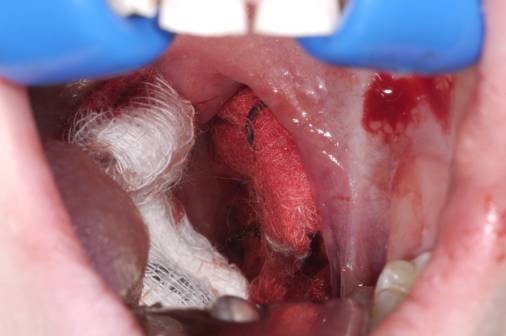
Laboratory tests, although not essential for initial management, are recommended to assess the patient’s baseline status and prepare the receiving facility. Hemoglobin, type and screen, and crossmatch should be prioritized for significant blood loss and potential transfusion requirements. Fibrinogen levels should also be obtained, where available, if severe hemorrhage suggests the potential need for administration of fibrinogen concentrate.
Explore This Issue
ACEP Now: Jan 01For patients with ongoing brisk bleeding despite the above measures, a coagulopathy should be suspected, and desmopressin (DDAVP) at a dose of 0.3 mcg/kg IV may be considered, especially if von Willebrand disease is suspected. DDAVP is shown to enhance platelet adhesion, potentially stabilizing bleeding until surgical intervention is available.11
Summary
The next time you’re faced with a post-tonsillectomy bleed, remember that primary hemorrhage occurs within 24 hours post-operatively and may indicate surgical causal factors or undiagnosed coagulopathies. Secondary hemorrhage, typically occurring between days five and seven, but as many as 14, can start as a trickle and escalate quickly. Even if you are successful in stopping the bleed in the ED, these patients need rapid ENT consultation for urgent definitive management in the operating room.
Using the three-pronged approach outlined here—resuscitation, early ENT consultation with expedited transport, and temporizing measures—while preparing for airway management and ordering appropriate laboratory investigations, will save your post-tonsillectomy patients from a potentially life-threatening hemorrhage.
Special thanks to Dr. Kevin Wasko, guest expert on the EM Cases podcast on this topic, who inspired this column.
 Dr. Helman is an emergency physician at North York General Hospital in Toronto. He is an assistant professor at the University of Toronto, Division of Emergency Medicine, and the education innovation lead at the Schwartz/Reisman Emergency Medicine Institute. He is the founder and host of the Emergency Medicine Cases podcast and website.
References
- Grasl S, Mekhail P, Janik S, et al. Temporal fluctuations of post-tonsillectomy haemorrhage. Eur Arch Otorhinolaryngol. 2022 ;279(3):1601-1607.
- Wall JJ, Tay KY. Postoperative tonsillectomy hemorrhage. Emerg Med Clin North Am. 2018;36(2):415-426.
- Dharmawardana N, Chandran D, Elias A, et al. Management of post tonsillectomy secondary haemorrhage: Flinders experience. Aust J Otolaryngol. 2018;1:31.
- Ker K, Edwards P, Perel P, et al. Effect of tranexamic acid on surgical bleeding: systematic review and cumulative meta-analysis. BMJ. 2012;344:e3054.
- Arora R, Saraiya S, Niu X, et al. Post tonsillectomy hemorrhage: who needs intervention? Int J Pediatr Otorhinolaryngol. 2015;79(2):165-169.
- Fields RG, Gencorelli FJ, Litman RS. Anesthetic management of the pediatric bleeding tonsil. Paediatr Anaesth. 2010;20(11):982-986.
- Morgenstern J. Massive hemorrhage post-tonsillectomy. First10EM. Published August 6, 2018. Accessed November 25, 2024.
- Dermendjieva M, Gopalsami, A, Glennon N, et al. Nebulized tranexamic acid in secondary post-tonsillectomy hemorrhage: case series and review of the literature. Clin Pract Cases Emerg Med. 2021;5(3):1-7.
- Helman A, Weingart S, Tillmann B. Hemoptysis – ED approach and management. Emergency Medicine Cases. Published November 2023. Accessed October 31, 2024.
- Andreae MC, Cox RD, Shy BD, et al. 319 Yankauer outperformed by alternative suction devices in evacuation of simulated emesis. Ann Emerg Med. 2016;68(4):S123.
- Swieringa F, Lancé MD, Fuchs B, et al. Desmopressin treatment improves platelet function under flow in patients with postoperative bleeding. J Thromb Haemost. 2015;13(8):1503-1513.
Pages: 1 2 3 4 | Single Page



4 Responses to “Post-Tonsillectomy Hemorrhage: A Three-Pronged Approach”
January 15, 2025
Creed MamikunianAs an ENT who has practiced for 35 years, I usually managed these patients in the ER awake. Spray topical lidocaine on the side bleeding. Then inject about 2-3 cc 1% lidocaine with epi at the site of bleeding. You need a strong headlight from the OR and a suction bovie machine also from the OR. Have your ENT teach you how to use these various instruments, they are your friend. Calmly talk the patient through what you’re doing and then cauterize the bleeding vessel. It’s usually at the plica triangularis (the bottom of the tonsillar fossa. Use two tongue blades to push the tongue down to find the bleeder. Give it a few good buzzes with the suction bovie and you’re done.
Everything else is just delaying the treatment. One last thing, if it’s a young patient, this won’t work. Teenagers at a minimum. Otherwise, you’d better hope your ENT is close by.
January 19, 2025
Paul MMany of us live in a world where there is no ENT…either on call or close by. Top 5 bad cases at 0300….tonsillar bleed in pediatric patient.
February 20, 2025
Dr James C MartinHaving practiced ENT for 35+ yrs, I’ve seen my share of post-tonsil bleeds, usually 5-10 days postop, but have seen them as late as several weeks. I don’t hesitate to take these patients to the OR, not only for excellent visualization, but there’s nothing worse than stopping the bleeding in the ER, only to be called back 2-3 hrs later because the patient rebled, usually secondary to N/V at home despite anti nausea meds.
Usually cautery or coblation solves the problem, and I then inject 1-2cc of 1/4% marcaine with 1/200K epinephrine for pain control, along with hemostatic effect.
Postop tonsil bleeds can be severe and cause you to age faster, and loose sleep!
July 26, 2025
Dee EmersThis sentence here “Calmly talk the patient through what you’re doing and then cauterize the bleeding vessel.” Was so nice to read. My son went through this and it was so scary for him and myself because no one explained anything and the blood was so scary for us to see. Possibly the people in ED didn’t know what was going on until the ENT arrived. Not sure but it was traumatizing for my 7 year old.