Logo

Log In Sign Up |  An official publication of: American College of Emergency Physicians
Navigation
  • Home
  • Multimedia
    • Podcasts
    • Videos
  • Clinical
    • Airway Managment
    • Case Reports
    • Critical Care
    • Guidelines
    • Imaging & Ultrasound
    • Pain & Palliative Care
    • Pediatrics
    • Resuscitation
    • Trauma & Injury
  • Resource Centers
    • mTBI Resource Center
  • Career
    • Practice Management
      • Benchmarking
      • Reimbursement & Coding
      • Care Team
      • Legal
      • Operations
      • Quality & Safety
    • Awards
    • Certification
    • Compensation
    • Early Career
    • Education
    • Leadership
    • Profiles
    • Retirement
    • Work-Life Balance
  • Columns
    • ACEP4U
    • Airway
    • Benchmarking
    • Brief19
    • By the Numbers
    • Coding Wizard
    • EM Cases
    • End of the Rainbow
    • Equity Equation
    • FACEPs in the Crowd
    • Forensic Facts
    • From the College
    • Images in EM
    • Kids Korner
    • Medicolegal Mind
    • Opinion
      • Break Room
      • New Spin
      • Pro-Con
    • Pearls From EM Literature
    • Policy Rx
    • Practice Changers
    • Problem Solvers
    • Residency Spotlight
    • Resident Voice
    • Skeptics’ Guide to Emergency Medicine
    • Sound Advice
    • Special OPs
    • Toxicology Q&A
    • WorldTravelERs
  • Resources
    • ACEP.org
    • ACEP Knowledge Quiz
    • Issue Archives
    • CME Now
    • Annual Scientific Assembly
      • ACEP14
      • ACEP15
      • ACEP16
      • ACEP17
      • ACEP18
      • ACEP19
    • Annals of Emergency Medicine
    • JACEP Open
    • Emergency Medicine Foundation
  • About
    • Our Mission
    • Medical Editor in Chief
    • Editorial Advisory Board
    • Awards
    • Authors
    • Article Submission
    • Contact Us
    • Advertise
    • Subscribe
    • Privacy Policy
    • Copyright Information

Ping Ping Ping Goes the Bullet—or Should It?

By Ralph J. Riviello, MD, MS, FACEP, and Heather V. Rozzi, MD, FACEP | on February 5, 2023 | 0 Comment
CME CME Now Forensic Facts
  • Tweet
  • Click to email a link to a friend (Opens in new window) Email
Print-Friendly Version

Note: This article is our CME Now offering for the February 2023 issue. After you read it, visit ACEP’s Online Learning Center to earn CME credit.

Case

A young male is brought to the emergency department (ED) via EMS after sustaining a gunshot wound. The trauma team is activated. The patient is hemodynamically stable and has an intact primary survey. On secondary survey, there is a perforating wound. Across from the wound is a bulge in the skin with a palpable foreign body, presumably a bullet. Radiographic imaging shows no serious vascular or bony injury, and confirms the presence of a superficial, bullet-shaped radiopaque foreign body as noted on exam. Given its position, the trauma team decides to remove the bullet at the bedside. You then hear the surgical resident tell the nurse, “Get me a scalpel, tray, and a metal basin. I love hearing the bullet drop into the basin.” How do you respond to this request?

You Might Also Like
  • Can Radiographs of Gunshot Wounds Determine Bullet Caliber?
  • EPs Should Continue to Improve Forensic Skills
  • Forensic Photography Tips
Explore This Issue
ACEP Now: Vol 42 – No 02 – February 2023

Discussion

Firearm injuries are increasingly common in the United States. In 2020, there were over 45,222 firearm-related deaths. Many more Americans were injured by firearms with more than 70 percent of them were firearm-related assaults.1 Following a gunshot wound, there are a few possible outcomes: the patient dies at the scene, the patient is transported to the hospital and dies either in the ED, operating room, or at some point after hospital admission. For patients who do not survive, their forensic needs are met by the coroner or medical examiner. Other patients following a gunshot would arrive to the ED and undergo treatment and evaluation, and are either admitted to the hospital or discharged. Ultimately, those who make it to the hospital and survive rely on emergency physicians and ED personnel to help meet their forensic needs. Our primary goal remains resuscitation and stabilization, however, we should be cognizant of the forensic needs.
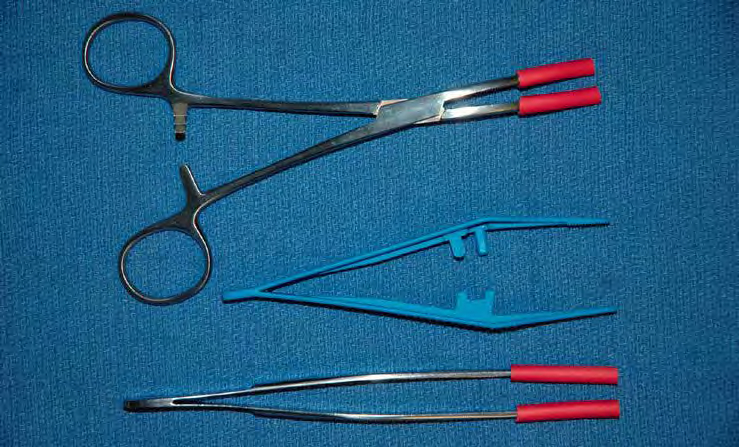
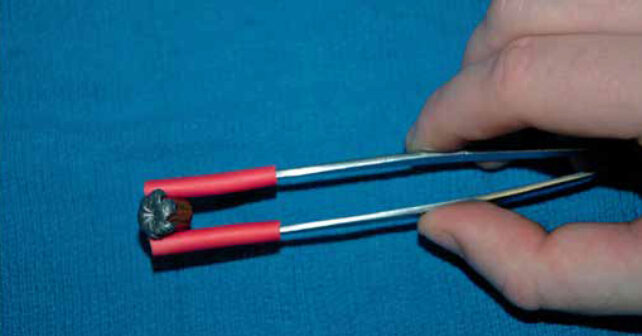
FIGURE A: Because bullets are soft and malleable, use of metallic surgical

instruments like forceps to grasp the bullet can impart marks from the instrument

into the bullet. (Click to enlarge.)

One aspect to consider is how to handle evidence. Ammunition, or a cartridge, is the object that is loaded into a firearm. It consists of a cartridge case which holds the bullet, a primer, and powder. Upon firing the weapon, the bullet becomes the projectile. Cartridges are commonly made of brass (copper and zinc). Bullets come in a variety of shapes, sizes, and compositions. Bullets are often made of copper, steel, and lead (though lead is becoming less common). Copper and lead are soft and malleable so they can conform to the barrel of the weapon, which has spiral impressions called lands and grooves. Traveling along the barrel imparts ballistic markings onto the bullet that experts can use to match it to the weapon and other possible casings.2,3

Pages: 1 2 3 | Single Page

Topics: FirearmGunsGunshot WoundLaw Enforcement

Related

  • August 2024 News from the College

    August 8, 2024 - 0 Comment
  • ACEP Rejects “Excited Delirium”

    April 5, 2024 - 0 Comment
  • Forensic Evaluation of Motor Vehicle Accidents

    May 6, 2023 - 0 Comment

Current Issue

ACEP Now: November 2025

Download PDF

Read More

No Responses to “Ping Ping Ping Goes the Bullet—or Should It?”

Leave a Reply Cancel Reply

Your email address will not be published. Required fields are marked *


*
*


Wiley
  • Home
  • About Us
  • Contact Us
  • Privacy
  • Terms of Use
  • Advertise
  • Cookie Preferences
Copyright © 2025 by John Wiley & Sons, Inc. All rights reserved, including rights for text and data mining and training of artificial technologies or similar technologies. ISSN 2333-2603
