
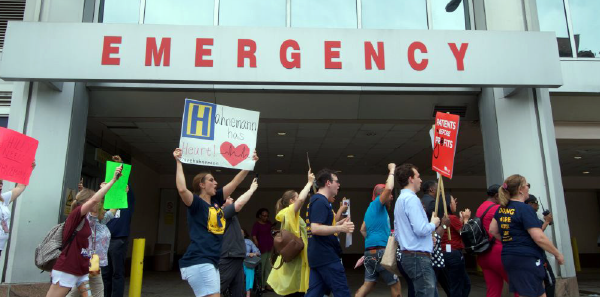
On July 10, Hahnemann, Drexel, and Tower Health announced a letter of intent to transfer the majority of Hahnemann/Drexel’s residency and fellowship programs to Tower Health. But while that may help new interns and future emergency medicine residents, Dr. Calhoun said Tower Health does not currently have the capacity to train senior residents. Drexel referred questions regarding resident displacement to AAHS, who did not respond to questions via email or telephone.
Explore This Issue
ACEP Now: Vol 38 – No 08 – August 2019According to EMRA, there are more than 2,500 annual emergency medical residency spots in the United States, and abrupt residency closures are uncommon. However, said Dr. Hughes, there have been a few closures of ACGME-accredited programs in recent years due to natural disasters (Hurricane Katrina), hospital bankruptcy, and failed contract negotiations.4
Loss of Critical Part of Community
Hahnemann University Hospital was established in 1848 as the Homeopathic Medical College of Philadelphia and later renamed. It merged with several other medical schools, and, in 1998, Tenet Healthcare acquired Hahnemann. Shortly after, Drexel took over management of the academic institution. In early 2018, AAHS purchased Hahnemann and nearby St. Christopher’s Hospital for Children from Tenet.
“Hahnemann has been a staple of the community for so long, and even though for 20 or 30 years the hospital has been on shaky ground, no one ever imagined it would close and certainly not on a 30-day or 60-day time frame,” said Dr. Calhoun.
Despite the September closure date, Hahnemann—considered a safety-net hospital for the area—stopped admitting patients through the emergency department on July 17 and planned to operate effectively as an urgent care center, open only to noncritical cases.
The closure will also send ripple effects through other regional hospitals at which Hahnemann/Drexel residents worked. For instance, Dr. Calhoun said that residents staff overnight shifts at the emergency departments and intensive care units of community hospitals in the Mercy Health system and that, with residents leaving, those hospitals will be scrambling for solutions.
Seeing the decline at Hahnemann has also been challenging, she said. “We have white boards with services that are no longer available. We’re just not seeing as many ambulances. There is no longer trauma or stroke or STEMI, no labor and delivery services, no elective OR cases … There are still sick patients who walk themselves through the door but certainly at a decreased volume and decreased acuity from several weeks ago.”
But she and her colleagues are trying to take it all in stride. “In emergency medicine, you need to be able to handle whatever’s thrown at you and keep a level head,” Dr. Calhoun said. “We were taught resilience early on, so hopefully we are stronger in the end, but we still have a difficult couple of weeks ahead.”
References
- Brubaker H. Hahnemann University Hospital closure upends career paths for 570 doctors-in-training. Philadelphia Inquirer. July 3, 2019. Available at: https://www.inquirer.com/business/hahnemann-university-hospital-residents-lose-training-grounds-20190703.html. Accessed July 24, 2019.
- Schaefer MA. For some Hahnemann medical residents, there’s an added stress: potential deportation. Philadelphia Inquirer. July 15, 2019. Available at: https://www.inquirer.com/health/hahnemann-j-1-visa-foreign-residents-medical-doctors-deported-20190715.html. Accessed July 24, 2019.
- Brubaker H. Hahnemann starts releasing stranded residents; St. Chris auction could see competitive bidding. Philadelphia Inquirer. July 24, 2019. Available at: https://www.inquirer.com/business/hahnemann-university-hospital-releases-residents-20190724.html. Accessed July 25, 2019.
- Berger E. A contract expires, an emergency medicine residency stands on the brink. Ann Emerg Med. 2017;69(4):A20-A23.
Pages: 1 2 3 4 | Single Page



No Responses to “Philly Hospital’s Unexpected Closure Leaves Residents Scrambling”