Logo

Log In Sign Up |  An official publication of: American College of Emergency Physicians
Navigation
  • Home
  • Multimedia
    • Podcasts
    • Videos
  • Clinical
    • Airway Managment
    • Case Reports
    • Critical Care
    • Guidelines
    • Imaging & Ultrasound
    • Pain & Palliative Care
    • Pediatrics
    • Resuscitation
    • Trauma & Injury
  • Resource Centers
    • mTBI Resource Center
  • Career
    • Practice Management
      • Benchmarking
      • Reimbursement & Coding
      • Care Team
      • Legal
      • Operations
      • Quality & Safety
    • Awards
    • Certification
    • Compensation
    • Early Career
    • Education
    • Leadership
    • Profiles
    • Retirement
    • Work-Life Balance
  • Columns
    • ACEP4U
    • Airway
    • Benchmarking
    • Brief19
    • By the Numbers
    • Coding Wizard
    • EM Cases
    • End of the Rainbow
    • Equity Equation
    • FACEPs in the Crowd
    • Forensic Facts
    • From the College
    • Images in EM
    • Kids Korner
    • Medicolegal Mind
    • Opinion
      • Break Room
      • New Spin
      • Pro-Con
    • Pearls From EM Literature
    • Policy Rx
    • Practice Changers
    • Problem Solvers
    • Residency Spotlight
    • Resident Voice
    • Skeptics’ Guide to Emergency Medicine
    • Sound Advice
    • Special OPs
    • Toxicology Q&A
    • WorldTravelERs
  • Resources
    • ACEP.org
    • ACEP Knowledge Quiz
    • Issue Archives
    • CME Now
    • Annual Scientific Assembly
      • ACEP14
      • ACEP15
      • ACEP16
      • ACEP17
      • ACEP18
      • ACEP19
    • Annals of Emergency Medicine
    • JACEP Open
    • Emergency Medicine Foundation
  • About
    • Our Mission
    • Medical Editor in Chief
    • Editorial Advisory Board
    • Awards
    • Authors
    • Article Submission
    • Contact Us
    • Advertise
    • Subscribe
    • Privacy Policy
    • Copyright Information

How to Perform Ultrasound-Guided Forearm Nerve Blocks to Provide Non-Drug Pain Relief for Acute Injuries

By Peter Wroe, MD, and Arun Nagdev, MD | on October 13, 2016 | 0 Comment
Sound Advice
  • Tweet
  • Click to email a link to a friend (Opens in new window) Email
Print-Friendly Version

While forearm nerve blocks provide excellent anesthesia for hand injuries (fractures, dislocations, lacerations, abscesses), they don’t provide anesthesia to the volar forearm or the wrist.

You Might Also Like
  • Ultrasound-Guided Forearm Nerve Blocks
  • How to Perform Ultrasound-Guided Distal Sciatic Nerve Block in the Popliteal Fossa
  • Ultrasound-Guided Posterior Tibial Nerve Block
Explore This Issue
ACEP Now: Vol 35 – No 10 – October 2016

Hand injuries are a very common emergency department complaint, accounting for a great deal of acute pain as well as chronic morbidity and productivity loss.1–3 Adequate analgesia and anesthesia are necessary to provide hemostasis, wound irrigation, debridement, an adequate examination, laceration or tendon repair, joint reduction, splinting, and other acute interventions. Ultrasound-guided forearm nerve blocks can provide definitive analgesia and facilitate these interventions in acute hand injuries in the emergency department.4–7
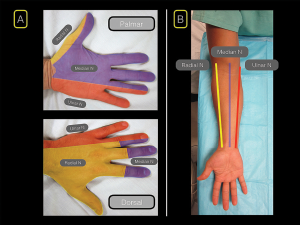
Figure 1.

Figure 1. Distribution of the median (purpe), radial (yellow), and ulnar (red) nerves on the hand (A) and forearm (b).

Anatomy of Forearm Nerves

The distribution of nerves throughout the forearm is in three segments (see Figure 1):

  • Median nerve: radial/lateral aspect of volar hand; volar surface of thumb, index, long, and radial/lateral side of ring finger
  • Radial nerve: radial/lateral aspect of dorsal hand; dorsal surface of thumb; dorsal surface of index, long, and radial/lateral side of ring finger, proximal to the distal interphalangeal (DIP) joints
  • Ulnar nerve: ulnar/medial aspect of dorsal and volar hand including hypothenar eminence, fifth digit, and ulnar/medial aspect of ring finger

For major injuries to the hand, such as firework blast injuries, all three forearm nerves can be blocked. For injuries to the radial aspect of the hand or the first four digits, consider blocking the median and/or radial nerve(s). For injuries to the ulnar hand or little finger (eg, a boxer’s fracture), utilize the ulnar nerve block. (See Figure 2.) There’s moderate overlap of innervation for each dermatomal location. Injuries located close to dermatomal transitions often require both nerves to be blocked to ensure adequate pain control. We also recommend using a multimodal approach to pain management that relies on oral agents as well as local anesthetic infiltration, if possible.
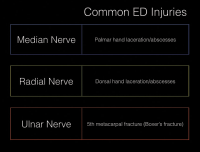
Figure 2. Choosing the correct nerve block for the injured area.

Figure 2. Choosing the correct nerve block for the injured area.

While forearm nerve blocks provide excellent anesthesia for hand injuries (fractures, dislocations, lacerations, abscesses), they don’t provide anesthesia to the volar forearm or the wrist. Therefore, other means of analgesia/anesthesia should be pursued for injuries to these areas, such as distal radius fractures and other wrist injuries.

Ultrasound Setup

Probe: The probe selection should be a high-frequency linear transducer (15-6 MHz) set at the nerve (or soft tissue) preset (found on most POCUS systems). A 10-5 MHz transducer could also be used. Use a standard 1.5-inch, 25-gauge needle. (An alternative is a 22-gauge, blunt-tipped regional block needle.)

Pages: 1 2 3 4 | Single Page

Topics: AnalgesiaClinicalCritical CareEmergency DepartmentEmergency MedicineEmergency PhysicianForearmImaging & UltrasoundPainPatient CareTrauma & Injury

Related

  • Why the Nonrebreather Should be Abandoned

    December 3, 2025 - 0 Comment
  • Let Core Values Help Guide Patient Care

    November 5, 2025 - 0 Comment
  • Non-Invasive Positive Pressure Ventilation in the Emergency Department

    October 1, 2025 - 0 Comment

Current Issue

ACEP Now: November 2025

Download PDF

Read More

No Responses to “How to Perform Ultrasound-Guided Forearm Nerve Blocks to Provide Non-Drug Pain Relief for Acute Injuries”

Leave a Reply Cancel Reply

Your email address will not be published. Required fields are marked *


*
*


Wiley
  • Home
  • About Us
  • Contact Us
  • Privacy
  • Terms of Use
  • Advertise
  • Cookie Preferences
Copyright © 2025 by John Wiley & Sons, Inc. All rights reserved, including rights for text and data mining and training of artificial technologies or similar technologies. ISSN 2333-2603
