
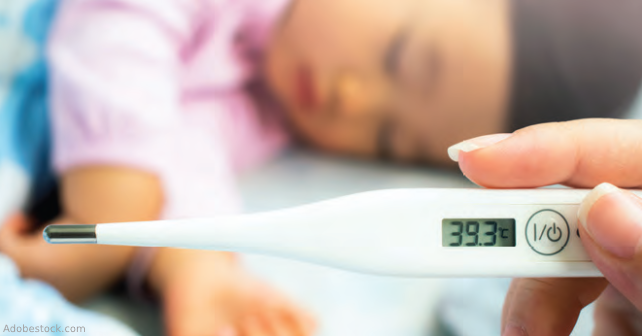
The study that currently best answers this clinical question is a 2015 prospective observational study that evaluated 15,781 children less than five years old and identified 1,120 (7.1 percent) SBIs.6 The authors noted the maximum axillary temperature at presentation and the maximum temperature (any location) reported by family within the previous 24 hours. SBI included bacteremia, urinary tract infection, pneumonia, osteomyelitis, meningitis, and septic arthritis. 42 percent of children had a fever greater than or equal to 39 degrees Celsius (102.2 degrees Fahrenheit) at presentation or reported by family. Overall, SBIs were present in 3.6 percent of children with a fever greater than or equal to 39 degrees Celsius and duration of illness less than or equal to 24 hours, while the prevalence of SBI in children with fever greater than or equal to 39 degrees Celsius and illness duration greater than 96 hours was 20 percent. Duration of fever, rather than height of fever, appeared to play a role. The authors do mention that 45 of 137 (32.8 percent) children less than six months of age with a fever greater than or equal to 39 degrees Celsius had an SBI, but using a cut-off of 39 degrees Celsius missed 82 percent of cases of SBI in this same age group. The authors conclude that “temperature is an inaccurate marker of serious bacterial infection in children presenting to the emergency department with fever and reliance on magnitude of fever to guide further evaluation will result in misclassification of both serious bacterial infections and self-limiting illnesses.”
Explore This Issue
ACEP Now: Vol 42 – No 05 – May 2023A 2018 systematic review and meta-analysis attempted to evaluate specifically this clinical question, but included studies that were both pre- and post-pneumococcal-vaccine time periods.7 The results were heterogenous and don’t apply to our current pediatric population in the post-pneumococcal-vaccine era.
Summary
In the post-pneumococcal vaccine era, the height of a child’s fever does not definitively predict a serious bacterial infection. While higher fevers do appear to have a higher association with bacterial illness, the actual temperature does not seem to predict whether a child has a bacterial versus a viral infection.
 Dr. Jones is assistant professor of pediatric emergency medicine at the University of Kentucky in Lexington.
 Dr. Cantor is professor of emergency medicine and pediatrics, director of the pediatric emergency department, and medical director of the Central New York Regional Poison Control Center at Upstate Medical University in Syracuse, New York.
Pages: 1 2 3 | Single Page


No Responses to “Pediatric Fever and Illness Correlations”