


Explore This Issue
ACEP Now: Vol 41 – No 12 – December 2022The therapy dogs at Cook Children’s Medical Center in Fort Worth, Texas, help reduce anxiety for patients who do not have parents or other support people with them while being cared for in the emergency department.
Of course, COVID changed the workplace for therapy dogs, too: They were banned from EDs while the pandemic raged, out of concern their handlers could spread or catch COVID. But the Saskatoon EDs have slowly begun to re-open their doggie doors. American EDs with similar programs, initially feeling equally cautious, have nonetheless found ways to allow the dogs to resume their work supporting staff. At six of the seven hospitals operated by Atlantic Health System in northern New Jersey, ED team members can relax with therapy dogs in a central location—off-unit in a lounge, or outdoors in a picnic area. “We even schedule office hours so that our team can come to them in a designated location during their break to decompress,” says Ashley L. Flannery, DO, associate director of pediatric emergency medicine at Atlantic’s Goryeb Children’s Hospital in Morristown, N.J.
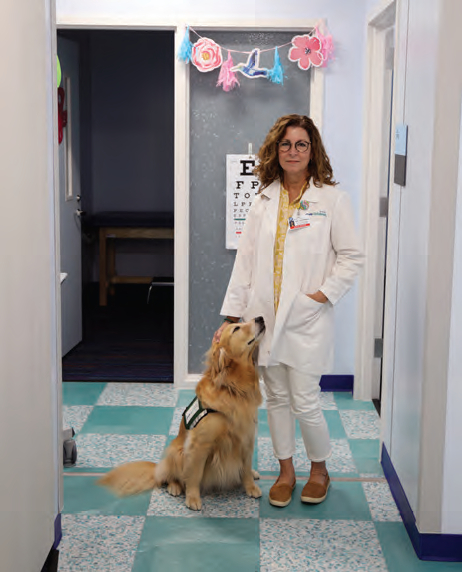
Dr. Jamye Coffman, medical director of the Child Advocacy, Resources, and Evaluation Team at Cook Children’s Medical Center in Fort Worth, Texas, and therapy dog Kitty often work with ED staff after caring for traumatic cases.
At Cook Children’s Medical Center in Fort Worth, Texas, therapy dogs are also focusing on ED staff for the moment. One of the physicians at Cook Children’s, Jamye Coffman, MD, medical director of the child advocacy, resources, and evaluation team, is also the handler for Kitty, her golden retriever, who started at Cook Children’s in 2015. “Kitty has gone to the ED to help patients who, for whatever reason, don’t have a parent or support person to reduce their anxiety,” says Dr. Coffman. “But primarily we’ve taken Kitty over for staff support after a particularly emotionally traumatic event. She also stops in the triage area pretty much every morning just to say hi. And any time we walk by, one nurse always calls out, ‘Kitty, I love you!’”
A Better Work Environment
Indeed, the canine teams may be as important for ED employees as for patients. “The amount of stress that the staff is under, particularly right now with COVID, staffing shortages, boarding issues, and overall societal angst, makes the ED a very challenging work environment,” says Jeffrey Lubin, MD, MPH, co-author of the 2012 study, now a professor of emergency medicine and public health sciences at Penn State College of Medicine in Hershey, Pa. “Taking a break for a minute to pet a dog really can reset and refocus you. I saw that in Cleveland and I’ve seen it in Hershey, too.” Dr. Lubin’s new ED in Pennsylvania has welcomed back therapy dogs, post-COVID-19, although his old ED at University Hospitals Cleveland Medical Center is limiting their use to ED staff. Dr. Lubin started the Cleveland program, where he moonlighted as the handler for his Labrador retriever, Quincy. The sweet-tempered black lab was particularly helpful with a frightened four-year-old. The boy refused to hold still for a computed tomography scan—until Quincy obeyed a command to lie down and stay put. Then the boy exclaimed, “If Quincy can lie still like that, I can too!”
Pages: 1 2 3 | Single Page


One Response to “Patients’ Best Friends: Therapy Dogs in the Emergency Department”
December 15, 2022
Mary Jo WarrenHow do you find a pet therapy volunteer program in Tacoma WA