
Logo

Log In Sign Up |  An official publication of: American College of Emergency Physicians
Navigation
  • Home
  • Multimedia
    • Podcasts
    • Videos
  • Clinical
    • Airway Managment
    • Case Reports
    • Critical Care
    • Guidelines
    • Imaging & Ultrasound
    • Pain & Palliative Care
    • Pediatrics
    • Resuscitation
    • Trauma & Injury
  • Resource Centers
    • mTBI Resource Center
  • Career
    • Practice Management
      • Benchmarking
      • Reimbursement & Coding
      • Care Team
      • Legal
      • Operations
      • Quality & Safety
    • Awards
    • Certification
    • Compensation
    • Early Career
    • Education
    • Leadership
    • Profiles
    • Retirement
    • Work-Life Balance
  • Columns
    • ACEP4U
    • Airway
    • Benchmarking
    • Brief19
    • By the Numbers
    • Coding Wizard
    • EM Cases
    • End of the Rainbow
    • Equity Equation
    • FACEPs in the Crowd
    • Forensic Facts
    • From the College
    • Images in EM
    • Kids Korner
    • Medicolegal Mind
    • Opinion
      • Break Room
      • New Spin
      • Pro-Con
    • Pearls From EM Literature
    • Policy Rx
    • Practice Changers
    • Problem Solvers
    • Residency Spotlight
    • Resident Voice
    • Skeptics’ Guide to Emergency Medicine
    • Sound Advice
    • Special OPs
    • Toxicology Q&A
    • WorldTravelERs
  • Resources
    • ACEP.org
    • ACEP Knowledge Quiz
    • Issue Archives
    • CME Now
    • Annual Scientific Assembly
      • ACEP14
      • ACEP15
      • ACEP16
      • ACEP17
      • ACEP18
      • ACEP19
    • Annals of Emergency Medicine
    • JACEP Open
    • Emergency Medicine Foundation
  • About
    • Our Mission
    • Medical Editor in Chief
    • Editorial Advisory Board
    • Awards
    • Authors
    • Article Submission
    • Contact Us
    • Advertise
    • Subscribe
    • Privacy Policy
    • Copyright Information

Out-Of-Hospital Cardiac Arrest: Remain and Gain, or Load and Go?

By Ken Milne, MD | on February 10, 2023 | 0 Comment
Skeptics' Guide to EM
  • Tweet
  • Click to email a link to a friend (Opens in new window) Email
Print-Friendly Version

Key Result

You Might Also Like
  • Amiodarone, Lidocaine, Placebo Treatments Compared for Patients with Out-of-Hospital Cardiac Arrest
  • Pediatric In-Hospital Cardiac Arrest: Lower Survival During Nights, Weekends
  • Should all Out-Of-Hospital Cardiac Arrests be Transported to Cardiac Centers?
Explore This Issue
ACEP Now: Vol 42 – No 02 – February 2023

Click to enlarge.

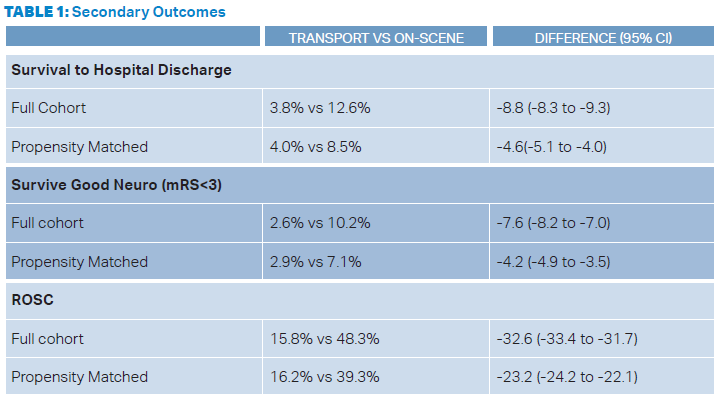
In adults with OHCAs, survival was more likely with continuous, on-scene resuscitation compared to intra-arrest transport.

  • Primary Outcome: Survival to hospital discharge 12.6 percent on-scene vs 3.8 percent with transport.
    • Difference -8.8 percent (95 percent CI -8.3 percent to -9.3 percent).
  • Secondary Outcomes: See Table 1.
  • EBM Commentary:
  1. Association is Not Causation: This was an observational study design, which means we cannot conclude causation, but rather only associations. Propensity score matching was done to mitigate some of the biases from non-randomized trials. While these statistical methods can help balance observed baseline covariates, they cannot get to the same level as a randomized control trial.2
  2. Prognosis Bias: Bias in research can be defined as something that could systematically move the results away from the best point estimate of an observed effect size. Prognosis bias has seven major domains: study participation, attrition, selection of candidate predictors, outcome definition, confounding factors, analysis, and interpretation of results.3 The authors felt that their study could suffer from attrition bias. Adult patients with OHCA and unfavorable phenotypes may have had resuscitation terminated. This means they would not have the opportunity to achieve ROSC. There was a large difference in the termination of resuscitation (0.2 percent of intra-arrest transport compared to 56.7 percent for the on-scene resuscitation).
  3. Safety of First Responders: While patient care is the primary concern, we must also be concerned about the wellbeing of the EMS paramedics. Providing CPR in the back of a moving ambulance raises concerns about safety. There are data published in Annals of Emergency Medicine reporting an increased odds ratio of crashing with the use of lights and sirens.4 This could lead to increased risk to paramedics who are providing resuscitation during transportation.

SGEM Bottom Line

Low-quality evidence suggests “remain and gain” is associated with better survival to hospital discharge in adults patients with OHCAs compared to “load and go.”

Case Resolution

The paramedic crew stay on scene providing high-quality CPR, identify a shockable rhythm, defibrillate the pitcher, achieve ROSC, and transport the patient to the hospital.

Remember to be skeptical of anything you learn, even if you heard it on the Skeptics’ Guide to Emergency Medicine.


William “Ken” Milne, MD

Dr. Milne (@TheSGEM) is chief of emergency medicine and chief of staff at South Huron Hospital, Ontario, Canada. He is on the Best Evidence in Emergency Medicine faculty and is creator of the knowledge translation project the Skeptics’ Guide to Emergency Medicine (www.TheSGEM.com).

Pages: 1 2 3 | Single Page

Topics: Cardiac ArrestParamedic

Related

  • Using Extracorporeal Membrane Oxygenation as Life-Sustaining Therapy

    June 30, 2025 - 0 Comment
  • Airway Considerations in Prehospital Cardiac Arrest

    May 9, 2025 - 0 Comment
  • Case Report: Coronary Vasospasm-Induced Cardiac Arrest

    December 6, 2024 - 0 Comment

Current Issue

ACEP Now: November 2025

Download PDF

Read More

No Responses to “Out-Of-Hospital Cardiac Arrest: Remain and Gain, or Load and Go?”

Leave a Reply Cancel Reply

Your email address will not be published. Required fields are marked *


*
*


Wiley
  • Home
  • About Us
  • Contact Us
  • Privacy
  • Terms of Use
  • Advertise
  • Cookie Preferences
Copyright © 2025 by John Wiley & Sons, Inc. All rights reserved, including rights for text and data mining and training of artificial technologies or similar technologies. ISSN 2333-2603
