Logo

Log In Sign Up |  An official publication of: American College of Emergency Physicians
Navigation
  • Home
  • Multimedia
    • Podcasts
    • Videos
  • Clinical
    • Airway Managment
    • Case Reports
    • Critical Care
    • Guidelines
    • Imaging & Ultrasound
    • Pain & Palliative Care
    • Pediatrics
    • Resuscitation
    • Trauma & Injury
  • Resource Centers
    • mTBI Resource Center
  • Career
    • Practice Management
      • Benchmarking
      • Reimbursement & Coding
      • Care Team
      • Legal
      • Operations
      • Quality & Safety
    • Awards
    • Certification
    • Compensation
    • Early Career
    • Education
    • Leadership
    • Profiles
    • Retirement
    • Work-Life Balance
  • Columns
    • ACEP4U
    • Airway
    • Benchmarking
    • Brief19
    • By the Numbers
    • Coding Wizard
    • EM Cases
    • End of the Rainbow
    • Equity Equation
    • FACEPs in the Crowd
    • Forensic Facts
    • From the College
    • Images in EM
    • Kids Korner
    • Medicolegal Mind
    • Opinion
      • Break Room
      • New Spin
      • Pro-Con
    • Pearls From EM Literature
    • Policy Rx
    • Practice Changers
    • Problem Solvers
    • Residency Spotlight
    • Resident Voice
    • Skeptics’ Guide to Emergency Medicine
    • Sound Advice
    • Special OPs
    • Toxicology Q&A
    • WorldTravelERs
  • Resources
    • ACEP.org
    • ACEP Knowledge Quiz
    • Issue Archives
    • CME Now
    • Annual Scientific Assembly
      • ACEP14
      • ACEP15
      • ACEP16
      • ACEP17
      • ACEP18
      • ACEP19
    • Annals of Emergency Medicine
    • JACEP Open
    • Emergency Medicine Foundation
  • About
    • Our Mission
    • Medical Editor in Chief
    • Editorial Advisory Board
    • Awards
    • Authors
    • Article Submission
    • Contact Us
    • Advertise
    • Subscribe
    • Privacy Policy
    • Copyright Information

Opinion: Stanford’s New Stroke Protocol Expands the Treatment Window

By Alexei Wagner, MD, MBA; and Sam Shen, MD, MBA | on April 13, 2018 | 0 Comment
New Spin
  • Tweet
  • Click to email a link to a friend (Opens in new window) Email
Print-Friendly Version
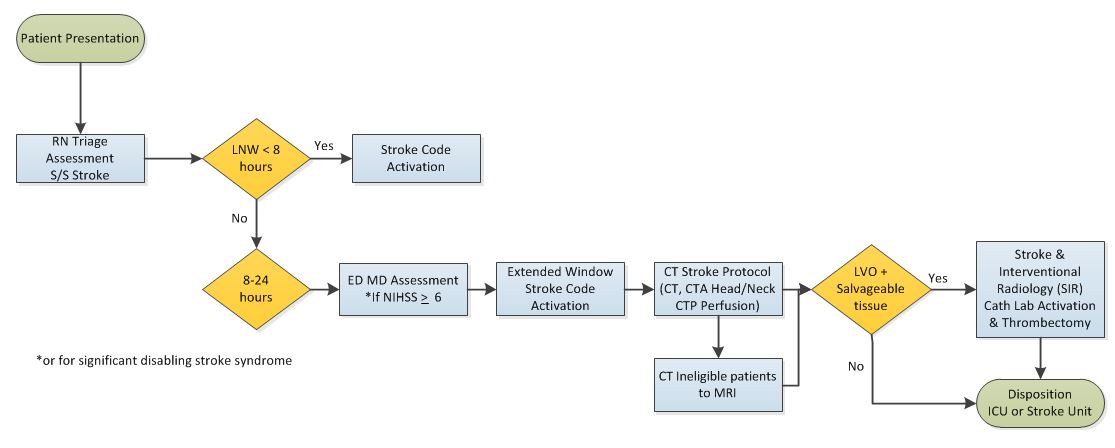
Stanford University’s Stroke Code Extended protocol.

You Might Also Like
  • Pushback Received to “Time to Expand Stroke Treatment Window?” Article
  • Similar Thrombectomy Benefits for Transferred “Late-Window” Stroke Patients
  • Endovascular Treatment May Help Stroke Patients with Large Ischemic Core, Mismatch Profile
Explore This Issue
ACEP Now: Vol 37 – No 04 – April 2018

Stanford University’s Stroke Code Extended protocol.(Click for larger image.)
Source: Alexei Wagner

Other unique protocol elements include expedited CT angiogram and perfusion imaging, and mobilization of the interventional neuroradiology team for thrombectomy. The CT angiogram and perfusion imaging is critical in determining the amount of brain tissue at risk of infarct, and therefore whether thrombectomy would be indicated. To determine patients appropriate for thrombectomy with adequate salvageable tissue, the team looks at the ratio of ischemic tissue to the initial infarct volume (ischemic core), and an absolute volume of potentially reversible ischemia (penumbra).

The Stroke Code Extended also requires the emergency department attending to perform and document a NIHSS score on all suspected stroke patients. Although this is a core emergency medicine skill, Stanford instituted an educational initiative to certify our entire faculty and residency in performing the assessment. This was accomplished through online training modules and traditional lecture-style didactics.

In addition, immediately upon arrival at the bedside, the neurology resident now performs an NIHSS stroke scale assessment. Our goal is to study the inter-rater reliability between neurology- and emergency medicine-completed NIHSS stroke scales.

Beyond the New Protocol

Parallel to our initiative to identify and treat extended strokes, Stanford’s neurology department has performed significant educational outreach to referral hospitals to facilitate the rapid transport of stroke patients to Stanford Hospital even if they’re outside the tPA window but still likely to benefit from thrombectomy. In addition, the Stanford School of Medicine has found that collaboration between the emergency medicine and neurology departments is instrumental in improving the treatment of acute stroke.

Looking ahead, we will evaluate the implementation of this protocol by collecting stroke quality metrics, measuring NIHSS inter-rater reliability, and monitoring the stroke mimic rate. We look forward to sharing further insights about our protocol and results.

Speak Out on Stroke

Have comments on extending the time window for thrombectomy? We want to hear from you! Send your comments to dantolin@wiley.com. We may publish them in a future issue.


Dr. WagnerDr. Wagner is assistant director of Adult Emergency Medicine at the Stanford University School of Medicine in Palo Alto, Calif.
Dr. ShenDr. Shen is the interim chair of the Department of Emergency Medicine at the Stanford University School of Medicine in Palo Alto, Calif.

References

  1. Nogueira RG, Jadhav AP, Haussen DC, et al. Thrombectomy 6 to 24 hours after stroke with a mismatch between deficit and infarct. N Engl J Med. 2018;378(1):11-21.
  2. Albers GW, Marks MP, Kemp S, et al. Thrombectomy for stroke at 6 to 16 hours with selection by perfusion imaging. N Engl J Med. 2018;378(8):708-718.

Pages: 1 2 3 | Single Page

Topics: Acute Ischemic StrokeCritical CareEmergency DepartmentEmergency MedicineEndovascular ThrombectomyStroke

Related

  • Why the Nonrebreather Should be Abandoned

    December 3, 2025 - 0 Comment
  • Non-Invasive Positive Pressure Ventilation in the Emergency Department

    October 1, 2025 - 0 Comment
  • Emergency Department Management of Prehospital Tourniquets

    October 1, 2025 - 0 Comment

Current Issue

ACEP Now: November 2025

Download PDF

Read More

No Responses to “Opinion: Stanford’s New Stroke Protocol Expands the Treatment Window”

Leave a Reply Cancel Reply

Your email address will not be published. Required fields are marked *


*
*


Wiley
  • Home
  • About Us
  • Contact Us
  • Privacy
  • Terms of Use
  • Advertise
  • Cookie Preferences
Copyright © 2025 by John Wiley & Sons, Inc. All rights reserved, including rights for text and data mining and training of artificial technologies or similar technologies. ISSN 2333-2603
