Logo

Log In Sign Up |  An official publication of: American College of Emergency Physicians
Navigation
  • Home
  • Multimedia
    • Podcasts
    • Videos
  • Clinical
    • Airway Managment
    • Case Reports
    • Critical Care
    • Guidelines
    • Imaging & Ultrasound
    • Pain & Palliative Care
    • Pediatrics
    • Resuscitation
    • Trauma & Injury
  • Resource Centers
    • mTBI Resource Center
  • Career
    • Practice Management
      • Benchmarking
      • Reimbursement & Coding
      • Care Team
      • Legal
      • Operations
      • Quality & Safety
    • Awards
    • Certification
    • Compensation
    • Early Career
    • Education
    • Leadership
    • Profiles
    • Retirement
    • Work-Life Balance
  • Columns
    • ACEP4U
    • Airway
    • Benchmarking
    • Brief19
    • By the Numbers
    • Coding Wizard
    • EM Cases
    • End of the Rainbow
    • Equity Equation
    • FACEPs in the Crowd
    • Forensic Facts
    • From the College
    • Images in EM
    • Kids Korner
    • Medicolegal Mind
    • Opinion
      • Break Room
      • New Spin
      • Pro-Con
    • Pearls From EM Literature
    • Policy Rx
    • Practice Changers
    • Problem Solvers
    • Residency Spotlight
    • Resident Voice
    • Skeptics’ Guide to Emergency Medicine
    • Sound Advice
    • Special OPs
    • Toxicology Q&A
    • WorldTravelERs
  • Resources
    • ACEP.org
    • ACEP Knowledge Quiz
    • Issue Archives
    • CME Now
    • Annual Scientific Assembly
      • ACEP14
      • ACEP15
      • ACEP16
      • ACEP17
      • ACEP18
      • ACEP19
    • Annals of Emergency Medicine
    • JACEP Open
    • Emergency Medicine Foundation
  • About
    • Our Mission
    • Medical Editor in Chief
    • Editorial Advisory Board
    • Awards
    • Authors
    • Article Submission
    • Contact Us
    • Advertise
    • Subscribe
    • Privacy Policy
    • Copyright Information

New Quality Measure Improves Screening for Abdominal Aortic Aneurysm

By Sandra M. Schneider, MD, FACEP | on April 4, 2024 | 0 Comment
Features
  • Tweet
  • Click to email a link to a friend (Opens in new window) Email
Print-Friendly Version

An abdominal aortic aneurysm (AAA) develops with age, occurring primarily in those older than 55 years. Risk factors include smoking, hypertension, male sex, atherosclerotic disease, and family history of AAA. Although AAA is less common in women, rupture is more common.1 Most aneurysms are less than 4 cm, with the normal diameter of the aorta less than 3 cm. When the aneurysm is greater than 5 cm, there is a risk of a rupture, which increases with increased aortic diameter.

You Might Also Like
  • Increased Abdominal Aortic Aneurysm Risk With Psoriasis
  • Bedside Ultrasound of the Abdominal Aorta
  • Compliance with SEP-1 Quality Measure Does Not Affect Sepsis Mortality
Explore This Issue
ACEP Now: Vol 43 – No 04 – April 2024

The classic triad of abdominal pain, hypotension and pulsatile abdominal mass is present in less than 25 percent of patients.2 Patients can present with back pain, or with focal neurologic signs such as numbness of the lower extremity. A pulsatile abdominal mass may be difficult to assess in patients with a higher BMI. About 35 percent of individuals with rAAA will die at home.3 The majority of those who arrive to the emergency department (ED) live for 2 hours or more, leaving a small window for surgical intervention.4 Depending on the study, rAAA is missed in 16-62 percent of cases.5 Untreated, nearly all patients die. The diagnosis is confirmed with bedside ultrasound (US) or CT. Bedside US can confirm the presence of AAA, but visualization of the actual rupture may be more difficult because most AAAs rupture into the retroperitoneal space. CT is more definitive but can take more time.

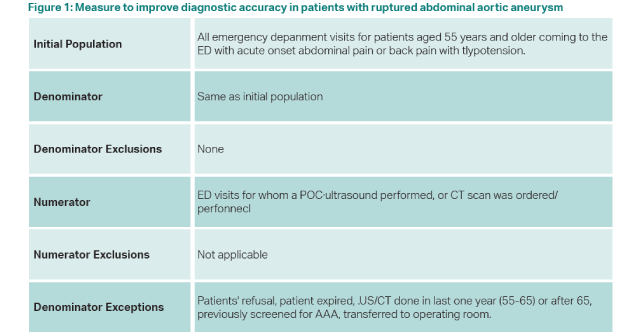
Recently, ACEP received a grant from the Gordon and Betty Moore Foundation to create a quality measure to improve the diagnostic accuracy of rAAA in patients. This measure has been approved by CMS and will be available for reporting soon. To meet the measure, and get credit for MIPS, all patients 55 years and older who present with new acute abdominal or back pain and hypotension (systolic BP less than 90mm Hg) must have an US or CT performed in the ED. Exceptions to this measure are patients who have been screened for an abdominal aortic aneurysm in the past, or have had a CT or US of the abdomen in the prior five years (for those 55-65 years old) or older than 65 years who demonstrate a normal size aorta. Other exceptions are patient refusal, patient death or immediate transfer to the operating room. It is hoped that more emergency physicians will use point of care bedside US, which can be performed more rapidly than a CT. Ultrasound of the aorta is a core competency of emergency physicians, but resources such as Sonoguide are available for a refresher at acep.org/sonoguide.

Pages: 1 2 3 | Single Page

Topics: Abdominal Aortic AneurysmDiagnostic Criteria

Related

  • Recognition and Treatment of Thrombotic Thrombocytopenic Purpura

    April 5, 2024 - 0 Comment
  • Understanding Diagnostic Criteria for Anaphylaxis, Anaphylactic Shock, Kounis Syndrome Critical to Initiating Lifesaving Treatment

    September 13, 2016 - 1 Comment
  • Increased Abdominal Aortic Aneurysm Risk With Psoriasis

    June 11, 2016 - 0 Comment

Current Issue

ACEP Now: November 2025

Download PDF

Read More

No Responses to “New Quality Measure Improves Screening for Abdominal Aortic Aneurysm”

Leave a Reply Cancel Reply

Your email address will not be published. Required fields are marked *


*
*


Wiley
  • Home
  • About Us
  • Contact Us
  • Privacy
  • Terms of Use
  • Advertise
  • Cookie Preferences
Copyright © 2025 by John Wiley & Sons, Inc. All rights reserved, including rights for text and data mining and training of artificial technologies or similar technologies. ISSN 2333-2603
