Logo

Log In Sign Up |  An official publication of: American College of Emergency Physicians
Navigation
  • Home
  • Multimedia
    • Podcasts
    • Videos
  • Clinical
    • Airway Managment
    • Case Reports
    • Critical Care
    • Guidelines
    • Imaging & Ultrasound
    • Pain & Palliative Care
    • Pediatrics
    • Resuscitation
    • Trauma & Injury
  • Resource Centers
    • mTBI Resource Center
  • Career
    • Practice Management
      • Benchmarking
      • Reimbursement & Coding
      • Care Team
      • Legal
      • Operations
      • Quality & Safety
    • Awards
    • Certification
    • Compensation
    • Early Career
    • Education
    • Leadership
    • Profiles
    • Retirement
    • Work-Life Balance
  • Columns
    • ACEP4U
    • Airway
    • Benchmarking
    • Brief19
    • By the Numbers
    • Coding Wizard
    • EM Cases
    • End of the Rainbow
    • Equity Equation
    • FACEPs in the Crowd
    • Forensic Facts
    • From the College
    • Images in EM
    • Kids Korner
    • Medicolegal Mind
    • Opinion
      • Break Room
      • New Spin
      • Pro-Con
    • Pearls From EM Literature
    • Policy Rx
    • Practice Changers
    • Problem Solvers
    • Residency Spotlight
    • Resident Voice
    • Skeptics’ Guide to Emergency Medicine
    • Sound Advice
    • Special OPs
    • Toxicology Q&A
    • WorldTravelERs
  • Resources
    • ACEP.org
    • ACEP Knowledge Quiz
    • Issue Archives
    • CME Now
    • Annual Scientific Assembly
      • ACEP14
      • ACEP15
      • ACEP16
      • ACEP17
      • ACEP18
      • ACEP19
    • Annals of Emergency Medicine
    • JACEP Open
    • Emergency Medicine Foundation
  • About
    • Our Mission
    • Medical Editor in Chief
    • Editorial Advisory Board
    • Awards
    • Authors
    • Article Submission
    • Contact Us
    • Advertise
    • Subscribe
    • Privacy Policy
    • Copyright Information

New Out-Of-Hospital Care Models Could Affect Your Emergency Dept

By James J. Augustine, MD, FACEP | on May 17, 2019 | 0 Comment
Benchmarking
  • Tweet
  • Click to email a link to a friend (Opens in new window) Email
Print-Friendly Version

“Whoop, whoop, whoop!” The EMS radio alerts the ED staff to an incoming patient. Minutes later arrives a patient who has a 33 percent chance of being moved to an inpatient bed in about five hours, a 5 percent chance of being moved to the ICU in about three hours, and a chance of being moved onto a medical helicopter or onto a medical examiner’s table.

You Might Also Like
  • National Hospital Ambulatory Medical Care Survey Data Show Increase in Emergency Department Visits
  • Emergency Medical Services Arrivals, Admission Rates to the Emergency Department Analyzed
  • How Will the American Health Care Act Affect Emergency Medicine?
Explore This Issue
ACEP Now: Vol 38 – No 05 – May 2019

For those emergency physicians working in medical centers that specialize in trauma, burns, acute cardiac intervention, and comprehensive stroke care, those ambulance patients represent the vast majority of patients who pay for such specialty programs and services. For those who don’t like ambulance patients, the future is arriving faster than a medic unit running lights and sirens.

Studying the Emergency Department Benchmarking Alliance (EDBA) data over the last 10 years, we find that EMS arrivals and admission rates are predictable, and ambulance patients continue to represent higher acuity than those arriving in a private automobile or other conveyance. Table 1 demonstrates that about 39 percent of EMS-arriving patients are admitted. Patients arriving by other means have a significantly lower admission rate of about 12.5 percent.
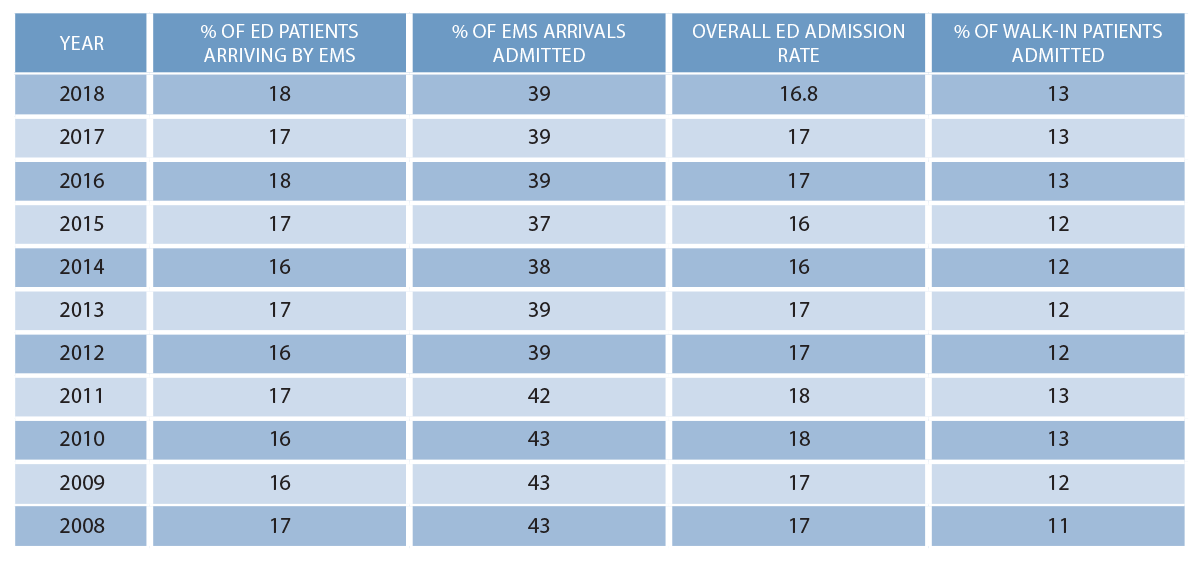
Table 1: EMS Arrival and Admission Trends

(click for larger image) Table 1: EMS Arrival and Admission Trends

CMS Launches New Payment Model

On Feb. 14, 2019, the Centers for Medicare and Medicaid Services (CMS) announced a new payment model for unscheduled care responders that pays for care that does not include transportation to the hospital.1 The proposed Emergency Triage, Treat, and Transport (ET3) Model will pay for care provided out of hospital, either in person or through telehealth processes. It also pays EMS responders to transport patients by ambulance to alternative out-of-hospital care sites, including urgent care or a primary care provider.

The model’s announced goal is to end the incentives for first responders to transport patients to the emergency department. The program is being introduced by the Center for Medicare and Medicaid Innovation as a method to improve the quality of care for unscheduled health events and is targeted to save the health care system $1 billion in avoidable ED costs. CMS believes 19 percent of Medicare fee-for-service beneficiaries could be treated at home or in another cheaper facility for their emergency needs. CMS also hopes Medicaid managed care plans and private payers will take an interest in the voluntary model.

Program rules have yet to be written, and it may take six or more months until applicants for the model are recruited. However, EMS providers selected to participate will have options in how they wish to structure the on-site element. Options will include a telehealth-heavy model in which a physician or advanced practice provider provides care on-site or remotely. The fact sheet says the demonstration will last five years.

The bottom line? There are evolving models of care that feature alternate providers paid to deliver a variety of services outside of the traditional model of emergency care delivered in the emergency department.

Pages: 1 2 3 | Single Page

Topics: Centers for Medicare & Medicaid ServicesEmergency Department Benchmarking AllianceEMS

Related

  • Event Medicine: Where Fun and Safety Sing in Perfect Harmony

    October 9, 2025 - 1 Comment
  • Trauma First Aid at the 2025 Boston Marathon

    September 22, 2025 - 0 Comment
  • Prehospital Buprenorphine Is a Powerful Tool in the Opioid-Crisis Fight

    June 4, 2025 - 0 Comment

Current Issue

ACEP Now: November 2025

Download PDF

Read More

About the Author

James J. Augustine, MD, FACEP

James J. Augustine, MD, FACEP, is national director of prehospital strategy for US Acute Care Solutions in Canton, Ohio; clinical professor of emergency medicine at Wright State University in Dayton, Ohio; and vice president of the Emergency Department Benchmarking Alliance.

View this author's posts »

No Responses to “New Out-Of-Hospital Care Models Could Affect Your Emergency Dept”

Leave a Reply Cancel Reply

Your email address will not be published. Required fields are marked *


*
*


Wiley
  • Home
  • About Us
  • Contact Us
  • Privacy
  • Terms of Use
  • Advertise
  • Cookie Preferences
Copyright © 2025 by John Wiley & Sons, Inc. All rights reserved, including rights for text and data mining and training of artificial technologies or similar technologies. ISSN 2333-2603
