Logo

Log In Sign Up |  An official publication of: American College of Emergency Physicians
Navigation
  • Home
  • Multimedia
    • Podcasts
    • Videos
  • Clinical
    • Airway Managment
    • Case Reports
    • Critical Care
    • Guidelines
    • Imaging & Ultrasound
    • Pain & Palliative Care
    • Pediatrics
    • Resuscitation
    • Trauma & Injury
  • Resource Centers
    • mTBI Resource Center
  • Career
    • Practice Management
      • Benchmarking
      • Reimbursement & Coding
      • Care Team
      • Legal
      • Operations
      • Quality & Safety
    • Awards
    • Certification
    • Compensation
    • Early Career
    • Education
    • Leadership
    • Profiles
    • Retirement
    • Work-Life Balance
  • Columns
    • ACEP4U
    • Airway
    • Benchmarking
    • Brief19
    • By the Numbers
    • Coding Wizard
    • EM Cases
    • End of the Rainbow
    • Equity Equation
    • FACEPs in the Crowd
    • Forensic Facts
    • From the College
    • Images in EM
    • Kids Korner
    • Medicolegal Mind
    • Opinion
      • Break Room
      • New Spin
      • Pro-Con
    • Pearls From EM Literature
    • Policy Rx
    • Practice Changers
    • Problem Solvers
    • Residency Spotlight
    • Resident Voice
    • Skeptics’ Guide to Emergency Medicine
    • Sound Advice
    • Special OPs
    • Toxicology Q&A
    • WorldTravelERs
  • Resources
    • ACEP.org
    • ACEP Knowledge Quiz
    • Issue Archives
    • CME Now
    • Annual Scientific Assembly
      • ACEP14
      • ACEP15
      • ACEP16
      • ACEP17
      • ACEP18
      • ACEP19
    • Annals of Emergency Medicine
    • JACEP Open
    • Emergency Medicine Foundation
  • About
    • Our Mission
    • Medical Editor in Chief
    • Editorial Advisory Board
    • Awards
    • Authors
    • Article Submission
    • Contact Us
    • Advertise
    • Subscribe
    • Privacy Policy
    • Copyright Information

Neonatal Meningitis Diagnosis Difficult Given Subtle Symptoms of Vomiting, Irritability

By Pingching N. Kwan, MD, FACEP, and Tyler J. Williams | on March 14, 2017 | 1 Comment
Features
  • Tweet
  • Click to email a link to a friend (Opens in new window) Email
Print-Friendly Version
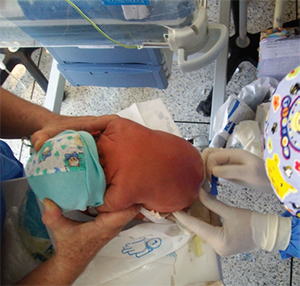
Photo: “New born spinal tap” by Bobjgalindo, licensed underCreative Commons Attribution-ShareAlike 4.0 International License <https://creativecommons.org/licenses/by-sa/4.0/>.

You Might Also Like
  • Guidance on Cerebrospinal Fluid Sterilization in Pediatric Meningitis, Carotid Injury Risk after Palatal Wound in Children
  • Rat-Bite Fever’s Non-Specific Symptoms Make Patient History Important for Diagnosis
  • New Test Could Help Contain Meningitis Outbreaks
Explore This Issue
ACEP Now: Vol 36 – No 03 – March 2017

Photo: “New born spinal tap” by Bobjgalindo, licensed underCreative Commons Attribution-ShareAlike 4.0 International License <https://creativecommons.org/licenses/by-sa/4.0/>.

The Case

An 11-day-old female neonate with a chief complaint of jaundice was brought to the emergency department by her father. Other symptoms included spitting up with feeding and tactile fever. The patient’s birth history was significant for a full-term vaginal delivery to a mother who was group B streptococcus (GBS) positive during delivery. The father stated that his daughter had been very “good” since birth, had been very “calm,” and almost never cried. On physical examination, the neonate appeared toxic, listless, and jaundiced and was actively vomiting. The initial workup in the emergency department included urinalysis, complete blood count (CBC), and chest X-ray, all of which were unremarkable except for total bilirubin of 19 mg/dL.
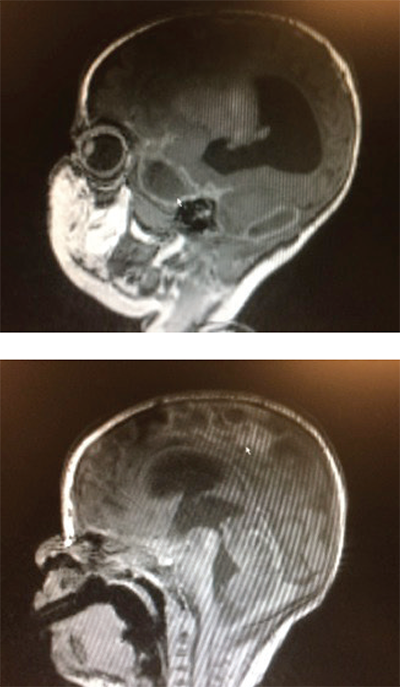
Figure 1 (TOP): Sagittal brain MRI demonstrating a focal area of ischemia (arrow) secondary to meningitis. Figure 2: Sagittal brain MRI. The ring-encasing lesion (arrow) is demonstrative of subdural empyema in the midbrain secondary to bacterial meningitis.

Figure 1 (TOP): Sagittal brain MRI demonstrating a focal area of ischemia (arrow) secondary to meningitis.
Figure 2: Sagittal brain MRI. The ring-encasing lesion (arrow) is demonstrative of subdural empyema in the midbrain secondary to bacterial meningitis.
Photos: Pingching N. Kwan

Given the child’s presentation, age, and birth history, bacterial meningitis was suspected, and a lumbar puncture was suggested. The child’s mother, whom the father was talking to over the phone, initially refused the procedure. However, after extensive discussion about the reasons the procedure was indicated and the low rates of complications associated with the procedure, the child’s mother was convinced, and verbal consent was obtained. The lumbar puncture was performed, and a scant amount (1 mL) of cerebrospinal fluid (CSF), which appeared to be xanthochromic and turbid, was obtained. The child was listless during the procedure. The fluid was sent for analysis and culture, and the child was started on empiric ampicillin and ceftazidime for suspected bacterial meningitis. The child was admitted to the NICU. CSF analysis and culture confirmed the diagnosis of Escherichia coli meningitis. E. coli was sensitive to cephalosporins.

During her hospital course in the NICU, the child subsequently developed persistent seizures and hydrocephalus. A cranial MRI demonstrated ischemic damage to the brain secondary to meningitis (see Figure 1, arrow) as well as a ring enhancing area in the midbrain (see Figure 2, arrow) representing a subdural empyema. The child was treated with five weeks of IV antibiotics. Unfortunately, her neurological prognosis remains poor.

Discussion

Neonatal meningitis is most commonly caused by vertical transmission of GBS (Streptococcus agalactiae) during delivery, implicated in nearly 50 percent of all cases. Other common pathogens include E. coli and Listeria monocytogenes.1 The cumulative incidence of meningitis is highest in the first month of life and is higher in preterm neonates than term neonates.2 Patients may present with difficulty feeding, apnea, bradycardia, hypotension, irritability, or lethargy. Stupor and irritability are common in late-onset meningitis as are neurological complications. A 2015 study demonstrated that central nervous system complications associated with late-onset GBS meningitis, such as hydrocephalus, epilepsy, subdural empyema, and ischemia, may be underestimated.3

Pages: 1 2 3 | Single Page

Topics: ClinicalDiagnosisED Critical CareEmergency DepartmentEmergency MedicineEmergency PhysicianMeningitisNeonatalNeurologyPatient CarePediatricsSymptoms

Related

  • FACEPs in the Crowd: Dr. John Ludlow

    November 5, 2025 - 0 Comment
  • Let Core Values Help Guide Patient Care

    November 5, 2025 - 0 Comment
  • Non-Invasive Positive Pressure Ventilation in the Emergency Department

    October 1, 2025 - 0 Comment

Current Issue

ACEP Now: November 2025

Download PDF

Read More

One Response to “Neonatal Meningitis Diagnosis Difficult Given Subtle Symptoms of Vomiting, Irritability”

  1. March 9, 2023

    Daniel Meressa Reply

    Good diagnosis with good investigation will end up with good treatment and follow-up

Leave a Reply Cancel Reply

Your email address will not be published. Required fields are marked *


*
*


Wiley
  • Home
  • About Us
  • Contact Us
  • Privacy
  • Terms of Use
  • Advertise
  • Cookie Preferences
Copyright © 2025 by John Wiley & Sons, Inc. All rights reserved, including rights for text and data mining and training of artificial technologies or similar technologies. ISSN 2333-2603
