
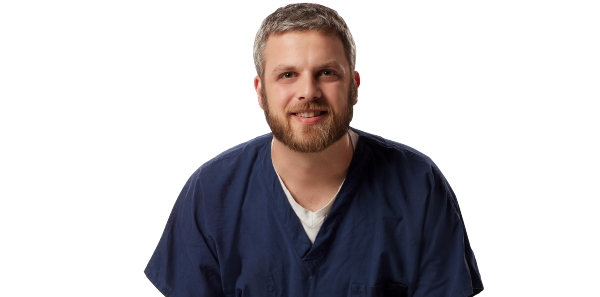
I’ve been in emergency services for years. I’ve done CPR on infants after a drowning and children who were accidentally shot by their friends. I’ve told the parents of teens that their children were dead. But despite the tragedy I witnessed, I always felt like I could bounce back. OK, I had to take a day off after the infant drowned, but that was one day—that’s it!
Explore This Issue
ACEP Now: Vol 40 – No 08 – August 2021When I entered my EM residency, treating patients with horrific injuries began to take its toll.
Maybe it was the volume and frequency, or maybe it was the pressure of being the final “decision maker” and having to make hard choices that had a big impact on my patients. As a PGY-2, one case hit differently than all the rest, and it pushed me over the edge into anxiety and depression; I needed help.
Looking back, it wasn’t a terribly steep drop-off. After that shift, I took my anger out on a traffic cone with my car. Still, feeling out of control in that moment indicated to me the pressure was getting to be too much. I had been to therapy before, but now, I was a doctor. I had medical licenses to obtain, ones that people told me I might not be able to get if I had a mental health “problem,” and I had a family depending on my professional livelihood. I had just stepped into a national leadership role. I couldn’t afford to give it all up that quickly. And what about my residency program—would they force me to give something up or delay my graduation?
Eventually, my supportive wife convinced me none of that was as important as my taking the first step toward my treatment, whatever that step was.
My Journey
Starting therapy wasn’t the hardest part. The hardest part was not giving up on therapy after only a few weeks of sessions. Unpacking and acknowledging all of the anxiety, frustration, fear, anger, and sadness I had pushed down for so long made me feel even worse, and truthfully, that made me feel like I wanted to end it all. Thankfully, my support network was there for me. It only took the encouragement of a few close friends and family members to convince me that therapy would help—that and starting medication.
Selective serotonin reuptake inhibitors (SSRIs) were a step I never thought I would have to take; to this day, I still sometimes feel like I don’t “need” them. Just like I tell hypertensive patients: taking medication only controls the illness but doesn’t remove it. I am starting to believe that about my own anxiety.
Therapy taught me how to talk to myself. I learned how the words I used to knock myself down when I didn’t “do it right” (whatever that meant) were just stories in my head. I saw how confronting those falsehoods, by asking for people’s feedback about a case or conversation, made me realize how untrue the negative stories were . It also revealed that the concern I had about “doing it right” showed on every patient, every time, and is what makes me a good doctor.
Senate Passes Dr. Lorna Breen Bill
On Aug. 6, the Senate approved S. 610, the “Dr. Lorna Breen Health Care Provider Protection Act” that prioritizes physician mental health. This comes on the heels of hundreds of ACEP members joining together to lobby for this legislation during last month’s Leadership & Advocacy Conference, conducting 287 meetings with legislators and staff from 44 states. ACEP will now focus on gaining support for the House version, H.R. 1677. Get more details.
Eating well and exercising never really worked well enough to curb my anxiety, but grounding myself, taking deep breaths, and repeating the mantra “I’ve got this” were the short breaks I needed in the middle of or after a shift to regroup and respond better.
My residency program was there for me. Their focus was to continue to support me in being successful, whatever that entailed, not to stand in my way and tell me how to handle my mental health. Allowing me to retain that power was key to moving past the depths of my depression. So was finding things outside of clinical care. For me, education, working out, and national advocacy proved the remedy. Feeling like I’m working to better the system I’m stuck in day in and day out gives me some sense of control. It has also enabled me to advocate within local systems for positive change. Sure, this is all extra work, but for me, this is what makes me able to do my clinical work. The licensing concerns are still a work in progress, but about three-quarters of states only ask about a mental health diagnosis when it impacts our job, and the Federation of State Medical Boards (FSMB) has policy that seeks to push this number to 100 percent.1,2 FSMB is a powerful ally for us to have in breaking down the barriers we face in managing our mental health.
Pages: 1 2 3 | Single Page




No Responses to “Mental Health Crisis Shows Emergency Physician the Importance of Getting Help”