Logo

Log In Sign Up |  An official publication of: American College of Emergency Physicians
Navigation
  • Home
  • Multimedia
    • Podcasts
    • Videos
  • Clinical
    • Airway Managment
    • Case Reports
    • Critical Care
    • Guidelines
    • Imaging & Ultrasound
    • Pain & Palliative Care
    • Pediatrics
    • Resuscitation
    • Trauma & Injury
  • Resource Centers
    • mTBI Resource Center
  • Career
    • Practice Management
      • Benchmarking
      • Reimbursement & Coding
      • Care Team
      • Legal
      • Operations
      • Quality & Safety
    • Awards
    • Certification
    • Compensation
    • Early Career
    • Education
    • Leadership
    • Profiles
    • Retirement
    • Work-Life Balance
  • Columns
    • ACEP4U
    • Airway
    • Benchmarking
    • Brief19
    • By the Numbers
    • Coding Wizard
    • EM Cases
    • End of the Rainbow
    • Equity Equation
    • FACEPs in the Crowd
    • Forensic Facts
    • From the College
    • Images in EM
    • Kids Korner
    • Medicolegal Mind
    • Opinion
      • Break Room
      • New Spin
      • Pro-Con
    • Pearls From EM Literature
    • Policy Rx
    • Practice Changers
    • Problem Solvers
    • Residency Spotlight
    • Resident Voice
    • Skeptics’ Guide to Emergency Medicine
    • Sound Advice
    • Special OPs
    • Toxicology Q&A
    • WorldTravelERs
  • Resources
    • ACEP.org
    • ACEP Knowledge Quiz
    • Issue Archives
    • CME Now
    • Annual Scientific Assembly
      • ACEP14
      • ACEP15
      • ACEP16
      • ACEP17
      • ACEP18
      • ACEP19
    • Annals of Emergency Medicine
    • JACEP Open
    • Emergency Medicine Foundation
  • About
    • Our Mission
    • Medical Editor in Chief
    • Editorial Advisory Board
    • Awards
    • Authors
    • Article Submission
    • Contact Us
    • Advertise
    • Subscribe
    • Privacy Policy
    • Copyright Information

How to Manage Fluids in Emergency Airway Procedures

By Richard M. Levitan, MD, FACEP; Yen Chow, MD; & Jim DuCanto, MD | on May 14, 2017 | 1 Comment
Airway
  • Tweet
  • Click to email a link to a friend (Opens in new window) Email
Print-Friendly Version
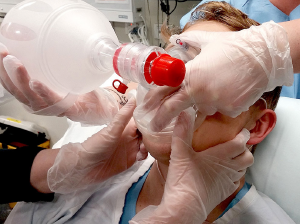
Figure 1: PEEP valve attached to bag-valve mask. Notice nasal cannula under the mask, as well as hand positioning of operators. The first operator holding the bag has his hand under the bag for balance. The second operator is holding the mask tightly against the patient’s face while actively moving the mandible forward at the same time. This patient positioning and two-operator coordination are far superior to trying this flat and pushing the mask down onto the mandible.

You Might Also Like
  • Oxygen Insufflated Into Lungs Can Prevent Desaturation, Aid in Emergency Airway Management
  • 10 Tips for Safety in Airway Management
  • Should Emergency Physicians Abandon Face-Mask Ventilation?
Explore This Issue
ACEP Now: Vol 36 – No 05 – May 2017

Figure 1: PEEP valve attached to bag-valve mask. Notice nasal cannula under the mask, as well as hand positioning of operators. The first operator holding the bag has his hand under the bag for balance. The second operator is holding the mask tightly against the patient’s face while actively moving the mandible forward at the same time. This patient positioning and two-operator coordination are far superior to trying this flat and pushing the mask down onto the mandible. PHOTOS: Richard Levitan

It has long been assumed in emergency airway management that the fundamental priorities are oxygenation and ventilation. Apart from instances of severe acidosis with compensatory respiratory alkalosis, ventilation is rarely as time critical as oxygenation. Desaturation and severe hypoxemia kills in seconds to minutes; the lack of ventilation causes a buildup of carbon dioxide and eventually acidosis, but it is only critical when patients start out severely acidotic (eg, diabetic ketoacidosis, salicylate overdose, acute renal failure, rhabdomyolysis, etc.).

Next to oxygenation, the priorities of emergency airway management are the management of fluids and the prevention of regurgitation and aspiration. Fluid regurgitation and vomiting has been underaddressed as a life threat in emergency airways.

Every seasoned clinician has encountered clinical situations where fluids impeded laryngoscopy and ventilation. Fluids are, in fact, the enemy of everything in the airway. They make direct and video laryngoscopy more challenging because they obscure landmarks. Look-around-the-curve video devices fail when fluid splatters across the optical element. Endoscopes are particularly useless when there is significant fluid in the airway as it is nearly impossible to keep the lens clean and discern an open pathway.

Figure 2 (Left): Flipping over the connector of a 7.0–8.0 mm tracheal tube, allowing it to be connected to standard suction tubing

Figure 2: Flipping over the connector of a 7.0–8.0 mm tracheal tube, allowing it to be connected to standard suction tubing PHOTOS: Richard Levitan

The most serious threat of fluids in the airway is not with laryngoscopy but rather with oxygenation. Apneic oxygenation, bag-mask ventilation, and rescue devices like the laryngeal mask airway and King LT all function poorly, if at all, when there is a high volume of fluid in the airway. In fact, there is only one airway management technique that can overcome massive fluids in the upper airway: cutting the neck. Cricothyrotomy, with a cuffed tube in the trachea, separates the airway from the shared aerodigestive tract through which all other means of oxygenation are dependent upon. When fluids are uncontrollable, it may be the only option and must be done quickly.

Pages: 1 2 3 | Single Page

Topics: AirwayCricothyrotomyED Critical CareEmergency DepartmentEmergency MedicineEmergency PhysiciansEndoscopefluidGastrointestinalIntubationLaryngoscopyPractice ManagementRegurgitation

Related

  • Why the Nonrebreather Should be Abandoned

    December 3, 2025 - 0 Comment
  • Florida Emergency Department Adds Medication-Dispensing Kiosk

    November 7, 2025 - 1 Comment
  • Q&A with ACEP President L. Anthony Cirillo

    November 5, 2025 - 0 Comment

Current Issue

ACEP Now: November 2025

Download PDF

Read More

One Response to “How to Manage Fluids in Emergency Airway Procedures”

  1. May 18, 2017

    Kyle Strickland Reply

    Are the authors advocating Preoxygenation of a spontaneously breathing patient with a BVM? I have read that this is superior to NRB but hear many arguments against the use of BVM in spontaneously breathing patients. thanks

Leave a Reply Cancel Reply

Your email address will not be published. Required fields are marked *


*
*


Wiley
  • Home
  • About Us
  • Contact Us
  • Privacy
  • Terms of Use
  • Advertise
  • Cookie Preferences
Copyright © 2025 by John Wiley & Sons, Inc. All rights reserved, including rights for text and data mining and training of artificial technologies or similar technologies. ISSN 2333-2603
