
Explore This Issue
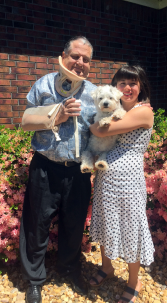
ACEP Now: Vol 40 – No 02 – February 2021Dr. Wernecke upon his arrival back home following his accident, pictured with his daughter Taylor and her dog.
After arriving, the hospital called my family, who called my insurance company, who misread my coverage and told them I was not covered in the country of Laos. Without insurance and with little cash on hand, I did not get treatment. They advised me that I needed to go to another hospital. I refused.
I was starting to become delirious, so they put me in a hospital ward. After 16 hours, the doctor returned to check on me. My oxygen saturations were in the 70s. I was in no condition to refuse any course of action. I was sent to Thailand, where on arrival to the next hospital, a chest tube was placed. They attended to my open fracture but not until my friend from Chang Mai flew to my rescue with cash in hand. Later, I was sent to the fourth and final hospital for definitive care.
Because of the extensive buildup of subcutaneous air, further surgery was delayed four more days. In the meantime, I was put in the ICU. I will never know if that delay contributed to my permanent paralysis.
The surgeon fixed my shoulder “the best they could.” By then, the insurance company confirmed that, in fact, I was covered for care, even in Laos. It was only after I recovered from anesthesia that I noticed my neck pain. Prior to my shoulder repair, the neck pain had been masked by my shoulder pain—the ultimate distracting injury. The team found the teardrop fractures. I told them I would deal with that once back home. I refused transfer to yet another hospital, this time in Bangkok. I figured that if my previous transports and intubations had not killed me, my neck was stable enough.
I spent a month in the hospital and flew home recumbent. I still suffer neck pain and shoulder paralysis, but I am thankful to be alive. The final bill, all told, came out to around $40,000, a fraction of what it would cost in the United States.
The Lesson
This is not just about me telling my unusual story. I want you to learn and educate others about the dangers that exist when emergent treatment is needed and you are far from home. As more and more people adventure to remote destinations, we need to be aware of the risks for ourselves and our friends and family. But it is also a call to action. We must assist in ongoing international efforts to help countries establish EMS programs and to obtain better emergency equipment and training.
Of course, I emphasize to all travelers to do what you can to avoid risky behaviors. In the event of an emergency, we or our representatives must make it clear to insurance providers that their immediate action is necessary. Without proper confirmation of coverage, lifesaving treatment may be withheld. You don’t want to die because someone said the wrong thing on the phone. I suspect that travelers and insurers do not realize that what happened to me could happen to others. In many wealthier countries, patients get lifesaving measures first and insurance is discussed later.
Since my accident, I’ve seen that I’m not the only person at risk. I made it to back to Sonja Kill Memorial Hospital in Cambodia to teach this year. While there, I witnessed a young tourist get hit by a van as he pulled onto the highway on his motorbike. Initially unconscious like I had been, he woke up with altered mental status and had severe facial fractures. We were able to get him to our emergency department. We did not have a CT scanner, and he needed be transferred to Phnom Penh. Getting his insurance confirmation took several hours. All the while, he lay in our emergency department. What if he had an emergent need for neurosurgery?
Before you travel abroad, make sure you know where your coverage covers you. If you need to add coverage, do it. If you truly are covered in remote locations, carry documentation to that effect. Additionally, it never hurts to carry some extra cash, avoid traveling alone, and keep an app on your phone for translations. Make sure copies of your insurance papers and emergency contact numbers are in your wallet, luggage, or backpack. Make these things easy to find. You may not be conscious and able to assist when that information is needed.
All that said, please do not let these stories deter you from traveling to wonderful places or providing medical care in places that need someone with your skills. Just be aware of this danger and prepare for any eventuality that may occur. I have been a family physician and emergency physician for more than three decades. But, by far, the greatest reward I have found is from volunteering my services to those much less fortunate than myself. I wouldn’t give that up for anything.
Pages: 1 2 3 | Single Page


One Response to “Make Sure You Prepare for Possible Medical Emergencies When Abroad”
February 20, 2021
JillMany of us prayed for you not knowing you, but your friend Cheryl who has been on many missions with you, asked us to pray. She was very distressed when she learned of your accident. Part of her heart will always be in Chiang Mai. She shared this article with us. Praise God and thank you for your mission work.