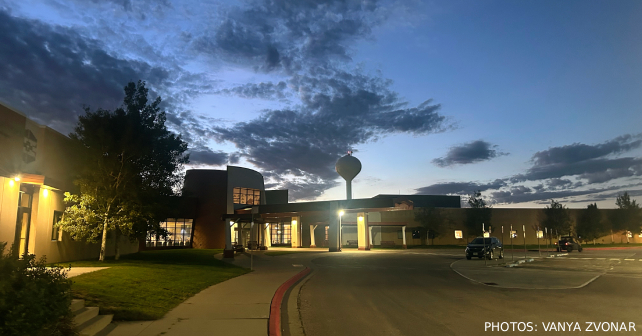
“Vanya, the plane is here for the patient in room three if you want to ride out to the airstrip with the EMS crew.”
Explore This Issue
ACEP Now: January 2026It is dark outside as we step out under the star-studded South Dakota sky. I hop in the passenger seat of the ambulance, and we drive a few minutes away where there is a tiny green fixed-wing plane waiting in the darkness, lights flashing. I watch, buzzing with excitement, as the pilot and flight crew load the patient onto the plane, then quickly take off to fly to Sioux Falls for what would have been a five-hour transport by ground. We watch them leave and then head back to the Cheyenne River Health Center to finish our night shift.
I get back to my desk in the emergency department, an 11-bed unit and check in with the team. Our night crew consists of several nurses, one physician assistant, and one attending physician. There is one radiology tech covering the X-ray and CT machines in the hallway adjacent to the department. Past radiology, the hall leads to the eight-bed inpatient unit where there are currently four admitted patients. The rest of the complex is quiet, waiting for daybreak when the outpatient offices start stirring. I take some time to wander the silent hallways, passing by plaques written in both English and the Lakota language, stopping in to see the traditional healing room where family members can burn sage when a loved one dies.
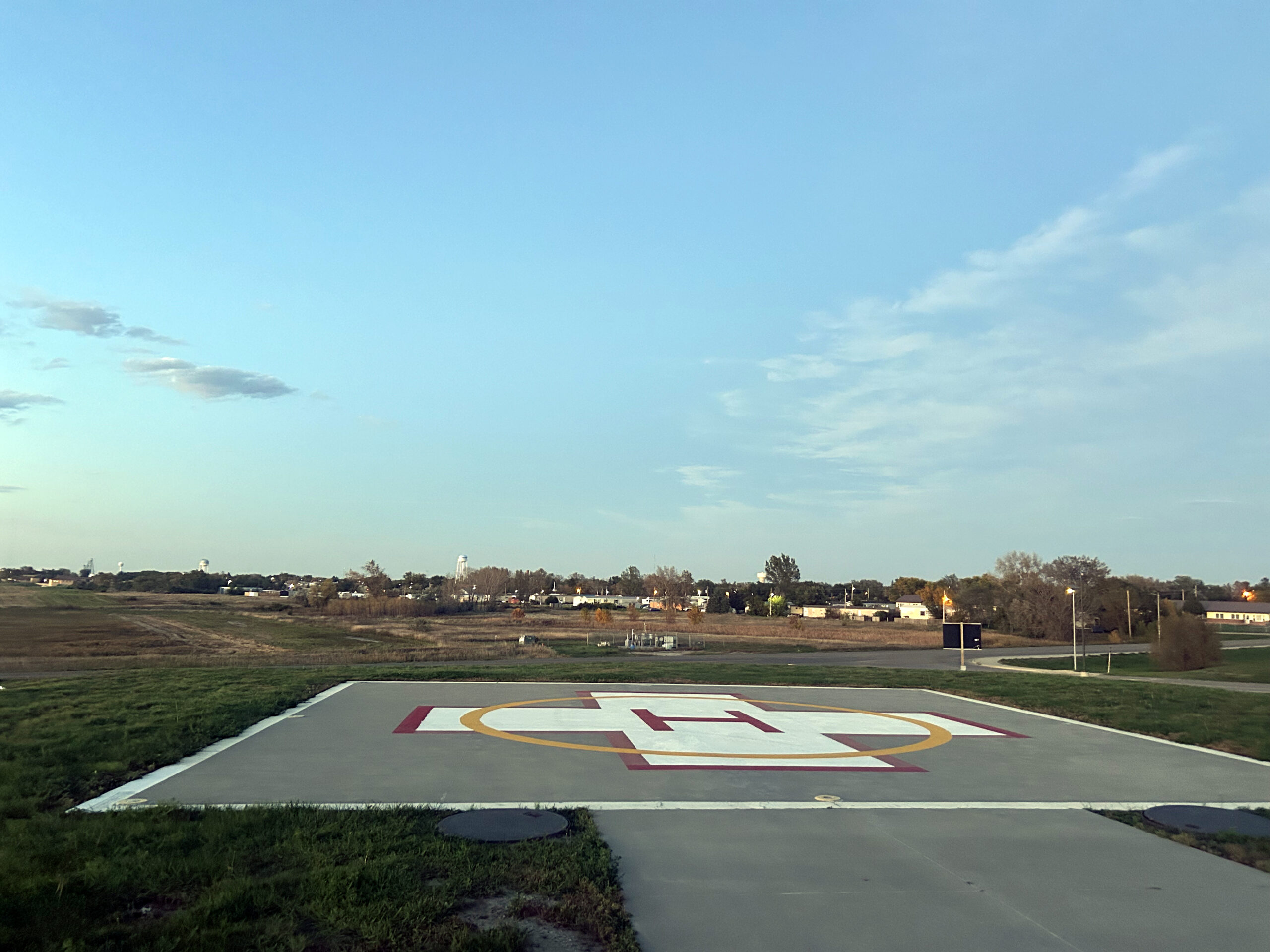
A landing pad near the health center allows for small plane landings and takeoffs to transport patients to larger health care facilities. (Click to enlarge.)
The hospital, which was reconstructed in 2012, is part of the Indian Health Service (IHS). The IHS provides care to some 2.8 million American Indians and Alaska Natives in 574 federally recognized tribes.1 It includes over 600 hospitals, clinics, and health stations on or near American Indian reservations. The Cheyenne River Health Center is in Eagle Butte, South Dakota, home to around 1,500 people, 85 percent of whom are Native American.2 It lies on the Cheyenne River Reservation, home to the Cheyenne River Sioux Tribe. The IHS mission statement hangs on a wall at the front of the hospital: “To raise the physical, mental, social, and spiritual health of American Indians and Alaska Natives to the highest level.”
Back in the emergency department, I reflect on everything I have seen and done during my week here. I have been handed a fetal heart tracing to look at, something I have not done since my obstetrics/gynecology (OB/GYN) rotation in medical school. I have called the transfer center countless times to discuss cases with hospitalists and specialists. I have taken care of a mother and her son in the same week during two different visits and learned how close knit this community is. I have cared for a stroke patient who received tenecteplase and was whisked away in an ambulance. I treated a trauma victim who needed blood, something that exists in very limited supply here. I have seen countless patients suffering from alcoholism and depression, conditions that are unfortunately very common in the community. I have taken care of a 9-day old infant who had not received any care since birth. This is the privilege of learning what it is like to work at a critical access IHS hospital dedicated to the survival of its community.
The Cheyenne River Health Center is part of the Indian Health Service network of hospitals, clinics and health stations on or near American Indian reservations. (Click to enlarge.)
My time there was much too brief, as part of an established rotation residents at my residency program can join, accompanying attendings who work out at Eagle Butte one week at a time throughout the year.
Yeisabeth Jimenez, MD, the acting emergency department director, told me about her vision for visiting residents and the value of the rotation. Dr. Jimenez emphasized the importance of being exposed to medicine at an IHS hospital and understanding the mission to provide excellent care to Native American communities. “You may see Native American patients at your hospital, but if you do not come to the reservation, you will not see and understand challenges they face daily: transportation issues, socioeconomic issues, children who cannot be fed at home, parents under the influence of drugs with a neglected child, grandparents taking care of kids.”
Teresa Bormann, MD, the clinical director, echoed this sentiment. “The system you are working within is much different than a private health system,” she told me as she discussed the value of being immersed in a different health system. “There are different rules about [the] care you give and how you go about giving that care.”
Dr. Bormann reinforced the value of residents seeing rural medicine and how the emergency department functions with limited resources. “The biggest thing is how to care for patients when you do not have all the specialty services around you. There is a different decision making skillset [that] you develop.”
Dr. Jimenez agreed that in this type of environment, “You need to know, and you need to be prepared….We do not have surgery; we do not have respiratory therapy. In the case of trauma, be ready to stabilize your patient and transfer them. You might not expect your biggest challenge of the day to be finding an accepting hospital that is not on diversion.”
Dr. Bormann stressed the fact that exposing residents to rural medicine is key as it can change career paths and where they choose to practice. “Having residents come [here] is very helpful as they get to understand what it is like to live and work in a rural environment. Learners who come to a location are more likely to return to work there in the future. They might consider working for IHS later in their career.”
Dr. Bormann also discussed the educational value that residents add to the hospital. “When learners are in an environment it elevates the level of scholarship in that facility. The people who are teaching have to be up to date on their knowledge and have the ability to teach. That drives the infrastructure around scholarship for everybody.”
Before coming to Eagle Butte, Dr. Jimenez stressed that physicians need to have cultural sensitivity and awareness. “You have to consider the respect we have to provide to our patients. You are coming as a foreigner to their land and must think about how to present yourself for them to trust you.”
Dr. Bormann suggested that “residents should at least have done some reading on cultural humility. When you come into our environment, you get a sense for people’s beliefs. For example, there is a certain subset of patients who do not prefer to engage in Western medicine and take care of themselves through Lakota spirituality and ceremony. Respecting those choices is a different mindset. We can see them as noncompliant, but they are not a bad patient. They just have a different belief system.”
Dr. Bormann and Dr. Jimenez’s words and advice perfectly summarize the incredible exposure this rotation offers to residents like me for the experience of working in a rural setting and at an IHS site. It was a pleasure to learn from them and the community, and I hope to return in the coming years.
I would like to thank the staff at the Cheyenne River Health Center for welcoming me into their hospital. It was a privilege to visit and work in the emergency department and learn from the staff and the patients. I would also like to thank Dr. John Rozehnal, who leads the Mount Sinai Hospital partnership, for allowing me to accompany him during his week of shifts and providing me with an abundance of knowledge outside of our usual New York City home.
Dr. Zvonar is a third-year resident at The Mount Sinai-Elmhurst Emergency Residency Program in New York City. Her interests include medical education, immigrant and refugee health, and global health.
References
- Indian Health Service. Indian Health Service Health Equity Report. Published 2024. Accessed October 5, 2025. https://www.ihs.gov/sites/newsroom/themes/responsive2017/display_objects/documents/factsheets/IHS_Health_Equity_Report_FactSheet_2024.pdf.
- Census Reporter: Eagle Butte, SD. Census Reporter Web site. https://censusreporter.org/profiles/16000US4617620-eagle-butte-sd/. Accessed October 5, 2025.


No Responses to “Lessons Learned at Cheyenne River Health Center”
