Logo

Log In Sign Up |  An official publication of: American College of Emergency Physicians
Navigation
  • Home
  • Multimedia
    • Podcasts
    • Videos
  • Clinical
    • Airway Managment
    • Case Reports
    • Critical Care
    • Guidelines
    • Imaging & Ultrasound
    • Pain & Palliative Care
    • Pediatrics
    • Resuscitation
    • Trauma & Injury
  • Resource Centers
    • mTBI Resource Center
  • Career
    • Practice Management
      • Benchmarking
      • Reimbursement & Coding
      • Care Team
      • Legal
      • Operations
      • Quality & Safety
    • Awards
    • Certification
    • Compensation
    • Early Career
    • Education
    • Leadership
    • Profiles
    • Retirement
    • Work-Life Balance
  • Columns
    • ACEP4U
    • Airway
    • Benchmarking
    • Brief19
    • By the Numbers
    • Coding Wizard
    • EM Cases
    • End of the Rainbow
    • Equity Equation
    • FACEPs in the Crowd
    • Forensic Facts
    • From the College
    • Images in EM
    • Kids Korner
    • Medicolegal Mind
    • Opinion
      • Break Room
      • New Spin
      • Pro-Con
    • Pearls From EM Literature
    • Policy Rx
    • Practice Changers
    • Problem Solvers
    • Residency Spotlight
    • Resident Voice
    • Skeptics’ Guide to Emergency Medicine
    • Sound Advice
    • Special OPs
    • Toxicology Q&A
    • WorldTravelERs
  • Resources
    • ACEP.org
    • ACEP Knowledge Quiz
    • Issue Archives
    • CME Now
    • Annual Scientific Assembly
      • ACEP14
      • ACEP15
      • ACEP16
      • ACEP17
      • ACEP18
      • ACEP19
    • Annals of Emergency Medicine
    • JACEP Open
    • Emergency Medicine Foundation
  • About
    • Our Mission
    • Medical Editor in Chief
    • Editorial Advisory Board
    • Awards
    • Authors
    • Article Submission
    • Contact Us
    • Advertise
    • Subscribe
    • Privacy Policy
    • Copyright Information

Laryngeal Injuries: An Introduction

By Jonathan Glauser, MD, MBA, FACEP; David Effron, MD, MBA, FACEP | on October 15, 2023 | 0 Comment
Airway
  • Tweet
  • Click to email a link to a friend (Opens in new window) Email
Print-Friendly Version

Reconstructive computed tomography can assess the laryngeal framework to avoid missing laryngeal fracture and, hopefully, long-term comorbidities. Non-contrast CT can evaluate the cartilaginous and bony components of the hyoid and larynx. Depending on availability and local expertise, videostroboscopy of the larynx and electromyography of the larynx may be performed by the appropriate consultants.

You Might Also Like
  • Case Report: Blunt Tracheal Injury Creates Difficult Airway
  • Tips and Tricks for Performing Cricothyrotomy
  • Use Accurate Wound Terminology When Describing Injuries
Explore This Issue
ACEP Now: Vol 42 – No 10 – October 2023

For Schaefer type 1 and 2 injuries, close monitoring is recommended, along with intravenous dexamethasone and nebulized steroids. Conservative management entails observation, elevation of the head of the bed, steam inhalation, voice rest, and IV corticosteroids.

SCHAEFER SYSTEM

One commonly cited classification system for laryngeal injury is the Schaefer (or Schaefer-Fuhrman) system. This was based on a literature review from 90 years of publications regarding acute laryngeal injuries:2

  • TYPE 1: Minor laceration of the endolarynx or fracture without laceration
  • TYPE 2: A fracture which is not dislocated; a break in the mucosa without exposure of cartilage, extreme edema, or hematoma
  • TYPE 3: Extensive edema, extensive break in the mucosa, dislocated fractures, exposed cartilage, immobility of vocal cord(s)
  • TYPE 4: Serious interruption of the anterior larynx, unstable fractures or fracture lines, severe trauma of mucosa
  • TYPE 5: Total isolation of the trachea and larynx (laryngotracheal separation)5,6

If the patient needs surgical exploration, tracheostomy is the recommended intervention to secure the airway. Early exploration and reconstruction of the laryngeal framework is generally recommended to preserve laryngeal function and to restore normal phonation. Surgical exploration and correction of fractures may utilize mini-plates, 3-D plates, bioresorbable plates, Montgomery intralaryngeal stent, thread, steel wires, titanium mesh to fix fractured laryngeal cartilage, or titanium plates.3

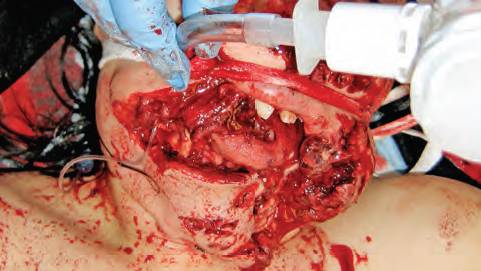
The patient was intubated successfully, in the ED under direct vision, as the vocal cords were visible through the wound and the trachea appeared to be intact. An endotracheal tube (ETT) was placed over a bougie. She was transported to the operating suite where a tracheostomy was performed. Significant mucosal lacerations were encountered. The mucosa was repaired to ensure coverage and to prevent scarring. Reduction of laryngeal fractures with fixation was accomplished. A minor esophageal injury was repaired. Soft tissue and skin were repaired last. She was given tube feedings for approximately one week. Major vessels were unharmed per neck CT with contrast. The tracheostomy was kept in place until the larynx was fully healed. She is currently undergoing therapy with a speech pathologist.

While her long-term result is still evolving, it is important to note that complications of laryngeal injuries may be both acute and chronic. Acute complications are upper-airway obstruction and asphyxia. Recurrent nerve injury, hematoma, infection, and death are possible. Chronic complications may cause problems which may cause patients to present to the ED: vocal-cord paralysis; chronic aspiration; recurrent granulation formation; hoarseness; supraglottic, glottic, subglottic, or tracheal stenosis; and recurrent laryngeal nerve dysfunction.

Pages: 1 2 3 4 | Single Page

Topics: ClinicalLaryngeal InjuriesTrauma & Injury

Related

  • Non-Invasive Positive Pressure Ventilation in the Emergency Department

    October 1, 2025 - 0 Comment
  • Emergency Department Management of Prehospital Tourniquets

    October 1, 2025 - 0 Comment
  • ACEP’s October 2025 Poll: How Often Do You Read Your Own X-Rays?

    September 30, 2025 - 0 Comment

Current Issue

ACEP Now: November 2025

Download PDF

Read More

No Responses to “Laryngeal Injuries: An Introduction”

Leave a Reply Cancel Reply

Your email address will not be published. Required fields are marked *


*
*


Wiley
  • Home
  • About Us
  • Contact Us
  • Privacy
  • Terms of Use
  • Advertise
  • Cookie Preferences
Copyright © 2025 by John Wiley & Sons, Inc. All rights reserved, including rights for text and data mining and training of artificial technologies or similar technologies. ISSN 2333-2603