Logo

Log In Sign Up |  An official publication of: American College of Emergency Physicians
Navigation
  • Home
  • Multimedia
    • Podcasts
    • Videos
  • Clinical
    • Airway Managment
    • Case Reports
    • Critical Care
    • Guidelines
    • Imaging & Ultrasound
    • Pain & Palliative Care
    • Pediatrics
    • Resuscitation
    • Trauma & Injury
  • Resource Centers
    • mTBI Resource Center
  • Career
    • Practice Management
      • Benchmarking
      • Reimbursement & Coding
      • Care Team
      • Legal
      • Operations
      • Quality & Safety
    • Awards
    • Certification
    • Compensation
    • Early Career
    • Education
    • Leadership
    • Profiles
    • Retirement
    • Work-Life Balance
  • Columns
    • ACEP4U
    • Airway
    • Benchmarking
    • Brief19
    • By the Numbers
    • Coding Wizard
    • EM Cases
    • End of the Rainbow
    • Equity Equation
    • FACEPs in the Crowd
    • Forensic Facts
    • From the College
    • Images in EM
    • Kids Korner
    • Medicolegal Mind
    • Opinion
      • Break Room
      • New Spin
      • Pro-Con
    • Pearls From EM Literature
    • Policy Rx
    • Practice Changers
    • Problem Solvers
    • Residency Spotlight
    • Resident Voice
    • Skeptics’ Guide to Emergency Medicine
    • Sound Advice
    • Special OPs
    • Toxicology Q&A
    • WorldTravelERs
  • Resources
    • ACEP.org
    • ACEP Knowledge Quiz
    • Issue Archives
    • CME Now
    • Annual Scientific Assembly
      • ACEP14
      • ACEP15
      • ACEP16
      • ACEP17
      • ACEP18
      • ACEP19
    • Annals of Emergency Medicine
    • JACEP Open
    • Emergency Medicine Foundation
  • About
    • Our Mission
    • Medical Editor in Chief
    • Editorial Advisory Board
    • Awards
    • Authors
    • Article Submission
    • Contact Us
    • Advertise
    • Subscribe
    • Privacy Policy
    • Copyright Information

Laryngeal Injuries: An Introduction

By Jonathan Glauser, MD, MBA, FACEP; David Effron, MD, MBA, FACEP | on October 15, 2023 | 0 Comment
Airway
  • Tweet
  • Click to email a link to a friend (Opens in new window) Email
Print-Friendly Version

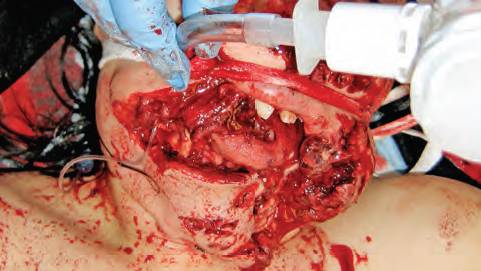
A 37-year-old female was walking home from grocery shopping when she had an encounter with a stray pit bull. For obvious reasons, all history was obtained via emergency medical services and Cleveland police. They were called to the scene to find her with a blood pressure of 135/85, pulse of 110 beats per minute, and respiratory rate of 26 per minute. The major injury was to her face and neck, with lacerations and bites to her legs.

You Might Also Like
  • Case Report: Blunt Tracheal Injury Creates Difficult Airway
  • Tips and Tricks for Performing Cricothyrotomy
  • Use Accurate Wound Terminology When Describing Injuries
Explore This Issue
ACEP Now: Vol 42 – No 10 – October 2023

On arrival to the emergency department (ED) she was awake and breathing with stridor. A tracheostomy was considered, but her trachea appeared to be grossly intact and her vocal cords were visible through her wounds. She was intubated with the assistance of bougie and ketamine, and her appearance after intubation is pictured above.

The patient was intubated successfully as the vocal cords were visible through the wound and the trachea appeared to be intact.

Overview

Laryngotracheal wounds occur rarely, whether blunt or penetrating. The larynx is generally protected from blunt injury by the mandible and sternum. These injuries’ significance lies, of course, in their high mortality rate. While they constitute less than one percent of all traumatic injuries, laryngeal injury is the second most common cause of death (after intracranial injuries) in patients with head and neck injuries.1 Missing a significant laryngotracheal injury can lead to airway obstruction and death. Injuries involving the cricoid cartilage are particularly lethal because of asphyxia from airway obstruction, edema, or hematoma. Patients with small lacerations or abrasions of the larynx or trachea may be managed conservatively with close observation, steroids, and serial endoscopy.

Laryngeal trauma occurs in one in 14,000 to one in 30,000 ED visits. Laryngotracheal trauma has been cited as accounting for less than one in 100,000 hospital admissions.2 As noted above, one major reason for its rarity is that the larynx is protected by the mandible, sternum, and cervical spine.

In children, the larynx is at the level of C4, and protected by the mandible. Fracturing the larynx requires considerable force, and the great majority of fractures are from blunt high-velocity trauma. These include motor vehicle crashes, sports injury, and penetrating neck injuries.3

The most severe occurrence is generally the “clothesline” injury, in which a motorcyclist, dirt biker, or snowmobiler hits a fixed item such as barbed wire, fencing net, or a tree branch, thus striking the front of the neck below the helmet. This mechanism may cause crumbling injury to the cartilage or a laryngotracheal separation. It is noteworthy that trauma to the trachea and larynx may be accompanied by vascular damage to the carotid arteries, jugular veins, or esophagus. The example in this case notwithstanding, motor vehicle crashes are the most common cause of laryngeal injuries.1

Pages: 1 2 3 4 | Single Page

Topics: ClinicalLaryngeal InjuriesTrauma & Injury

Related

  • Non-Invasive Positive Pressure Ventilation in the Emergency Department

    October 1, 2025 - 0 Comment
  • Emergency Department Management of Prehospital Tourniquets

    October 1, 2025 - 0 Comment
  • ACEP’s October 2025 Poll: How Often Do You Read Your Own X-Rays?

    September 30, 2025 - 0 Comment

Current Issue

ACEP Now: November 2025

Download PDF

Read More

No Responses to “Laryngeal Injuries: An Introduction”

Leave a Reply Cancel Reply

Your email address will not be published. Required fields are marked *


*
*


Wiley
  • Home
  • About Us
  • Contact Us
  • Privacy
  • Terms of Use
  • Advertise
  • Cookie Preferences
Copyright © 2025 by John Wiley & Sons, Inc. All rights reserved, including rights for text and data mining and training of artificial technologies or similar technologies. ISSN 2333-2603