
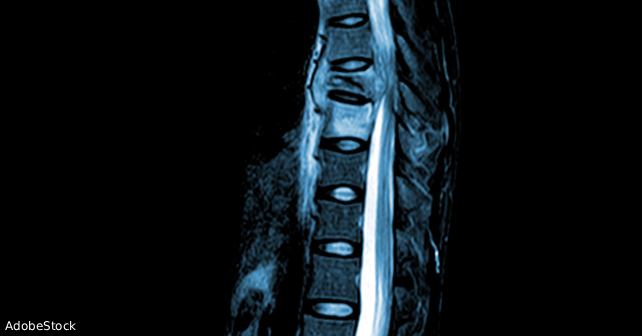
As far as medicolegal liability goes in emergency medicine, the spinal epidural abscess (SEA), along with other acute infectious spinal pathology (AISP), remains one of the big ones. Considering the missed diagnosis and opportunity for intervention that can occur with SEA can result in permanent disability, it is unsurprising that this is the domain of multimillion dollar settlements and jury awards. Prompt neurosurgical intervention is necessary to reduce the risk of progression, putting the onus on emergency physicians to make a timely diagnosis. Roughly speaking, through 2017, the average plaintiff award for filed cases in the VerdictSearch database was $5.2M, and this ranged all the way up to nearly $20M.1
Explore This Issue
ACEP Now: November 2025These lawsuits illustrate the potential danger lurking within every seemingly benign patient with back pain. The classic triad of fever, pain, and neurologic deficit is absent in over three-quarters of cases. Some evidence suggests a bare majority may present even without neurologic deficit as a clue.2 This requires the diagnosis be considered in virtually every patient with back pain, although estimates place the prevalence of SEA at only around two to eight cases per 10,000 hospital admissions.
Whereas some “can’t miss” diagnoses have straightforward diagnostic pathways in the emergency department, SEA and other AISP are dramatically more challenging. A high-sensitivity troponin-I can be relied upon to aid in the diagnosis of an acute coronary syndrome. A CT pulmonary angiogram can be performed in a timely manner in virtually every ED. The best test for spinal pathology — magnetic resonance imaging — is slow, uncomfortable, and unsettling at best, while being unobtainable or unavailable in other scenarios.
To circumvent the limitations of MRI, much investigation has been pursued into non-specific inflammatory markers as surrogates for infection. Similar to the approach to septic arthritis, the most-explored biomarkers are erythrocyte sedimentation rate (ESR) and C-reactive protein (CRP). A host of retrospective studies, dating back to the 1990s, have evaluated these biomarkers in patients diagnosed with AISP. These studies are skewed by small samples and other limitations, but ESR and CRP are certainly elevated in advanced disease.
A new study published in JACEP Open investigates these two biomarkers in an attempt to better characterize their diagnostic capability. Building upon the few hundred patients included in prior work, this study expands the evaluation to several thousand patients collected from a multisite data warehouse. This retrospective study looked at four years of presentations to 2,000 sites of care associated with a single hospital network, then used ICD-10 codes to retrospectively identify candidate patients with presenting complaints potentially arising from AISP. Patients were then narrowed solely to those who had either ESR or CRP ordered and concluded evaluation with a subsequent MRI of the spine.
Pages: 1 2 3 | Single Page



One Response to “Is There Any Way Out for Spinal Epidural Abscess?”
November 17, 2025
Gabe WilsonReally informative data.
Anecdotally, I always wonder if the issue with diagnosing AISP is simply the availability of MRI and barriers to testing.
In the best of circumstances, early on a Monday morning with staff just starting the week, it takes 2-3 hours to get an MRI done and read.
Night and weekends – forget it. So automatically a patient presenting with AISP during these 108 hours of the week are at a huge disadvantage.
Imagine hypothetically a world in which MRI were as quick and easy to get as an x-ray 24-hours-a-day. Would be be ordering many more MRI’s? With 100% certainty – yes, we would.
The question is, what would be our rate of picking up AISP?
As an administrative and logistical side note, hospitals pay quite a bit to have an MRI. Why not run them 24-hours-a-day? Then we could more easily scan Peds for appendicitis or provide much better radiation-free care to patients.
But alas….