Logo

Log In Sign Up |  An official publication of: American College of Emergency Physicians
Navigation
  • Home
  • Multimedia
    • Podcasts
    • Videos
  • Clinical
    • Airway Managment
    • Case Reports
    • Critical Care
    • Guidelines
    • Imaging & Ultrasound
    • Pain & Palliative Care
    • Pediatrics
    • Resuscitation
    • Trauma & Injury
  • Resource Centers
    • mTBI Resource Center
  • Career
    • Practice Management
      • Benchmarking
      • Reimbursement & Coding
      • Care Team
      • Legal
      • Operations
      • Quality & Safety
    • Awards
    • Certification
    • Compensation
    • Early Career
    • Education
    • Leadership
    • Profiles
    • Retirement
    • Work-Life Balance
  • Columns
    • ACEP4U
    • Airway
    • Benchmarking
    • Brief19
    • By the Numbers
    • Coding Wizard
    • EM Cases
    • End of the Rainbow
    • Equity Equation
    • FACEPs in the Crowd
    • Forensic Facts
    • From the College
    • Images in EM
    • Kids Korner
    • Medicolegal Mind
    • Opinion
      • Break Room
      • New Spin
      • Pro-Con
    • Pearls From EM Literature
    • Policy Rx
    • Practice Changers
    • Problem Solvers
    • Residency Spotlight
    • Resident Voice
    • Skeptics’ Guide to Emergency Medicine
    • Sound Advice
    • Special OPs
    • Toxicology Q&A
    • WorldTravelERs
  • Resources
    • ACEP.org
    • ACEP Knowledge Quiz
    • Issue Archives
    • CME Now
    • Annual Scientific Assembly
      • ACEP14
      • ACEP15
      • ACEP16
      • ACEP17
      • ACEP18
      • ACEP19
    • Annals of Emergency Medicine
    • JACEP Open
    • Emergency Medicine Foundation
  • About
    • Our Mission
    • Medical Editor in Chief
    • Editorial Advisory Board
    • Awards
    • Authors
    • Article Submission
    • Contact Us
    • Advertise
    • Subscribe
    • Privacy Policy
    • Copyright Information

Is An Aging Population Aging Out Younger Patients?

By James J. Augustine, MD, FACEP | on April 18, 2022 | 0 Comment
Benchmarking Benchmarking Alliance
  • Tweet
  • Click to email a link to a friend (Opens in new window) Email
Print-Friendly Version
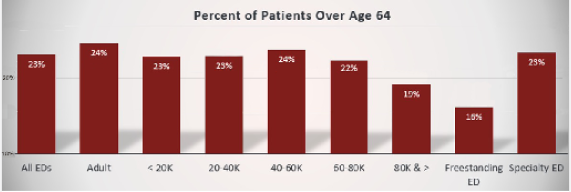
Figure 2 (LEFT): Percentage of patients in general service EDs over age 64, by ED cohort.

You Might Also Like
  • Where Are All the Children Going? ED Pediatric Patients Are Decreasing
  • Injury in the Mix: Changing Nature of ED Patients
  • Identify and Plan for Your Emergency Department’s Particular Patient Mix
Explore This Issue
ACEP Now: Vol 41 – No 04 – April 2022

Figure 2: Percentage of patients in general service EDs over age 64, by ED cohort.

What Other Factors May Be Contributing to the Decrease in ED Visits by Children?

There are increasing pathways to unscheduled care for children and their parents. That includes expanded hours for pediatricians, the larger presence of urgent care centers in many metropolitan areas and the emerging presence of telehealth.

The role of emergency physicians has dramatically changed in response to the COVID-19 pandemic, and trends suggest emergency departments will see older, higher-acuity patients with more complex medical needs.5 The emergency department remains the portal for all patients, and general service emergency departments must be prepared for persons of any age. Even if the inpatient areas of the hospital do not care for children, the emergency department must provide initial care for all who will either be admitted or transferred. Recent publications point to the need for all emergency departments to be better prepared for ill or injured children and include access to preparedness materials.3,4

Thirteen percent of children present to community emergency departments these days. The relative infrequency of pediatric ED patients must not change the need to be prepared to care for them, including the equipment, processes, and training available in general service emergency departments.

References

  1. Welch S, Augustine J, Camargo CA Jr, et al. Emergency department performance measures and benchmarking summit. Acad Emerg Med. 2006;13(10):1074-1080.
  2. Cairns C, Kang K, Santo L. National Hospital Ambulatory Medical Care Survey: 2018 emergency department summary tables. Centers for Disease Control and Prevention.
  3. Newgard C, Lin A, Goldhaber-Fiebert JD, et al. Association of emergency department pediatric readiness with mortality to 1 year among injured children treated at trauma centers [published online ahead of print February 2, 2022]. JAMA Surg.
  4. Remick K, Gausche-Hill M, Joseph MM, et al. Pediatric readiness in the emergency department. J Emerg Nurs. 2019;45(1):e3-e18.
  5. Augustine JJ. Pre-COVID ED trends suggest more challenges lie ahead. ACEP Now. 2020;39(11):10.

Pages: 1 2 | Single Page

Topics: AgingDemographics

Related

  • By the Numbers: U.S. COVID-19 Demographics

    December 15, 2020 - 0 Comment
  • Emergency Department Usage Trends Before COVID-19

    May 21, 2020 - 0 Comment
  • ACEP Accredits Geriatric Emergency Care for Emergency Departments

    April 10, 2017 - 0 Comment

Current Issue

ACEP Now: November 2025

Download PDF

Read More

About the Author

James J. Augustine, MD, FACEP

James J. Augustine, MD, FACEP, is national director of prehospital strategy for US Acute Care Solutions in Canton, Ohio; clinical professor of emergency medicine at Wright State University in Dayton, Ohio; and vice president of the Emergency Department Benchmarking Alliance.

View this author's posts »

No Responses to “Is An Aging Population Aging Out Younger Patients?”

Leave a Reply Cancel Reply

Your email address will not be published. Required fields are marked *


*
*


Wiley
  • Home
  • About Us
  • Contact Us
  • Privacy
  • Terms of Use
  • Advertise
  • Cookie Preferences
Copyright © 2025 by John Wiley & Sons, Inc. All rights reserved, including rights for text and data mining and training of artificial technologies or similar technologies. ISSN 2333-2603