Logo

Log In Sign Up |  An official publication of: American College of Emergency Physicians
Navigation
  • Home
  • Multimedia
    • Podcasts
    • Videos
  • Clinical
    • Airway Managment
    • Case Reports
    • Critical Care
    • Guidelines
    • Imaging & Ultrasound
    • Pain & Palliative Care
    • Pediatrics
    • Resuscitation
    • Trauma & Injury
  • Resource Centers
    • mTBI Resource Center
  • Career
    • Practice Management
      • Benchmarking
      • Reimbursement & Coding
      • Care Team
      • Legal
      • Operations
      • Quality & Safety
    • Awards
    • Certification
    • Compensation
    • Early Career
    • Education
    • Leadership
    • Profiles
    • Retirement
    • Work-Life Balance
  • Columns
    • ACEP4U
    • Airway
    • Benchmarking
    • Brief19
    • By the Numbers
    • Coding Wizard
    • EM Cases
    • End of the Rainbow
    • Equity Equation
    • FACEPs in the Crowd
    • Forensic Facts
    • From the College
    • Images in EM
    • Kids Korner
    • Medicolegal Mind
    • Opinion
      • Break Room
      • New Spin
      • Pro-Con
    • Pearls From EM Literature
    • Policy Rx
    • Practice Changers
    • Problem Solvers
    • Residency Spotlight
    • Resident Voice
    • Skeptics’ Guide to Emergency Medicine
    • Sound Advice
    • Special OPs
    • Toxicology Q&A
    • WorldTravelERs
  • Resources
    • ACEP.org
    • ACEP Knowledge Quiz
    • Issue Archives
    • CME Now
    • Annual Scientific Assembly
      • ACEP14
      • ACEP15
      • ACEP16
      • ACEP17
      • ACEP18
      • ACEP19
    • Annals of Emergency Medicine
    • JACEP Open
    • Emergency Medicine Foundation
  • About
    • Our Mission
    • Medical Editor in Chief
    • Editorial Advisory Board
    • Awards
    • Authors
    • Article Submission
    • Contact Us
    • Advertise
    • Subscribe
    • Privacy Policy
    • Copyright Information

Intranasal Fentanyl for Sickle Cell Vaso-Occlusive Pain

By Ken Milne, MD | on August 25, 2023 | 0 Comment
Skeptics' Guide to EM
  • Tweet
  • Click to email a link to a friend (Opens in new window) Email
Print-Friendly Version

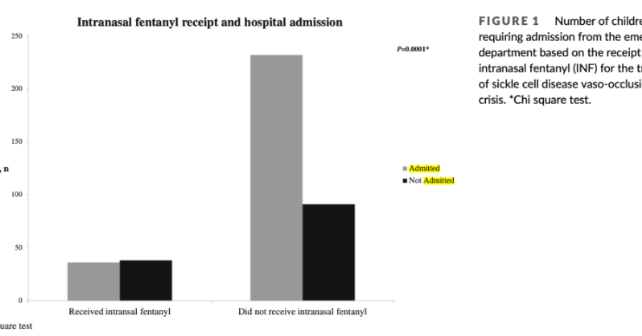
There was also a great deal of variation for admission rates which ranged from 45 to 90 percent. Despite this variation in practice, IN fentanyl administration was still associated with discharge even accounting for pain scores and opioid administration. Further, when the analysis includes only sites that administer IN fentanyl, the association is even stronger.

You Might Also Like
  • Manage Sickle Cell Pain in the Emergency Department
  • ACEP Teams Up to Improve ED Sickle Cell Disease Care
  • Fentanyl Versus Ketamine for Intranasal Pain Relief
Explore This Issue
ACEP Now: Vol 42 – No 09 – September 2023

The differences observed in this study make it uncertain if these findings can be generalized outside of these academic settings. However, adopting IN fentanyl administration does not seem difficult and community hospitals may want to consider this treatment option.

Bottom Line

Intranasal fentanyl may be helpful for children with SCD presenting with VOE.

Case Resolution: 

You decide to give the patient a dose of IN fentanyl while she is awaiting IV access. After IV access is obtained, she receives a few doses of parenteral morphine and tells you that she feels like her pain is much better controlled. She is discharged from the ED.

Thank you to Dr. Dennis Ren for his help on this critical appraisal. He is a pediatric emergency medicine physician at Children’s National Hospital in Washington, DC. 

Remember to be skeptical of anything you learn, even if you heard it on the Skeptics’ Guide to Emergency Medicine. 

References

  1. Campbell F, Hudspith M, Choinière M, et al. An action plan for pain in Canada. Health Canada website. https://www.canada.ca/content/dam/hc-sc/documents/corporate/about-health-canada/public-engagement/external-advisory-bodies/canadian-pain-task-force/report-2021-rapport/report-rapport-2021-eng.pdf. Published May 2021. Accessed August 8, 2023.
  2. National Heart Lung, and Blood Institute. Evidence-based management of sickle cell disease: Expert panel report, 2014. National Institutes of Health website. https://www.nhlbi.nih.gov/health-topics/evidence-based-management-sickle-cell-disease. Published 2014. Accessed August 8, 2023.
  3. Murphy A, O‘Sullivan R, Wakai A, et al. Intranasal fentanyl for the management of acute pain in children. Cochrane Database Syst Rev. 2014;2014(10):CD009942.
  4. Murphy A, O‘Sullivan R, Wakai A, et al. Intranasal fentanyl for the management of acute pain in children. Cochrane Database Syst Rev. 2014;2014(10):CD009942. 

Pages: 1 2 3 | Single Page

Topics: Sickle Cell Disease

Related

  • Is Splenic Dysfunction Correlated with Sickle Cell Anemia in Kids?

    September 13, 2023 - 0 Comment
  • June 2023 News From the College

    June 3, 2023 - 0 Comment
  • Visual Dx Answer: a) Acute Chest Syndrome

    May 3, 2023 - 0 Comment

Current Issue

ACEP Now: November 2025

Download PDF

Read More

About the Author

Ken Milne, MD

Ken Milne, MD, is chief of emergency medicine and chief of staff at South Huron Hospital, Ontario, Canada. He is on the Best Evidence in Emergency Medicine faculty and is creator of the knowledge translation project the Skeptics Guide to Emergency Medicine.

View this author's posts »

No Responses to “Intranasal Fentanyl for Sickle Cell Vaso-Occlusive Pain”

Leave a Reply Cancel Reply

Your email address will not be published. Required fields are marked *


*
*


Wiley
  • Home
  • About Us
  • Contact Us
  • Privacy
  • Terms of Use
  • Advertise
  • Cookie Preferences
Copyright © 2025 by John Wiley & Sons, Inc. All rights reserved, including rights for text and data mining and training of artificial technologies or similar technologies. ISSN 2333-2603
