Logo

Log In Sign Up |  An official publication of: American College of Emergency Physicians
Navigation
  • Home
  • Multimedia
    • Podcasts
    • Videos
  • Clinical
    • Airway Managment
    • Case Reports
    • Critical Care
    • Guidelines
    • Imaging & Ultrasound
    • Pain & Palliative Care
    • Pediatrics
    • Resuscitation
    • Trauma & Injury
  • Resource Centers
    • mTBI Resource Center
  • Career
    • Practice Management
      • Benchmarking
      • Reimbursement & Coding
      • Care Team
      • Legal
      • Operations
      • Quality & Safety
    • Awards
    • Certification
    • Compensation
    • Early Career
    • Education
    • Leadership
    • Profiles
    • Retirement
    • Work-Life Balance
  • Columns
    • ACEP4U
    • Airway
    • Benchmarking
    • Brief19
    • By the Numbers
    • Coding Wizard
    • EM Cases
    • End of the Rainbow
    • Equity Equation
    • FACEPs in the Crowd
    • Forensic Facts
    • From the College
    • Images in EM
    • Kids Korner
    • Medicolegal Mind
    • Opinion
      • Break Room
      • New Spin
      • Pro-Con
    • Pearls From EM Literature
    • Policy Rx
    • Practice Changers
    • Problem Solvers
    • Residency Spotlight
    • Resident Voice
    • Skeptics’ Guide to Emergency Medicine
    • Sound Advice
    • Special OPs
    • Toxicology Q&A
    • WorldTravelERs
  • Resources
    • ACEP.org
    • ACEP Knowledge Quiz
    • Issue Archives
    • CME Now
    • Annual Scientific Assembly
      • ACEP14
      • ACEP15
      • ACEP16
      • ACEP17
      • ACEP18
      • ACEP19
    • Annals of Emergency Medicine
    • JACEP Open
    • Emergency Medicine Foundation
  • About
    • Our Mission
    • Medical Editor in Chief
    • Editorial Advisory Board
    • Awards
    • Authors
    • Article Submission
    • Contact Us
    • Advertise
    • Subscribe
    • Privacy Policy
    • Copyright Information

Inconsistent Records & Insufficient Imaging Complicate Malpractice Case

By Eric Funk, MD | on September 24, 2019 | 0 Comment
Medicolegal Mind
  • Tweet
  • Click to email a link to a friend (Opens in new window) Email
Print-Friendly Version
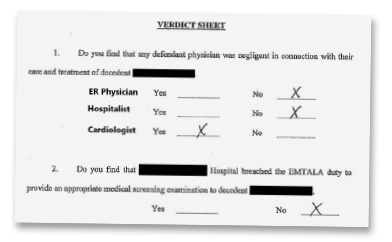
Figure 3: Arbitrator verdict sheet

You Might Also Like
  • Do We Need a New Standard of Proof in Medical Malpractice Cases?
  • Malpractice Defense Costs Are Real
  • Sheltering Personal Assets from Medical Malpractice Liability Is Overrated
Explore This Issue
ACEP Now: Vol 38 – No 09 – September 2019

Figure 3: Arbitrator verdict sheet

The arbitrator awarded the plaintiffs $791,000 in damages, which was reduced to $500,000 per the previous agreement and was paid by the cardiologist’s malpractice insurer. As agreed, the law firm took 40 percent of the awarded damages ($200,000) plus their expenses of $69,000. This left $144,000 for the patient’s wife and $43,500 for each of his two children.

Take-home Points

There are several learning points from this case in regard to both medical care and documentation. A key concept is that fatal aortic pathology may not reliably localize to a specific anatomical area. If there is reasonable concern for aortic pathology, the entirety of the aorta should be imaged (a CT of the chest and abdomen/pelvis should be ordered for any aortic syndrome evaluation). (As a sidebar, it was later revealed that the patient’s reported anaphylactic reaction to contrast may not have been accurate, underscoring the importance of accurate medical record keeping in general.) Nonetheless, there are other options available for imaging the aorta, including MRI or transesophageal echocardiography. Emergency physicians should be prepared to advocate vigorously for the necessary testing, despite the fact that these are uncommon work-ups and may result in some pushback.

Finally, the documentation in this case presented problems for the emergency physician’s defense. Discrepancies between the physician and nurse created opportunities for criticism, even if management would not have been substantially altered by resolving that discrepancy in real time. More striking were discrepancies within the emergency physician’s own chart. This made it easy for the plaintiff’s attorney to suggest that a chest X-ray should have been ordered, potentially averting tragedy.

A review of the details of this case reveals a behind-the-scenes look at medical malpractice litigation, giving the reader practical tips to improve both their care and documentation. Interested readers can view more of the details from this case—including the original medical record, legal documents, expert witness opinions, and further analysis of the medical care and documentation—at www.medmalreviewer.com. 


Dr. FunkDr. Funk is a practicing emergency medicine physician in Springfield, Missouri, and owner of Med Mal Reviewer, LLC. He writes about medical malpractice at www.medmalreviewer.com.

Pages: 1 2 3 | Single Page

Topics: Diagnostic Imaging ExamsDocumentationElectronic Health RecordMalpractice

Related

  • Poll: Emergency Physicians Read Their Own X-Rays More Often Than Not

    November 6, 2025 - 0 Comment
  • How Evidence-Based Medicine Strengthens Your Malpractice Defense

    October 28, 2025 - 0 Comment
  • The Business of Emergency Medicine: Insurance Essentials

    October 9, 2025 - 0 Comment

Current Issue

ACEP Now: November 2025

Download PDF

Read More

No Responses to “Inconsistent Records & Insufficient Imaging Complicate Malpractice Case”

Leave a Reply Cancel Reply

Your email address will not be published. Required fields are marked *


*
*


Wiley
  • Home
  • About Us
  • Contact Us
  • Privacy
  • Terms of Use
  • Advertise
  • Cookie Preferences
Copyright © 2025 by John Wiley & Sons, Inc. All rights reserved, including rights for text and data mining and training of artificial technologies or similar technologies. ISSN 2333-2603
