Logo

Log In Sign Up |  An official publication of: American College of Emergency Physicians
Navigation
  • Home
  • Multimedia
    • Podcasts
    • Videos
  • Clinical
    • Airway Managment
    • Case Reports
    • Critical Care
    • Guidelines
    • Imaging & Ultrasound
    • Pain & Palliative Care
    • Pediatrics
    • Resuscitation
    • Trauma & Injury
  • Resource Centers
    • mTBI Resource Center
  • Career
    • Practice Management
      • Benchmarking
      • Reimbursement & Coding
      • Care Team
      • Legal
      • Operations
      • Quality & Safety
    • Awards
    • Certification
    • Compensation
    • Early Career
    • Education
    • Leadership
    • Profiles
    • Retirement
    • Work-Life Balance
  • Columns
    • ACEP4U
    • Airway
    • Benchmarking
    • Brief19
    • By the Numbers
    • Coding Wizard
    • EM Cases
    • End of the Rainbow
    • Equity Equation
    • FACEPs in the Crowd
    • Forensic Facts
    • From the College
    • Images in EM
    • Kids Korner
    • Medicolegal Mind
    • Opinion
      • Break Room
      • New Spin
      • Pro-Con
    • Pearls From EM Literature
    • Policy Rx
    • Practice Changers
    • Problem Solvers
    • Residency Spotlight
    • Resident Voice
    • Skeptics’ Guide to Emergency Medicine
    • Sound Advice
    • Special OPs
    • Toxicology Q&A
    • WorldTravelERs
  • Resources
    • ACEP.org
    • ACEP Knowledge Quiz
    • Issue Archives
    • CME Now
    • Annual Scientific Assembly
      • ACEP14
      • ACEP15
      • ACEP16
      • ACEP17
      • ACEP18
      • ACEP19
    • Annals of Emergency Medicine
    • JACEP Open
    • Emergency Medicine Foundation
  • About
    • Our Mission
    • Medical Editor in Chief
    • Editorial Advisory Board
    • Awards
    • Authors
    • Article Submission
    • Contact Us
    • Advertise
    • Subscribe
    • Privacy Policy
    • Copyright Information

Identify and Treat Lisfranc Injuries
By Yenisleidy Paez Perez, DO | on January 4, 2018 | 0 Comment
CME Now Features
  • Tweet
  • Click to email a link to a friend (Opens in new window) Email
Print-Friendly Version
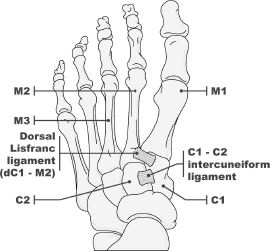
Figure 2: The Lisfranc ligament connects the base of the second metatarsal to the lateral aspect of the medial cuneiform.

You Might Also Like
  • Tips for Catching Commonly Missed Ankle Injuries
  • How to Perform Ultrasound-Guided Forearm Nerve Blocks to Provide Non-Drug Pain Relief for Acute Injuries
  • Online Clinical Tool for Post–Bariatric Surgery Patients Could Improve Management
Explore This Issue
ACEP Now: Vol 36 – No 12 – December 2017

Figure 2: The Lisfranc ligament connects the base of the second metatarsal to the lateral aspect of the medial cuneiform.
Credit: Siddiqui N A, Galizia M S, Almusa E, et al. RadioGraphics. 2014;34(2):514-531.
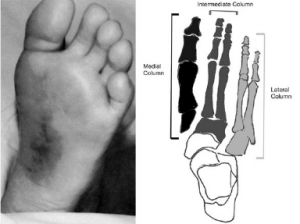
Figure 3: Left: Plantar ecchymosis. Right: Medial, intermediate and lateral column associated with midfoot biomechanics.

Figure 3: Left: Plantar ecchymosis. Right: Medial, intermediate and lateral column associated with midfoot biomechanics.
Emerg Med J. 2017;34:52-56.

Physical Exam Suggestive of Lisfranc Fracture

  • Inability to bear weight or stand on tiptoes.2
  • Ecchymosis on medial plantar aspect of foot is pathognomonic but may be absent in minor fractures (see Figure 3).2
  • Dorsal midfoot pain and swelling.
  • Pain elicited with passive supination and pronation of the forefoot with the hindfoot held fixed.4
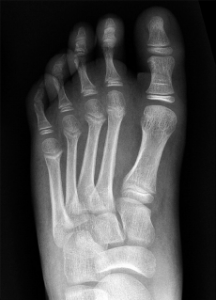
Figure 4A(ABOVE): Initial AP non-weight-bearing radiograph shows normal alignment of the medial and middle columns of an 11-year-old boy after a fall. Credit: RadioGraphics. 2014;34(2):514-531.

Figure 4A: Initial AP non-weight-bearing radiograph shows normal alignment of the medial and middle columns of an 11-year-old boy after a fall.
Credit: Siddiqui N A, Galizia M S, Almusa E, et al. RadioGraphics. 2014;34(2):514-531.
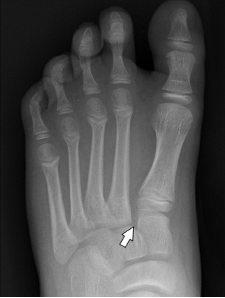
Figure 4b(BELOW): AP weight-bearing radiograph shows widening of the joint seen as a gap of more than 2 mm between C1 and M2 and between M1 and M2 (arrow).

Figure 4b: AP weight-bearing radiograph shows widening of the joint seen as a gap of more than 2 mm between C1 and M2 and between M1 and M2 (arrow).
Credit: Siddiqui N A, Galizia M S, Almusa E, et al. RadioGraphics. 2014;34(2):514-531.
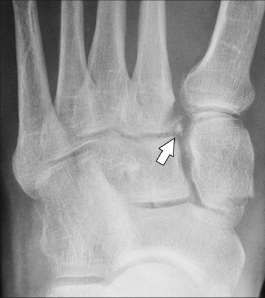
Figure 6: AP weight-bearing radiograph showing a small chip fracture from medial margin of base of M2, known as the “fleck sign.”

Figure 6: AP weight-bearing radiograph showing a small chip fracture from medial margin of base of M2, known as the “fleck sign.”
Credit: Siddiqui N A, Galizia M S, Almusa E, et al. RadioGraphics. 2014;34(2):514-531.

Diagnosis

Obtain three view radiographs of the foot (anteroposterior [AP], lateral, and standard 45-degree oblique views). Ideally, weight-bearing stress views should be obtained since initial plain X-rays may fail to show subtle widening of the articulation spaces (See Figure 4).1 Consider a CT scan of the foot if X-rays do not show an injury but you remain highly suspicious.

Normal Three-Column Anatomy of Lisfranc Complex on X-Ray (see Figures 1 and 5)

  • On the AP view, the medial edge of the base of the second metatarsal (M2) should line up with the medial edge of the middle cuneiform (C2).1
  • The gap between the second metatarsal and medial cuneiform is <2 mm.
  • On the oblique view, the medial edge of the third and fourth metatarsal should line up with the medial edges of the middle cuneiform and cuboid, respectively.1
  • On the lateral view, the superior border of the first metatarsal (M1) should align with the superior border of the medial cuneiform (C1).

Pages: 1 2 3 | Single Page

Topics: CMECME NowEmergency DepartmentEmergency MedicineEmergency PhysiciansfractureimagingPatient CareTrauma and InjuryX-Ray

Related

  • Patterns of Injury in Elder Abuse

    November 6, 2025 - 0 Comment
  • Poll: Emergency Physicians Read Their Own X-Rays More Often Than Not

    November 6, 2025 - 0 Comment
  • Let Core Values Help Guide Patient Care

    November 5, 2025 - 0 Comment

Current Issue

ACEP Now: November 2025

Download PDF

Read More

No Responses to “Identify and Treat Lisfranc Injuries”

Leave a Reply Cancel Reply

Your email address will not be published. Required fields are marked *


*
*


Wiley
  • Home
  • About Us
  • Contact Us
  • Privacy
  • Terms of Use
  • Advertise
  • Cookie Preferences
Copyright © 2025 by John Wiley & Sons, Inc. All rights reserved, including rights for text and data mining and training of artificial technologies or similar technologies. ISSN 2333-2603
