Logo

Log In Sign Up |  An official publication of: American College of Emergency Physicians
Navigation
  • Home
  • Multimedia
    • Podcasts
    • Videos
  • Clinical
    • Airway Managment
    • Case Reports
    • Critical Care
    • Guidelines
    • Imaging & Ultrasound
    • Pain & Palliative Care
    • Pediatrics
    • Resuscitation
    • Trauma & Injury
  • Resource Centers
    • mTBI Resource Center
  • Career
    • Practice Management
      • Benchmarking
      • Reimbursement & Coding
      • Care Team
      • Legal
      • Operations
      • Quality & Safety
    • Awards
    • Certification
    • Compensation
    • Early Career
    • Education
    • Leadership
    • Profiles
    • Retirement
    • Work-Life Balance
  • Columns
    • ACEP4U
    • Airway
    • Benchmarking
    • Brief19
    • By the Numbers
    • Coding Wizard
    • EM Cases
    • End of the Rainbow
    • Equity Equation
    • FACEPs in the Crowd
    • Forensic Facts
    • From the College
    • Images in EM
    • Kids Korner
    • Medicolegal Mind
    • Opinion
      • Break Room
      • New Spin
      • Pro-Con
    • Pearls From EM Literature
    • Policy Rx
    • Practice Changers
    • Problem Solvers
    • Residency Spotlight
    • Resident Voice
    • Skeptics’ Guide to Emergency Medicine
    • Sound Advice
    • Special OPs
    • Toxicology Q&A
    • WorldTravelERs
  • Resources
    • ACEP.org
    • ACEP Knowledge Quiz
    • Issue Archives
    • CME Now
    • Annual Scientific Assembly
      • ACEP14
      • ACEP15
      • ACEP16
      • ACEP17
      • ACEP18
      • ACEP19
    • Annals of Emergency Medicine
    • JACEP Open
    • Emergency Medicine Foundation
  • About
    • Our Mission
    • Medical Editor in Chief
    • Editorial Advisory Board
    • Awards
    • Authors
    • Article Submission
    • Contact Us
    • Advertise
    • Subscribe
    • Privacy Policy
    • Copyright Information

How To Use Video-Assisted Flexible Endoscopic Intubation

By Reuben J. Strayer, MD, FRCPC, FAAEM, and Nicholas Caputo, MD, MSC, FACEP, FAAEM, MAJ (MC, USAR) | on November 11, 2022 | 0 Comment
Features
  • Tweet
  • Click to email a link to a friend (Opens in new window) Email
Print-Friendly Version

Unlike traditional awake flexible endoscopy, VAFEI can be performed very rapidly, which allows the procedure to be incorporated into an RSI-based paralyzed approach. RSI maximizes the likelihood of first pass success and for decades has been used in the majority of emergency department intubations.12,13,14,15

You Might Also Like
  • Is Video or Direct Laryngoscopy Better for Intubation in Trauma Patients?
  • Videolaryngoscope Helps Residents Learn Neonatal Endotracheal Intubation
  • Keep Video Laryngoscope Clear with IV Tubing, Saline, and Some Ingenuity
Explore This Issue
ACEP Now: Vol 41 – No 11 – November 2022

VAFEI can be used as part of a topically anesthetized awake approach, however achieving sufficient local anesthesia that an awake patient will tolerate laryngoscopy requires more time than is available in many emergency intubation cases and is enabled by specialized equipment (e.g., atomizers, concentrated lidocaine) that may not be available.

VAFEI can also be incorporated into a ketamine-only strategy that attempts to take advantage of the safety benefit of ATI by maintaining spontaneous respirations while overcoming the challenges in executing effective topicalization, by using enough ketamine that the patient will tolerate laryngoscopy and tracheal intubation.16 The use of atomized lidocaine about the posterior oropharynx and glottis is still recommended, if feasible, to attenuate airway reflexes and laryngospasm that may impede tube delivery even in dissociated patients.

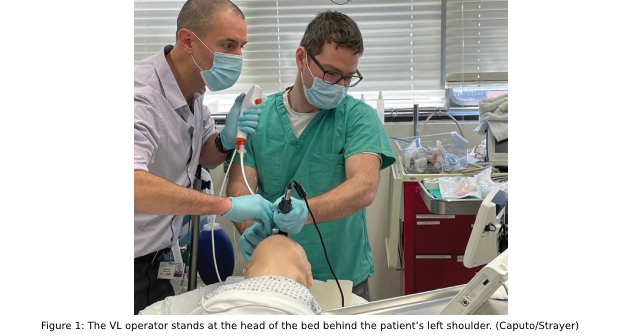
The primary drawback of the VAFEI technique is that it requires two operators: one to perform video laryngoscopy and one to advance the flexible endoscope. However, both operators need not be physicians, and in fact one operator can perform VAFEI by first completing laryngoscopy and then handing off the VL to an assistant positioned to the operator’s left, behind the patient. VAFEI requires that both VL and FE devices be available and ready, which is a barrier in many departments; however, the emergence of single-use, disposable VL blades and endoscopes allows wider adoption of this technology in emergency settings. Operation of the flexible endoscope in VAFEI does not require the same degree of skill as is needed to perform conventional flexible endoscopic intubation, but does require familiarity with the device and its basic functions, which can easily be acquired in a simulation training session.

Conclusion

VAFEI is a powerful intubation technique that takes advantage of the strengths of video laryngoscopy and flexible endoscopy while diminishing their drawbacks.17 It can be incorporated into approaches that preserve spontaneous ventilation and performed quickly enough to be used with paralysis and rapid sequence intubation. Because most anatomically difficult airways are unpredicted, it is essential that airway management strategies plan for first-attempt failure.18,19,20


Dr. Strayer is an emergency physician at Maimonides Medical Center, in Brooklyn.

Dr. Caputo is associate chief of the Department of Emergency Medicine at NYC H+H/Lincoln Medical Center in the South Bronx.

Pages: 1 2 3 4 5 | Single Page

Topics: AirwayClinicalIntubationVideo Laryngoscope

Related

  • Why the Nonrebreather Should be Abandoned

    December 3, 2025 - 0 Comment
  • Non-Invasive Positive Pressure Ventilation in the Emergency Department

    October 1, 2025 - 0 Comment
  • Emergency Department Management of Prehospital Tourniquets

    October 1, 2025 - 0 Comment

Current Issue

ACEP Now: November 2025

Download PDF

Read More

No Responses to “How To Use Video-Assisted Flexible Endoscopic Intubation”

Leave a Reply Cancel Reply

Your email address will not be published. Required fields are marked *


*
*


Wiley
  • Home
  • About Us
  • Contact Us
  • Privacy
  • Terms of Use
  • Advertise
  • Cookie Preferences
Copyright © 2025 by John Wiley & Sons, Inc. All rights reserved, including rights for text and data mining and training of artificial technologies or similar technologies. ISSN 2333-2603
