Logo

Log In Sign Up |  An official publication of: American College of Emergency Physicians
Navigation
  • Home
  • Multimedia
    • Podcasts
    • Videos
  • Clinical
    • Airway Managment
    • Case Reports
    • Critical Care
    • Guidelines
    • Imaging & Ultrasound
    • Pain & Palliative Care
    • Pediatrics
    • Resuscitation
    • Trauma & Injury
  • Resource Centers
    • mTBI Resource Center
  • Career
    • Practice Management
      • Benchmarking
      • Reimbursement & Coding
      • Care Team
      • Legal
      • Operations
      • Quality & Safety
    • Awards
    • Certification
    • Compensation
    • Early Career
    • Education
    • Leadership
    • Profiles
    • Retirement
    • Work-Life Balance
  • Columns
    • ACEP4U
    • Airway
    • Benchmarking
    • Brief19
    • By the Numbers
    • Coding Wizard
    • EM Cases
    • End of the Rainbow
    • Equity Equation
    • FACEPs in the Crowd
    • Forensic Facts
    • From the College
    • Images in EM
    • Kids Korner
    • Medicolegal Mind
    • Opinion
      • Break Room
      • New Spin
      • Pro-Con
    • Pearls From EM Literature
    • Policy Rx
    • Practice Changers
    • Problem Solvers
    • Residency Spotlight
    • Resident Voice
    • Skeptics’ Guide to Emergency Medicine
    • Sound Advice
    • Special OPs
    • Toxicology Q&A
    • WorldTravelERs
  • Resources
    • ACEP.org
    • ACEP Knowledge Quiz
    • Issue Archives
    • CME Now
    • Annual Scientific Assembly
      • ACEP14
      • ACEP15
      • ACEP16
      • ACEP17
      • ACEP18
      • ACEP19
    • Annals of Emergency Medicine
    • JACEP Open
    • Emergency Medicine Foundation
  • About
    • Our Mission
    • Medical Editor in Chief
    • Editorial Advisory Board
    • Awards
    • Authors
    • Article Submission
    • Contact Us
    • Advertise
    • Subscribe
    • Privacy Policy
    • Copyright Information

How To: The Ultrasound-Guided Supraclavicular Brachial Plexus Block

By Alex Ayala, MD; Henry Ashworth, MD, MPH; Arun Nagdev, MD | on April 6, 2023 | 0 Comment
Sound Advice
  • Tweet
  • Click to email a link to a friend (Opens in new window) Email
Print-Friendly Version

Injuries to the upper extremity (e.g., fractures, dislocations, lacerations, abscesses, and foreign bodies) are common, but can be challenging to manage in the emergency department (ED) due to severe pain.1 Procedural sedation and/or hematoma blocks can be great tools for pain control but, in our experience, often fail to provide adequate analgesia. While the use of hematoma blocks for lower forearm injuries such as distal radius fractures have been shown to be effective, there is little evidence suggesting that they are effective in upper arm injuries.2-4 Also, procedural sedation requires significant resources (e.g., additional nursing staff, a respiratory therapist, and monitoring equipment).5-7

You Might Also Like
  • Ultrasound-Guided Interscalene Approach To the Brachial Plexus Nerve Block
  • Pain Control Using Ultrasound-Guided Superficial Cervical Plexus Block
  • How to Perform Ultrasound-Guided Interscalene Nerve Blocks
Explore This Issue
ACEP Now: Vol 42 – No 04 – April 2023

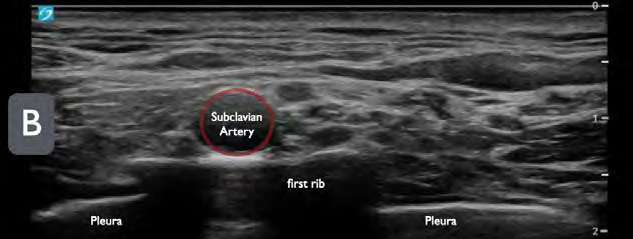
Single-injection, ultrasound-guided, brachial plexus blocks provide targeted analgesia for upper extremity injuries. Specifically, the interscalene block is effective for proximal injuries including the deltoid and shoulder and the supraclavicular block may be ideal for injuries at the elbow or lower.8 The supraclavicular brachial plexus block has a number of advantages including visualization of the brachial plexus, clearly defined ultrasonographic landmarks, and having been used for various arm injuries (from distal humeral injuries to distal radius fractures) in our ED. By delivering sonographically guided anesthesia, we can effectively reduce pain, opioid utilization, and need for procedural sedation.

The following sections outline important clinical anatomy, equipment for the block, and procedural steps that will allow for a successful supraclavicular brachial plexus block.

Indications and Considerations

The supraclavicular brachial plexus block is indicated for anesthesia and analgesia to common ED injuries below the shoulder including but not limited to: deltoid abscess, midshaft and distal humerus fractures, and elbow dislocations. For simplicity we think of the interscalene brachial plexus block for injuries from the proximal shoulder to the distal humerus and the supraclavicular brachial plexus block for injuries beyond the distal humerus.8 The decision to perform a brachial plexus block is a multifactorial decision. The clinician should be aware of the patient’s underlying medical history as well as have clear communication with the other services who may need to be involved in the patient’s care. Also, in our experience, sonoanatomy of the brachial plexus can be varied (both in location and overlying vasculature). Finding the right location (whether supraclavicular or interscalene) or not performing the block will depend on the patient’s underlying sonoanatomy as well as the ability to position an acutely injured patient.

Allergies, overlying infections, and coagulopathy are important contraindications, as with all peripheral nerve blocks.9 There are a few important limitations to the supraclavicular brachial plexus block that should be considered:

Pages: 1 2 3 4 5 | Single Page

Topics: ClinicalImaging & UltrasoundNerve Blocks

Related

  • Non-Invasive Positive Pressure Ventilation in the Emergency Department

    October 1, 2025 - 0 Comment
  • Emergency Department Management of Prehospital Tourniquets

    October 1, 2025 - 0 Comment
  • ACEP’s October 2025 Poll: How Often Do You Read Your Own X-Rays?

    September 30, 2025 - 0 Comment

Current Issue

ACEP Now: November 2025

Download PDF

Read More

No Responses to “How To: The Ultrasound-Guided Supraclavicular Brachial Plexus Block”

Leave a Reply Cancel Reply

Your email address will not be published. Required fields are marked *


*
*


Wiley
  • Home
  • About Us
  • Contact Us
  • Privacy
  • Terms of Use
  • Advertise
  • Cookie Preferences
Copyright © 2025 by John Wiley & Sons, Inc. All rights reserved, including rights for text and data mining and training of artificial technologies or similar technologies. ISSN 2333-2603
