Logo

Log In Sign Up |  An official publication of: American College of Emergency Physicians
Navigation
  • Home
  • Multimedia
    • Podcasts
    • Videos
  • Clinical
    • Airway Managment
    • Case Reports
    • Critical Care
    • Guidelines
    • Imaging & Ultrasound
    • Pain & Palliative Care
    • Pediatrics
    • Resuscitation
    • Trauma & Injury
  • Resource Centers
    • mTBI Resource Center
  • Career
    • Practice Management
      • Benchmarking
      • Reimbursement & Coding
      • Care Team
      • Legal
      • Operations
      • Quality & Safety
    • Awards
    • Certification
    • Compensation
    • Early Career
    • Education
    • Leadership
    • Profiles
    • Retirement
    • Work-Life Balance
  • Columns
    • ACEP4U
    • Airway
    • Benchmarking
    • Brief19
    • By the Numbers
    • Coding Wizard
    • EM Cases
    • End of the Rainbow
    • Equity Equation
    • FACEPs in the Crowd
    • Forensic Facts
    • From the College
    • Images in EM
    • Kids Korner
    • Medicolegal Mind
    • Opinion
      • Break Room
      • New Spin
      • Pro-Con
    • Pearls From EM Literature
    • Policy Rx
    • Practice Changers
    • Problem Solvers
    • Residency Spotlight
    • Resident Voice
    • Skeptics’ Guide to Emergency Medicine
    • Sound Advice
    • Special OPs
    • Toxicology Q&A
    • WorldTravelERs
  • Resources
    • ACEP.org
    • ACEP Knowledge Quiz
    • Issue Archives
    • CME Now
    • Annual Scientific Assembly
      • ACEP14
      • ACEP15
      • ACEP16
      • ACEP17
      • ACEP18
      • ACEP19
    • Annals of Emergency Medicine
    • JACEP Open
    • Emergency Medicine Foundation
  • About
    • Our Mission
    • Medical Editor in Chief
    • Editorial Advisory Board
    • Awards
    • Authors
    • Article Submission
    • Contact Us
    • Advertise
    • Subscribe
    • Privacy Policy
    • Copyright Information

How To Remove Incarcerating Metallic Penile Hardware

By Matthias Barden, MD, FACEP; and Iman Rasheed, MD | on October 25, 2021 | 1 Comment
Tricks of the Trade
  • Tweet
  • Click to email a link to a friend (Opens in new window) Email
Print-Friendly Version
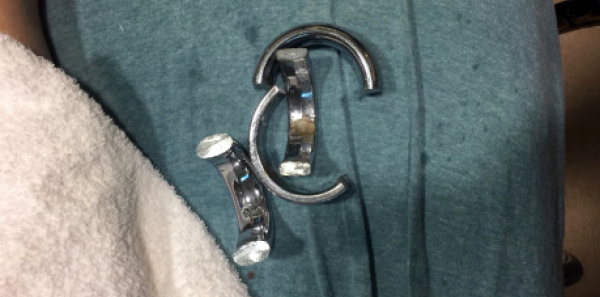
Figure 1: Example of multiple rings removed from a single patient that were too hard and thick for normal ring removal devices.

You Might Also Like
  • Use Bolt Cutters to Remove a Constricted Titanium Ring
  • ‘Home Depot’ Tools Come in Handy
  • Road Map for a Makeshift Tap
Explore This Issue
ACEP Now: Vol 40 – No 10 – October 2021

Figure 1: Example of multiple rings removed from a single patient that were too hard and thick for normal ring removal devices.
Photos: Matthias Barden

The location of our emergency department in the greater Palm Springs, California, area has likely contributed to significant departmental experience with the removal of constrictive metallic penile hardware. This presentation can be quite anxiety-provoking, both for the patient and the clinicians involved. Removing penile hardware is a time-sensitive, appendage-threatening procedure for which the emergency physician may have limited specialist backup.

Standard tools used for digital jewelry removal in the emergency department have often proven insufficient to deal with this particular type of ring (see Figure 1), and more powerful equipment may not be readily available.

An option described previously has been to rely on EMS for additional tools and assistance, such as use of pneumatic saws or grinding tools.1 However, our experience has been that requesting EMS come into the hospital to assist with a procedure has created liability and scope-of-practice concerns.

A better option is making sure the necessary equipment is ready and available for the emergency department to handle this presentation internally. There have been published case reports describing the use of a widely commercially available electric rotary grinding tool (e.g., a Dremel) for similar situations.2 As described, using a power tool in such proximity to an already vascularly compromised penis poses multiple risks and concerns. Here, we describe our tips and tricks based on our multiple experiences with successfully managing these cases in our department.

Suggested Equipment and Process

You will need a rotary grinding tool such as a Dremel, saline drip set for irrigation, face shield to avoid spark injury to the physician, metallic guard such as a foam aluminum splint or forceps split in half, and towels to avoid spark injury to the patient (see Figure 2).
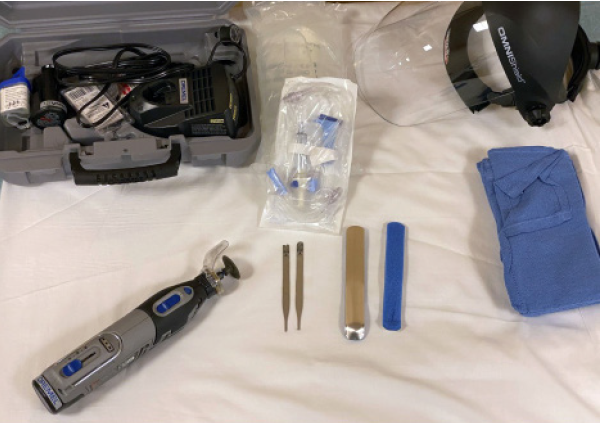
Figure 2: This removal technique requires a rotary grinding tool such as a Dremel, saline drip set for irrigation, face shield to avoid spark injury to the physician, metallic guard such as a foam aluminum splint or forceps split in half, and towels to avoid spark injury to the patient.

Figure 2: This removal technique requires a rotary grinding tool such as a Dremel, saline drip set for irrigation, face shield to avoid spark injury to the physician, metallic guard such as a foam aluminum splint or forceps split in half, and towels to avoid spark injury to the patient.

The patient should be advised of the risks, benefits, and alternatives for the procedure. We have occasionally utilized moderate sedation with patients who are extremely apprehensive or anxious, but in general, it is helpful to have the patient awake so that they may provide feedback on any discomfort that develops during the procedure. Three major risks that must be mitigated include direct injury if the grinder contacts the skin, injury caused by sparks, and burns from heat generated from the grinding that can be conducted through metal rings.

To avoid direct injury, a metal guard should be inserted between the ring and the patient’s skin. A foam aluminum finger splint can be used. If the available foam aluminum splints are too wide or thick to get into this tight space, we have also had success using a standard set of forceps, which can be manually split into two parts, with one half being used as the guard.

Pages: 1 2 3 | Single Page

Topics: Clinicaljewelry removalRing Constriction

Related

  • Non-Invasive Positive Pressure Ventilation in the Emergency Department

    October 1, 2025 - 0 Comment
  • Emergency Department Management of Prehospital Tourniquets

    October 1, 2025 - 0 Comment
  • ACEP’s October 2025 Poll: How Often Do You Read Your Own X-Rays?

    September 30, 2025 - 0 Comment

Current Issue

ACEP Now: November 2025

Download PDF

Read More

One Response to “How To Remove Incarcerating Metallic Penile Hardware”

  1. October 31, 2021

    Sam Grady Reply

    Most people don’t necessarily have access to all those supplies. Instead, use a cast cutter and have cold saline to reduce excessive heating from the cutter.

Leave a Reply Cancel Reply

Your email address will not be published. Required fields are marked *


*
*


Wiley
  • Home
  • About Us
  • Contact Us
  • Privacy
  • Terms of Use
  • Advertise
  • Cookie Preferences
Copyright © 2025 by John Wiley & Sons, Inc. All rights reserved, including rights for text and data mining and training of artificial technologies or similar technologies. ISSN 2333-2603
