Logo

Log In Sign Up |  An official publication of: American College of Emergency Physicians
Navigation
  • Home
  • Multimedia
    • Podcasts
    • Videos
  • Clinical
    • Airway Managment
    • Case Reports
    • Critical Care
    • Guidelines
    • Imaging & Ultrasound
    • Pain & Palliative Care
    • Pediatrics
    • Resuscitation
    • Trauma & Injury
  • Resource Centers
    • mTBI Resource Center
  • Career
    • Practice Management
      • Benchmarking
      • Reimbursement & Coding
      • Care Team
      • Legal
      • Operations
      • Quality & Safety
    • Awards
    • Certification
    • Compensation
    • Early Career
    • Education
    • Leadership
    • Profiles
    • Retirement
    • Work-Life Balance
  • Columns
    • ACEP4U
    • Airway
    • Benchmarking
    • Brief19
    • By the Numbers
    • Coding Wizard
    • EM Cases
    • End of the Rainbow
    • Equity Equation
    • FACEPs in the Crowd
    • Forensic Facts
    • From the College
    • Images in EM
    • Kids Korner
    • Medicolegal Mind
    • Opinion
      • Break Room
      • New Spin
      • Pro-Con
    • Pearls From EM Literature
    • Policy Rx
    • Practice Changers
    • Problem Solvers
    • Residency Spotlight
    • Resident Voice
    • Skeptics’ Guide to Emergency Medicine
    • Sound Advice
    • Special OPs
    • Toxicology Q&A
    • WorldTravelERs
  • Resources
    • ACEP.org
    • ACEP Knowledge Quiz
    • Issue Archives
    • CME Now
    • Annual Scientific Assembly
      • ACEP14
      • ACEP15
      • ACEP16
      • ACEP17
      • ACEP18
      • ACEP19
    • Annals of Emergency Medicine
    • JACEP Open
    • Emergency Medicine Foundation
  • About
    • Our Mission
    • Medical Editor in Chief
    • Editorial Advisory Board
    • Awards
    • Authors
    • Article Submission
    • Contact Us
    • Advertise
    • Subscribe
    • Privacy Policy
    • Copyright Information

How To Prepare for In-Flight Emergencies

By Sophia Görgens, MD, and Amy Faith Ho, MD | on December 9, 2022 | 1 Comment
Features
  • Tweet
  • Click to email a link to a friend (Opens in new window) Email
Print-Friendly Version

You Might Also Like
  • Be Prepared for In-Flight Medical Emergencies
  • A Congressman Responds to In-flight Medical Crisis
  • Be Prepared to Respond to a Mid-Air Health Crisis
Explore This Issue
ACEP Now: Vol 41 – No 12 – December 2022

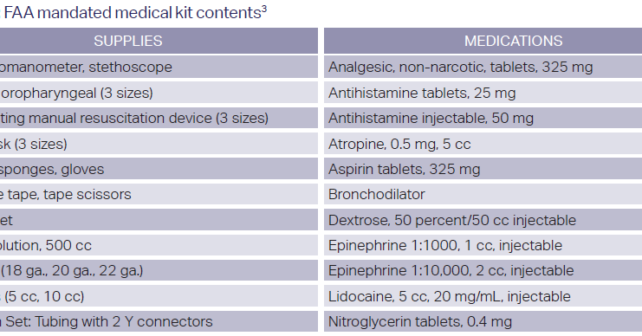
Click to enlarge.

Legal Considerations

On flights within the United States, as a health care professional, you are protected under Good Samaritan laws, meaning that you are not required to assist and if you choose to do so, you are protected from lawsuits (barring gross negligence or willful misconduct).6 This was codified under the Federal Aviation Medical Assistance Act of 1998 and applies to non-U.S. carriers as well.6 However, on international flights, rules and regulations are different and often differ to the country in which the airlines are based or sometimes which countries’ airspace an aircraft is at the time of an event. It’s important to note that some countries, such as Australia, require physicians to help.

Case Resolution

Since there’s no EpiPen auto-injector in the medical kit, you painstakingly draw up the epinephrine into a syringe and inject it into the patient’s thigh. The patient rapidly improves, and after observing him for a little longer, you return to your seat. As a reward, the flight attendant brings you a handful of extra snacks, including a bag of salted cashews. You cringe a little as you wonder: Who else on this flight has an allergy to nuts?


Dr. Görgens is resident fellow of ACEP Now.

Dr. Ho is assistant editor of ACEP Now.

References

  1. Peterson DC, Martin-Gill C, Guyette FX, et al. Outcomes of medical emergencies on commercial airline flights. N Engl J Med. 2013;368(22):2075-2083.
  2. Martin-Gill C, Doyle TJ, Yealy DM. In-Flight medical emergencies: A review. JAMA. 2018;320(24):2580-2590. doi:10.1001/jama.2018.19842
  3. Ballough, JJ. Federal Aviation Administration Advisory Circular 121-33B: Emergency Medical Equipment. https://www.faa.gov/documentLibrary/media/Advisory_Circular/AC121-33B.pdf. Published January 12, 2006. Accessed November 13, 2022.
  4. Aerospace Medical Association Air Transport Medicine Committee. Guidance Document. https://www.asma.org/asma/media/AsMA/Travel-Publications/FAA-med-kit-Guidance-Document-June-2019.pdf. Published June, 2019. Accessed November 13, 2022.
  5. Federal Aviation Administration. Exemption No. 10690J, Regulatory Docket No. FAA-2013-0034, Extension of Exemption. https://www.regulations.gov/document/FAA-2013-0034-0039. Published March 29, 2022. Accessed November 13, 2022.
  6. Family Practice Management editors. How to respond to mid-air medical emergencies. Blog post. https://www.aafp.org/pubs/fpm/blogs/inpractice/entry/good_samaritan.html. Published July 20, 2018. Accessed November 13, 2022.

Pages: 1 2 | Single Page

Topics: Airplane

Related

  • Space Medicine: Emergency Physicians Voyage Into the Final Frontier

    May 2, 2023 - 2 Comments
  • Flying After Concussion May Not Affect Symptoms, Recovery

    January 29, 2021 - 0 Comment
  • Emergency Physician Dr. Bradford Walters on Being First Responder to Northwest Flight 255 Crash

    April 14, 2015 - 0 Comment

Current Issue

ACEP Now: November 2025

Download PDF

Read More

One Response to “How To Prepare for In-Flight Emergencies”

  1. December 18, 2022

    Doron Spierer, MD Reply

    If the airline gives the Physician a gift (credit, miles, or even a bag of salted cashews) after rendering medical aid to a fellow passenger, could this be construed as compensation, thus jeopardizing Good Samaritan status?

Leave a Reply Cancel Reply

Your email address will not be published. Required fields are marked *


*
*


Wiley
  • Home
  • About Us
  • Contact Us
  • Privacy
  • Terms of Use
  • Advertise
  • Cookie Preferences
Copyright © 2025 by John Wiley & Sons, Inc. All rights reserved, including rights for text and data mining and training of artificial technologies or similar technologies. ISSN 2333-2603
