Logo

Log In Sign Up |  An official publication of: American College of Emergency Physicians
Navigation
  • Home
  • Multimedia
    • Podcasts
    • Videos
  • Clinical
    • Airway Managment
    • Case Reports
    • Critical Care
    • Guidelines
    • Imaging & Ultrasound
    • Pain & Palliative Care
    • Pediatrics
    • Resuscitation
    • Trauma & Injury
  • Resource Centers
    • mTBI Resource Center
  • Career
    • Practice Management
      • Benchmarking
      • Reimbursement & Coding
      • Care Team
      • Legal
      • Operations
      • Quality & Safety
    • Awards
    • Certification
    • Compensation
    • Early Career
    • Education
    • Leadership
    • Profiles
    • Retirement
    • Work-Life Balance
  • Columns
    • ACEP4U
    • Airway
    • Benchmarking
    • Brief19
    • By the Numbers
    • Coding Wizard
    • EM Cases
    • End of the Rainbow
    • Equity Equation
    • FACEPs in the Crowd
    • Forensic Facts
    • From the College
    • Images in EM
    • Kids Korner
    • Medicolegal Mind
    • Opinion
      • Break Room
      • New Spin
      • Pro-Con
    • Pearls From EM Literature
    • Policy Rx
    • Practice Changers
    • Problem Solvers
    • Residency Spotlight
    • Resident Voice
    • Skeptics’ Guide to Emergency Medicine
    • Sound Advice
    • Special OPs
    • Toxicology Q&A
    • WorldTravelERs
  • Resources
    • ACEP.org
    • ACEP Knowledge Quiz
    • Issue Archives
    • CME Now
    • Annual Scientific Assembly
      • ACEP14
      • ACEP15
      • ACEP16
      • ACEP17
      • ACEP18
      • ACEP19
    • Annals of Emergency Medicine
    • JACEP Open
    • Emergency Medicine Foundation
  • About
    • Our Mission
    • Medical Editor in Chief
    • Editorial Advisory Board
    • Awards
    • Authors
    • Article Submission
    • Contact Us
    • Advertise
    • Subscribe
    • Privacy Policy
    • Copyright Information

How to Perform Ultrasound-Guided Knee Arthrocentesis

By Brian Johnson, MD, MPH, Emily Lovallo, MD, Daniel Mantuani, MD, MPH, and Arun Nagdev, MD | on August 13, 2015 | 1 Comment
Sound Advice
  • Tweet
  • Click to email a link to a friend (Opens in new window) Email
Print-Friendly Version
How to Perform Ultrasound-Guided Knee Arthrocentesis
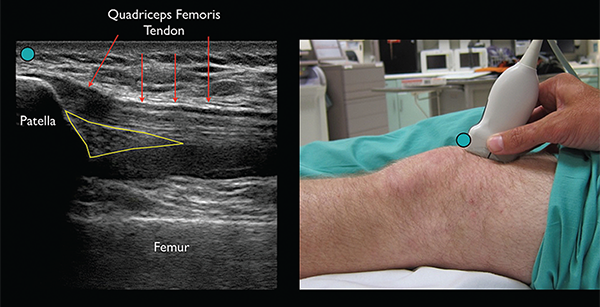
Figure 2. Identify the patella and then slide the transducer cephalad until the approach ultrasound landmarks, including the patella, femur, quadriceps femoris tendon, and fat pad, are appreciated. The effusion will appear as an anechoic (black) space underneath the fat pad. (Green circle indicates ultrasound transducer directional marker.)

You Might Also Like
  • Ultrasound-Guided Elbow Arthrocentesis
  • How to Perform Ultrasound-Guided Forearm Nerve Blocks to Provide Non-Drug Pain Relief for Acute Injuries
  • How To Perform an Ultrasound-Guided TAP Block for Appendicitis Pain
Explore This Issue
ACEP Now: Vol 34 – No 08 – August 2015

(Click for larger image)
Figure 2. Identify the patella and then slide the transducer cephalad until the approach ultrasound landmarks, including the patella, femur, quadriceps femoris tendon, and fat pad, are appreciated. The effusion will appear as an anechoic (black) space underneath the fat pad. (Green circle indicates ultrasound transducer directional marker.) Credit: Arun Nagdev

Ultrasound-Guided Knee Arthrocentesis
Materials:

  1. Sterile ultrasound sheath and gel
  2. 18g 1.5 needle attached to a 5–10 mL syringe
  3. Chlorhexidine
  4. Sterile drape
  5. Sterile gloves
  6. 30 g tuberculin syringe filled with 1–2% lidocaine or ethyl chloride spray

*Pictures are for educational purposes, and sterile precautions (sterile probe cover, gloves, drapes, etc.) should be used for all joint aspirations.
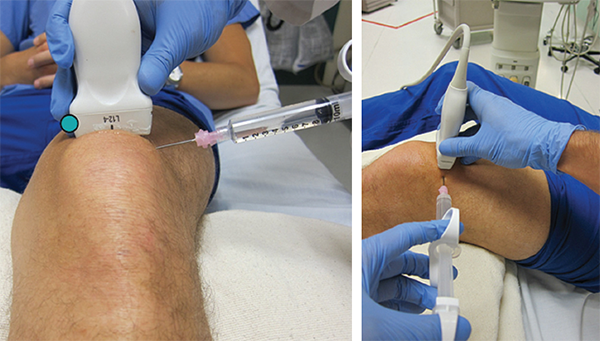
Figure 3. Rotate the probe marker to the patient’s right in order to visualize a transverse view of the prepatellar space with the effusion.

(Click for larger image)
Figure 3. Rotate the probe marker to the patient’s right in order to visualize a transverse view of the prepatellar space with the effusion. Credit: Arun Nagdev

Joint aspiration:

For ultrasound-guided arthrocentesis, we recommend a lateral to medial in-plane technique. With the linear probe in the prepatellar fossa, rotate the probe marker (clockwise) to the patient’s right to obtain a transverse view of the prepatellar space (see Figure 3). A large area around the suprapatellar space should be cleaned and draped in a sterile manner. The ultrasound transducer should be placed in a sterile sheath and then on the sterile field. The ultrasound system should be positioned opposite to the provider so the screen is in the direct line of sight. Using a 10 mL syringe attached to a standard 18g needle, enter the skin in plane and just lateral to the probe at a shallow angle (see Figure 4). The needle will traverse between the iliotibial band (superiorly) and vastus lateralis (inferiorly) without risk for vascular puncture. Clear needle visualization can be achieved by slowly advancing just under the transducer. Gentle aspiration of synovial fluid with needle tip being visualized within the fluid collection will confirm violation of the joint space.
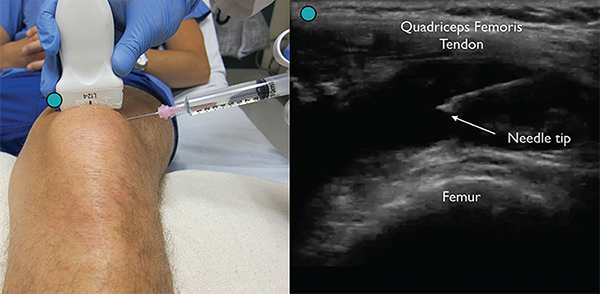
Figure 4. Enter the skin lateral to the probe using an 18g needle attached to a syringe for an in-plane arthrocentesis while visualizing the needle tip.

(Click for larger image)
Figure 4. Enter the skin lateral to the probe using an 18g needle attached to a syringe for an in-plane arthrocentesis while visualizing the needle tip. Credit: Arun Nagdev

Summary

Point-of-care ultrasound can be a useful adjunct in the evaluation of the patient with a swollen, painful knee. Ultrasound can identify a suspected knee effusion as well as assist with arthrocentesis. A simplified in-plane technique can easily be incorporated into the evaluation of the patient with a suspected septic knee.

Pages: 1 2 3 | Single Page

Topics: Imaging & UltrasoundMusculoskeletalProcedures and Skills

Related

  • ACEP’s October 2025 Poll: How Often Do You Read Your Own X-Rays?

    September 30, 2025 - 0 Comment
  • Nail Bed Injuries: What to Do—or Not to Do

    August 18, 2025 - 0 Comment
  • 10 Essentials for Your Emergency Department Fanny Pack

    June 17, 2025 - 0 Comment

Current Issue

ACEP Now: November 2025

Download PDF

Read More

One Response to “How to Perform Ultrasound-Guided Knee Arthrocentesis”

  1. September 30, 2018

    Cassandra Reply

    Is ultrasound injection good for ten knee after a keyhole surgery? I had this surgery for sometimes ago and now my left is severe with pain and decided to go for the ultrasound injection.. I had this injection on my shoulder and is good. I had it twice and never back again.So thinking of having one on my knee. Can you
    Advise please thanks.

Leave a Reply Cancel Reply

Your email address will not be published. Required fields are marked *


*
*


Wiley
  • Home
  • About Us
  • Contact Us
  • Privacy
  • Terms of Use
  • Advertise
  • Cookie Preferences
Copyright © 2025 by John Wiley & Sons, Inc. All rights reserved, including rights for text and data mining and training of artificial technologies or similar technologies. ISSN 2333-2603
