Logo

Log In Sign Up |  An official publication of: American College of Emergency Physicians
Navigation
  • Home
  • Multimedia
    • Podcasts
    • Videos
  • Clinical
    • Airway Managment
    • Case Reports
    • Critical Care
    • Guidelines
    • Imaging & Ultrasound
    • Pain & Palliative Care
    • Pediatrics
    • Resuscitation
    • Trauma & Injury
  • Resource Centers
    • mTBI Resource Center
  • Career
    • Practice Management
      • Benchmarking
      • Reimbursement & Coding
      • Care Team
      • Legal
      • Operations
      • Quality & Safety
    • Awards
    • Certification
    • Compensation
    • Early Career
    • Education
    • Leadership
    • Profiles
    • Retirement
    • Work-Life Balance
  • Columns
    • ACEP4U
    • Airway
    • Benchmarking
    • Brief19
    • By the Numbers
    • Coding Wizard
    • EM Cases
    • End of the Rainbow
    • Equity Equation
    • FACEPs in the Crowd
    • Forensic Facts
    • From the College
    • Images in EM
    • Kids Korner
    • Medicolegal Mind
    • Opinion
      • Break Room
      • New Spin
      • Pro-Con
    • Pearls From EM Literature
    • Policy Rx
    • Practice Changers
    • Problem Solvers
    • Residency Spotlight
    • Resident Voice
    • Skeptics’ Guide to Emergency Medicine
    • Sound Advice
    • Special OPs
    • Toxicology Q&A
    • WorldTravelERs
  • Resources
    • ACEP.org
    • ACEP Knowledge Quiz
    • Issue Archives
    • CME Now
    • Annual Scientific Assembly
      • ACEP14
      • ACEP15
      • ACEP16
      • ACEP17
      • ACEP18
      • ACEP19
    • Annals of Emergency Medicine
    • JACEP Open
    • Emergency Medicine Foundation
  • About
    • Our Mission
    • Medical Editor in Chief
    • Editorial Advisory Board
    • Awards
    • Authors
    • Article Submission
    • Contact Us
    • Advertise
    • Subscribe
    • Privacy Policy
    • Copyright Information

How to Perform Ultrasound-Guided Interscalene Nerve Blocks

By Arun Nagdev, MD; Graham Becherer-Bailey, DO; Rob Farrow, DO; and Daniel Mantuani, MD, MPH | on April 14, 2020 | 1 Comment
Sound Advice
  • Tweet
  • Click to email a link to a friend (Opens in new window) Email
Print-Friendly Version
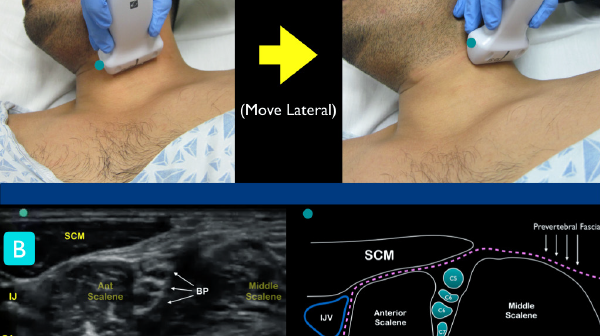
Figure 1 Figure 1A: Classic technique for locating the interscalene brachial plexus. At the level of the larynx, slide lateral until the ultrasound landmarks are noted Figure 1B: Just under the sternocleidomastoid muscle (SCM), locate the anterior and middle scalene muscles. The interscalene groove will contain the nerve roots of the brachial plexus. Note the internal jugular vein (IJV) and carotid artery (CA) on the medial aspect of the anterior scalene muscle.
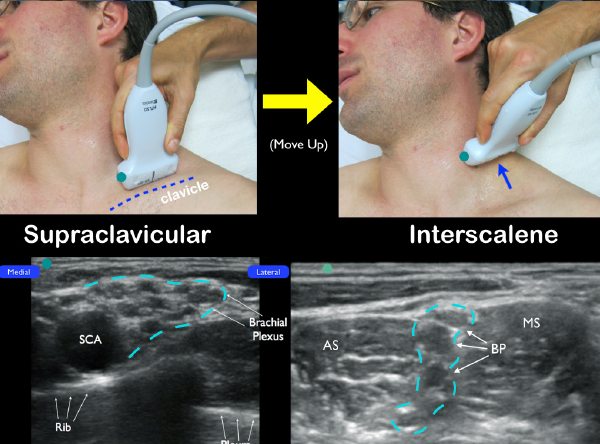
Figure 2 An alternative technique to locate the interscalane brachial plexus. Start with the transducer in the supraclavicular fossa. Locate the subclavian artery (SCA) in cross-section and note the brachial plexus just lateral (dotted blue line). Slide up the neck until the interscalene brachial plexus (BP) is located in between the anterior scalene (AS) and middle scalene (MS) muscles.

You Might Also Like
  • How to Implement Ultrasound-Guided Nerve Blocks in Your ED
  • Ultrasound-Guided Interscalene Approach To the Brachial Plexus Nerve Block
  • How to Perform Ultrasound-Guided Forearm Nerve Blocks to Provide Non-Drug Pain Relief for Acute Injuries
Explore This Issue
ACEP Now: Vol 39 – No 04 – April 2020

Figure 2
An alternative technique to locate the interscalane brachial plexus. Start with the transducer in the supraclavicular fossa. Locate the subclavian artery (SCA) in cross-section and note the brachial plexus just lateral (dotted blue line). Slide up the neck until the interscalene brachial plexus (BP) is located in between the anterior scalene (AS) and middle scalene (MS) muscles.
PHOTOS: Arun Nagdev

2) A fascial landmark to improve safety: Get anesthetic under the prevertebral fascia.

When performing ultrasound-guided femoral nerve blocks, we recommend depositing anesthetic under the fascia iliaca (lateral to the femoral nerve) to improve success. This target allows the clinician to enter far away from the nerve bundle, inject normal saline for hydrodissection, and then gently deposit anesthetic. This “stay away” approach has been our standard teaching technique (if possible) for all ultrasound-guided nerve blocks. Similarly, when performing the ultrasound-guided ISNB, the prevertebral fascia can act as an ideal sonographic landmark. This fascial plane lies on top of both the middle and anterior scalene muscles and allows the clinician a target that is far from the brachial plexus nerve roots (see Figures 3 and 4). With this ultrasound landmark in view, the clinician can come from a lateral to medial in-plane approach, then deposit anechoic normal saline (for hydrodissection) under the prevertebral fascia (far away from the interscalene brachial plexus). After getting under the fascial plane and visualizing fluid track down into the interscalene groove, anesthetic can safely be placed in the fluid-filled potential space (see Figures 5 and 6). In our opinion, placing the needle tip directly into the interscalene groove and between the nerve roots is not advisable, and it may lead to unwanted intraneural injections.
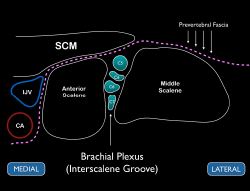
Figure 3 Schematic representation of the interscalene brachial plexus. Note the prevertebral fascia located above the middle and anterior scalene muscles.
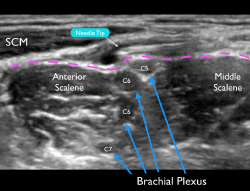
Figure 3
Schematic representation of the interscalene brachial plexus. Note the prevertebral fascia located above the middle and anterior scalene muscles.

Figure 4 Ultrasound image of a failed block. Note that the needle tip is above the prevertebral fascia (pink dotted line). A small amount of anechoic anesthetic can be noted deposited above this important sonographic landmark.
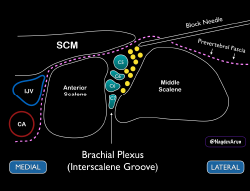
Figure 4
Ultrasound image of a failed block. Note that the needle tip is above the prevertebral fascia (pink dotted line). A small amount of anechoic anesthetic can be noted deposited above this important sonographic landmark.

Figure 5 Schematic of how the needle tip should be placed just under the prevertebral fascia (and away from the roots of the brachial plexus).
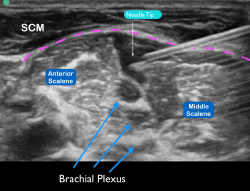
Figure 5
Schematic of how the needle tip should be placed just under the prevertebral fascia (and away from the roots of the brachial plexus).

Figure 6 Ultrasound image of the needle tip under the prevertebral fascia (pink dotted line) with anechoic anesthetic deposited near the interscalene brachial plexus.

Figure 6
Ultrasound image of the needle tip under the prevertebral fascia (pink dotted line) with anechoic anesthetic deposited near the interscalene brachial plexus.

Pages: 1 2 3 | Single Page

Topics: Imaging & UltrasoundNerve Blocks

Related

  • ACEP’s October 2025 Poll: How Often Do You Read Your Own X-Rays?

    September 30, 2025 - 0 Comment
  • Case Report: Rapid Diagnosis of Acute Aortic Dissection with POCUS

    June 11, 2025 - 1 Comment
  • How Well Does Ultrasound Detect Volvulus in Infants?

    September 5, 2024 - 0 Comment

Current Issue

ACEP Now: November 2025

Download PDF

Read More

One Response to “How to Perform Ultrasound-Guided Interscalene Nerve Blocks”

  1. May 6, 2020

    Vir Singh Reply

    Excited to implement this in my practice and share this with my residency program

Leave a Reply Cancel Reply

Your email address will not be published. Required fields are marked *


*
*


Wiley
  • Home
  • About Us
  • Contact Us
  • Privacy
  • Terms of Use
  • Advertise
  • Cookie Preferences
Copyright © 2025 by John Wiley & Sons, Inc. All rights reserved, including rights for text and data mining and training of artificial technologies or similar technologies. ISSN 2333-2603