Logo

Log In Sign Up |  An official publication of: American College of Emergency Physicians
Navigation
  • Home
  • Multimedia
    • Podcasts
    • Videos
  • Clinical
    • Airway Managment
    • Case Reports
    • Critical Care
    • Guidelines
    • Imaging & Ultrasound
    • Pain & Palliative Care
    • Pediatrics
    • Resuscitation
    • Trauma & Injury
  • Resource Centers
    • mTBI Resource Center
  • Career
    • Practice Management
      • Benchmarking
      • Reimbursement & Coding
      • Care Team
      • Legal
      • Operations
      • Quality & Safety
    • Awards
    • Certification
    • Compensation
    • Early Career
    • Education
    • Leadership
    • Profiles
    • Retirement
    • Work-Life Balance
  • Columns
    • ACEP4U
    • Airway
    • Benchmarking
    • Brief19
    • By the Numbers
    • Coding Wizard
    • EM Cases
    • End of the Rainbow
    • Equity Equation
    • FACEPs in the Crowd
    • Forensic Facts
    • From the College
    • Images in EM
    • Kids Korner
    • Medicolegal Mind
    • Opinion
      • Break Room
      • New Spin
      • Pro-Con
    • Pearls From EM Literature
    • Policy Rx
    • Practice Changers
    • Problem Solvers
    • Residency Spotlight
    • Resident Voice
    • Skeptics’ Guide to Emergency Medicine
    • Sound Advice
    • Special OPs
    • Toxicology Q&A
    • WorldTravelERs
  • Resources
    • ACEP.org
    • ACEP Knowledge Quiz
    • Issue Archives
    • CME Now
    • Annual Scientific Assembly
      • ACEP14
      • ACEP15
      • ACEP16
      • ACEP17
      • ACEP18
      • ACEP19
    • Annals of Emergency Medicine
    • JACEP Open
    • Emergency Medicine Foundation
  • About
    • Our Mission
    • Medical Editor in Chief
    • Editorial Advisory Board
    • Awards
    • Authors
    • Article Submission
    • Contact Us
    • Advertise
    • Subscribe
    • Privacy Policy
    • Copyright Information

How to Perform an Adductor Canal Nerve Block

By Peter E. Croft, MD; and David Mackenzie, MDCM, FACEP, FRCPC | on August 21, 2020 | 0 Comment
Features
  • Tweet
  • Click to email a link to a friend (Opens in new window) Email
Print-Friendly Version
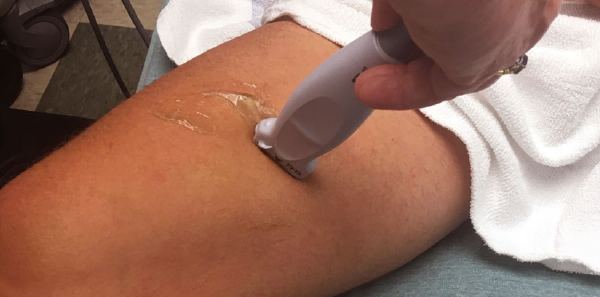
Figure 1: Positioning the patient in a “frog-leg” orientation allows for easy access to the adductor canal.

Technique

Pre-Block Assessment: As with any nerve block, assess for distal motor and sensory function along with a distal pulse check.

You Might Also Like
  • Avoid These Two Common Femoral Nerve-Block Errors
  • Ultrasound-Guided Posterior Tibial Nerve Block
  • How to Perform Ultrasound-Guided Distal Sciatic Nerve Block in the Popliteal Fossa
Explore This Issue
ACEP Now: Vol 39 – No 08 – August 2020

Patient Positioning: Patient positioning for the adductor canal is relatively easy compared to the ergonomic challenges of some other blocks. Place the patient in a “frog-leg” position (see Figure 1), with the machine on the side of the affected leg and the proceduralist on the opposite side of the bed. (As with any bedside ultrasound procedure, position the machine on the opposite side of the bed from the side of the procedure. This allows a clinician to observe the ultrasound screen comfortably.) While local anesthetic systemic toxicity is rare, cardiac monitoring is technically considered a best practice.1
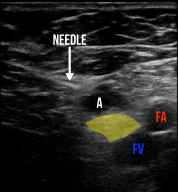
Figure 5: The hyperechoic needle is positioned correctly as the operator administers local anesthetic (A) just above the saphenous nerve (yellow). This in-plane approach provides better visualization of the needle during the procedure.

Figure 5: The hyperechoic needle is positioned correctly as the operator administers local anesthetic (A) just above the saphenous nerve (yellow). This in-plane approach provides better visualization of the needle during the procedure.

Ultrasound Landmarks: Position the probe in transverse at the junction between the middle and distal third of the anteromedial thigh. Identify the femoral artery in this area and direct attention to the superomedial aspect of the artery (see Figure 2), which is where the saphenous nerve passes deep to the sartorius muscle. Do not expect the nerve to appear perfectly circular in this region (see Figure 3). Rely on the anatomical consistency that the saphenous nerve will run with the neurovascular bundle of the distal femoral artery and vein in this fascial plane (see Figure 4). Once anesthetic is placed superomedially to the femoral artery and deep to the posterior fascia of the sartorius muscle, the saphenous nerve will become more visible as a result of hydrodissection.

Performing the Block: Using an in-plane approach, direct the needle toward the plane of the vascular bundle while maintaining visualization of the needle tip (see Figure 5). Once the needle pierces through the posterior fascia of the sartorius muscle (you may feel a popping sensation), administer anesthetic. If injected at the correct location, hydrodissection will occur, which, as noted above, often allows for better identification of the nerve. The anesthetic will bathe and envelop the nerve bundle. Avoid injecting directly into the nerve so as to avoid potential nerve injury.

Summary

The adductor canal block is a useful nerve block to facilitate the management of lower extremity soft tissue injuries or infections in the emergency department. It is a valuable addition to other peripheral nerve blocks used commonly by emergency clinicians.

Pages: 1 2 3 | Single Page

Topics: Imaging & UltrasoundNerve BlocksPain and Palliative CareUltrasoundUltrasound-Guided Nerve Block

Related

  • ACEP’s October 2025 Poll: How Often Do You Read Your Own X-Rays?

    September 30, 2025 - 0 Comment
  • Case Report: Rare Pulmonary Embolism After Routine PIVC Insertion

    September 22, 2025 - 1 Comment
  • 10 Essentials for Your Emergency Department Fanny Pack

    June 17, 2025 - 0 Comment

Current Issue

ACEP Now: November 2025

Download PDF

Read More

No Responses to “How to Perform an Adductor Canal Nerve Block”

Leave a Reply Cancel Reply

Your email address will not be published. Required fields are marked *


*
*


Wiley
  • Home
  • About Us
  • Contact Us
  • Privacy
  • Terms of Use
  • Advertise
  • Cookie Preferences
Copyright © 2025 by John Wiley & Sons, Inc. All rights reserved, including rights for text and data mining and training of artificial technologies or similar technologies. ISSN 2333-2603
