Logo

Log In Sign Up |  An official publication of: American College of Emergency Physicians
Navigation
  • Home
  • Multimedia
    • Podcasts
    • Videos
  • Clinical
    • Airway Managment
    • Case Reports
    • Critical Care
    • Guidelines
    • Imaging & Ultrasound
    • Pain & Palliative Care
    • Pediatrics
    • Resuscitation
    • Trauma & Injury
  • Resource Centers
    • mTBI Resource Center
  • Career
    • Practice Management
      • Benchmarking
      • Reimbursement & Coding
      • Care Team
      • Legal
      • Operations
      • Quality & Safety
    • Awards
    • Certification
    • Compensation
    • Early Career
    • Education
    • Leadership
    • Profiles
    • Retirement
    • Work-Life Balance
  • Columns
    • ACEP4U
    • Airway
    • Benchmarking
    • Brief19
    • By the Numbers
    • Coding Wizard
    • EM Cases
    • End of the Rainbow
    • Equity Equation
    • FACEPs in the Crowd
    • Forensic Facts
    • From the College
    • Images in EM
    • Kids Korner
    • Medicolegal Mind
    • Opinion
      • Break Room
      • New Spin
      • Pro-Con
    • Pearls From EM Literature
    • Policy Rx
    • Practice Changers
    • Problem Solvers
    • Residency Spotlight
    • Resident Voice
    • Skeptics’ Guide to Emergency Medicine
    • Sound Advice
    • Special OPs
    • Toxicology Q&A
    • WorldTravelERs
  • Resources
    • ACEP.org
    • ACEP Knowledge Quiz
    • Issue Archives
    • CME Now
    • Annual Scientific Assembly
      • ACEP14
      • ACEP15
      • ACEP16
      • ACEP17
      • ACEP18
      • ACEP19
    • Annals of Emergency Medicine
    • JACEP Open
    • Emergency Medicine Foundation
  • About
    • Our Mission
    • Medical Editor in Chief
    • Editorial Advisory Board
    • Awards
    • Authors
    • Article Submission
    • Contact Us
    • Advertise
    • Subscribe
    • Privacy Policy
    • Copyright Information

How to Intubate Suspected COVID-19 Patients With a Protective Box

By David C. Weech DO, MBA; and John Ashurst DO, MSc, FACEP, FACOEP | on May 19, 2020 | 0 Comment
Features
  • Tweet
  • Click to email a link to a friend (Opens in new window) Email
Print-Friendly Version
PHOTOS: David Weech & John Ashurst

Procedure

PHOTOS: David Weech & John Ashurst

You Might Also Like
  • COVID-19 Lessons Learned by an Emergency Physician in New York City
  • Survey Shows Financial Impact of COVID-19 on Practices and Physicians
  • ACEP Virtual Hill Day Focuses on COVID-19 Response
Explore This Issue
ACEP Now: Vol 39 – No 05 – May 2020

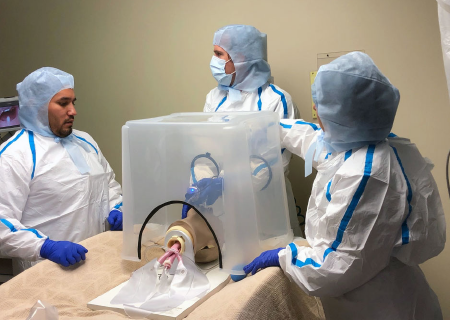
Figure 2: Simulated COVID-19 intubation process with protective intubation box.
PHOTOS: David Weech & John Ashurst

Rapid sequence induction medications are administered. The physician then utilizes the two holes to intubate the patient as routinely done (see Figure 2). Once the tube is placed, the stylet is removed and the tube is then clamped with the large forceps, followed by insufflation of the cuff. The options at this point are to remove the intubation box completely as the system is closed or to proceed with the box in place. If the box is kept in place, the nurse passes the ventilator tubing through the caudal aspect of the box and holds the tube in place while a respiratory therapist works through the two primary operator holes to attach the endotracheal tube securing device.

The intubation team then stays in the room for one complete cycle of ambient air, according to local specifications. All necessary related procedures likely to be needed in the near future should be performed at this time to preserve PPE. These may include placement of nasogastric tubes, central lines, arterial lines, chest tubes, etc. The team then moves to the anteroom to doff PPE. This process should be done in a systematic manner: Remove of Tyvek gown and first set of gloves; perform hand hygiene with hand sanitizer; remove the white coverall, boot cover, and second pair of gloves; hand hygiene; place a new set of gloves to remove head covers (including N95); remove of the final pair of gloves; and hand hygiene for a third time. The team may then return to regular duties in the department. Once the patient is transported out of the emergency department, the drapes on the intubation box are discarded. The box is then wiped down with appropriate disinfectant to be reused after the time frame specified by the manufacturer of the disinfectant.

Conclusion

While this rigorous process may seem excessive, we suggest it out of recognition of the severity of the situation we face today. The possibility of losing critical health care workers and medical personnel if they are inadvertently or carelessly exposed to SARS-CoV-2 is far too great to ignore. Emergency departments are among the most critical resources of the health care system. If proper protective measures such as those suggested here are not taken, our ability to save the most lives and to keep the largest number of people healthy will be compromised.

Pages: 1 2 3 | Single Page

Topics: coronavirusCOVID-19IntubationPPE

Related

  • Why the Nonrebreather Should be Abandoned

    December 3, 2025 - 0 Comment
  • Non-Invasive Positive Pressure Ventilation in the Emergency Department

    October 1, 2025 - 0 Comment
  • ACEP Member Uses ED, Military Training To Set Standards at FEMA

    August 11, 2025 - 0 Comment

Current Issue

ACEP Now: November 2025

Download PDF

Read More

No Responses to “How to Intubate Suspected COVID-19 Patients With a Protective Box”

Leave a Reply Cancel Reply

Your email address will not be published. Required fields are marked *


*
*


Wiley
  • Home
  • About Us
  • Contact Us
  • Privacy
  • Terms of Use
  • Advertise
  • Cookie Preferences
Copyright © 2025 by John Wiley & Sons, Inc. All rights reserved, including rights for text and data mining and training of artificial technologies or similar technologies. ISSN 2333-2603