Logo

Log In Sign Up |  An official publication of: American College of Emergency Physicians
Navigation
  • Home
  • Multimedia
    • Podcasts
    • Videos
  • Clinical
    • Airway Managment
    • Case Reports
    • Critical Care
    • Guidelines
    • Imaging & Ultrasound
    • Pain & Palliative Care
    • Pediatrics
    • Resuscitation
    • Trauma & Injury
  • Resource Centers
    • mTBI Resource Center
  • Career
    • Practice Management
      • Benchmarking
      • Reimbursement & Coding
      • Care Team
      • Legal
      • Operations
      • Quality & Safety
    • Awards
    • Certification
    • Compensation
    • Early Career
    • Education
    • Leadership
    • Profiles
    • Retirement
    • Work-Life Balance
  • Columns
    • ACEP4U
    • Airway
    • Benchmarking
    • Brief19
    • By the Numbers
    • Coding Wizard
    • EM Cases
    • End of the Rainbow
    • Equity Equation
    • FACEPs in the Crowd
    • Forensic Facts
    • From the College
    • Images in EM
    • Kids Korner
    • Medicolegal Mind
    • Opinion
      • Break Room
      • New Spin
      • Pro-Con
    • Pearls From EM Literature
    • Policy Rx
    • Practice Changers
    • Problem Solvers
    • Residency Spotlight
    • Resident Voice
    • Skeptics’ Guide to Emergency Medicine
    • Sound Advice
    • Special OPs
    • Toxicology Q&A
    • WorldTravelERs
  • Resources
    • ACEP.org
    • ACEP Knowledge Quiz
    • Issue Archives
    • CME Now
    • Annual Scientific Assembly
      • ACEP14
      • ACEP15
      • ACEP16
      • ACEP17
      • ACEP18
      • ACEP19
    • Annals of Emergency Medicine
    • JACEP Open
    • Emergency Medicine Foundation
  • About
    • Our Mission
    • Medical Editor in Chief
    • Editorial Advisory Board
    • Awards
    • Authors
    • Article Submission
    • Contact Us
    • Advertise
    • Subscribe
    • Privacy Policy
    • Copyright Information

How to Effectively Block an Acutely Fractured Distal Radius

By Josh Luftig, PA; Daniel Mantuani, MD; and Arun Nagdev, MD | on October 16, 2018 | 2 Comments
Sound Advice
  • Tweet
  • Click to email a link to a friend (Opens in new window) Email
Print-Friendly Version

Survey scan: Place a high-frequency linear transducer in the infraclavicular region with the cephalad portion of the probe resting on the medial portion of the clavicle (see Figure 3A). The transducer should be in parasagittal orientation with the probe marker facing cephalad. Slide the transducer laterally along the inferior portion of the clavicle (see Figure 3B). While sliding laterally, sonographically visualize the axillary artery in cross section as it emerges from under the clavicle (see Figure 3C), traverses the second rib, then courses away from the thoracic cage, appearing on ultrasound to be moving farther and farther from the clavicle. Fix the probe at the position where the axillary artery is 2–3 cm from the clavicle on the ultrasound (see Figure 3D). At this location, rotate the probe slightly to aim towards the axilla and identify the injection target, which lies just posterior to the artery.

You Might Also Like
  • Pain Control Using Ultrasound-Guided Superficial Cervical Plexus Block
  • How to Perform Ultrasound-Guided Distal Sciatic Nerve Block in the Popliteal Fossa
  • Ultrasound-Guided Posterior Tibial Nerve Block
Explore This Issue
ACEP Now: Vol 37 – No 10 – October 2018
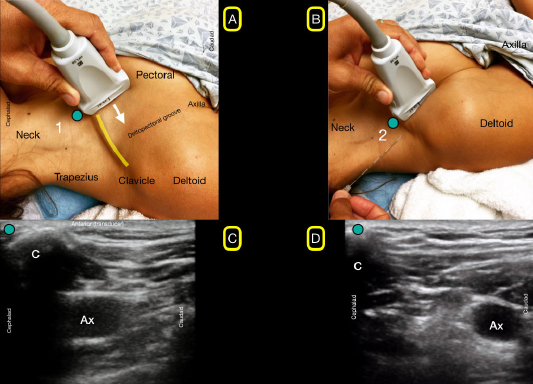
Figure 3A: The ultrasound probe is placed in the initial position (1) with the probe marker facing cephalad. 3B: Slide the ultrasound transducer along the inferior aspect of the clavicle until close to the deltopectoral groove (2). 3C: Note that in the initial position (1) the axillary artery (Ax) may be visible just under the clavicle (C). 3D: In the second position (2), the axillary artery (Ax) is visible and away from the pleura.

Figure 3A: The ultrasound probe is placed in the initial position (1) with the probe marker facing cephalad. 3B: Slide the ultrasound transducer along the inferior aspect of the clavicle until close to the deltopectoral groove (2). 3C: Note that in the initial position (1) the axillary artery (Ax) may be visible just under the clavicle (C). 3D: In the second position (2), the axillary artery (Ax) is visible and away from the pleura.
Credit: Luftig, Mantuani, Nagdev

Anesthetic: For a 70 kg patient, use 35–40 mL of 0.25% bupivacaine, 0.5% ropivacaine, or 1% lidocaine with epinephrine. Always adhere to weight-based local anesthetic dosing guidelines.

Needle type: Use a Tuohy 20g, 90 mm epidural needle (block needle) and a 25–27g hypodermic needle (for the local anesthetic skin wheal needle).

Injection setup: We commonly use a two-person technique to perform this block. One operator is advancing the needle under ultrasound visualization with the second operator slowly injecting the anesthetic while frequently aspirating to prevent inadvertent vascular puncture.

Injection: The primary challenge of the RAPTIR is passing the block needle through the “blind zone” created by the acoustic shadow of the clavicle during the initial portion of needle insertion. Keeping the transducer fixed over the injection target and aligned aiming towards the axilla, identify a block needle insertion site aligned with the long axis of the ultrasound beam and approximately 2 cm cephalad to the clavicle (see Figure 4A). This will ensure a safe needle path and allow adequate room for the needle to clear the posterior surface of the clavicle without angling posteriorly. Probing the insertion site with a gloved finger and seeing transmitted tissue motion on the ultrasound view help the operator get a feel for the needle insertion path and help determine if the insertion site is posterior enough to clear the clavicle.

Pages: 1 2 3 4 5 | Single Page

Topics: Emergency UltrasoundPain & Palliative CareUltrasoundUltrasound-Guided Nerve Block

Related

  • Case Report: Rare Pulmonary Embolism After Routine PIVC Insertion

    September 22, 2025 - 1 Comment
  • 10 Essentials for Your Emergency Department Fanny Pack

    June 17, 2025 - 0 Comment
  • Case Report: Rapid Diagnosis of Acute Aortic Dissection with POCUS

    June 11, 2025 - 1 Comment

Current Issue

ACEP Now: November 2025

Download PDF

Read More

2 Responses to “How to Effectively Block an Acutely Fractured Distal Radius”

  1. November 4, 2018

    Mark Bailey Reply

    Nice if the ED MD can have a specialist come down. Too much time wasted for a real ED.

  2. November 4, 2018

    Michael Anthony Macias Reply

    Love this block and looking forward to incorporating into my practice though probably should reserve for more complex injuries as majority of distal radius fractures are easily reduced comfortably with a simple hematoma block.

Leave a Reply Cancel Reply

Your email address will not be published. Required fields are marked *


*
*


Wiley
  • Home
  • About Us
  • Contact Us
  • Privacy
  • Terms of Use
  • Advertise
  • Cookie Preferences
Copyright © 2025 by John Wiley & Sons, Inc. All rights reserved, including rights for text and data mining and training of artificial technologies or similar technologies. ISSN 2333-2603
