
Explore This Issue
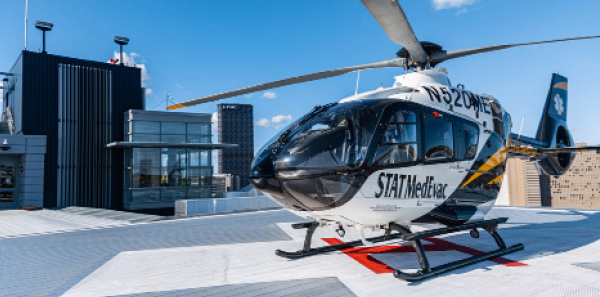
ACEP Now: Vol 40 – No 12 – December 2021EC-135 on top of the University of Pittsburgh Medical Center Mercy Hospital helipad.
Clinical Care
Aerosolizing Procedures
Aerosolizing procedures such as intubation, nebulized medications, and noninvasive ventilation (NIV) create the highest risk of virus transmission. Additionally, certain emergent procedures (needle decompression) carry some risk. We limit aerosolizing procedures in the aircraft, performing them prior to transport when possible. We use video laryngoscopy to optimize first-pass success and reduce exposure time. During NIV, we place in-line HEPA filtration and use nonvented masks while monitoring and minimizing leaks. Nebulization and high-flow nasal cannula (HFNC) were initially used on a limited basis; however, more recently with improved protection assurance through PPE and vaccinations, utilization has increased. These interventions have been provided for COVID-19 and other patients, using the highest-level PPE.
Oxygen Consumption
COVID-19 hypoxemic respiratory failure requires massive oxygen delivery consuming up to 80 LPM through NIV and HFNC. Our aircraft are fitted with either one or two M-size main oxygen cylinders (≥1,200 psi) and two portable cylinders (sizes D and E, 2,000 psi). Despite having more than 2,000 L, oxygen remains a limiting factor. Crew training and a custom smartphone application facilitates oxygen consumption calculations prior to transport, supplemented by bedside discussions with a medical director to ensure adequate supply, delivery method, and FiO2 optimization. A minimum 30-minute oxygen reserve is required for safety.
Mechanically Ventilated Patients
Nearly one-quarter of STAT MedEvac transports are mechanically ventilated. Patients presenting with COVID-19–related respiratory failure present unique challenges in transport. To minimize risk to the crew, we use an in-line HEPA viral filter and clamp the endotracheal tube prior to any transitions. Treatment of hypoxemia in intubated patients generally follows the ARDSnet mechanical ventilation protocol.3 We primarily use adaptive support ventilation (ASV) with the Hamilton-T1, a pressure-regulated volume-control mode that automatically adjusts tidal volume and respiratory rate based on a target minute volume, dynamic lung compliance, and the Otis work of breathing equation.4 While this mode has been successful in most COVID-19 patients, some require alternate ventilation strategies.
Prone Positioning
Proning hypoxic COVID-19/acute respiratory distress syndrome (ARDS) patients refractory to other treatments improves pulmonary mechanics and oxygenation.5 We have performed prone transports since 20126 and provided all staff with refresher training using printed and video materials. Patient characteristics for which proning is considered include a P:F <150 despite FiO2 >0.6 and PEEP >10. Self-proning for awake patients is uncommon due to the limited space and aircraft restraint systems.
Extracorporeal Membrane Oxygenation (ECMO)
ECMO may rescue patients with refractory hypoxemia. We provide both primary and secondary ECMO transport. For primary ECMO, we deploy a cannulation team including two physician proceduralists and a perfusionist to outlying facilities to cannulate patients who would otherwise be too ill to transport safely. Secondary transports require only our standard crew and a perfusionist to retrieve a patient already on ECMO. ECMO missions require additional planning, equipment, and time.
Health Resource Management and Telemedicine
Across our health system, we experienced capacity shortages due to both bed space and staffing. Our medical direction and patient referral center work closely together with a COVID-19 resource center for the health system. This system provides teleconsultation to referring hospitals to maximize their ability to care for critically ill COVID patients on-site and to limit transfers for patients who both exceed local resources and might still benefit from quaternary care. As such, we have the unique ability to optimize bed utilization within the regional system, ensuring that destinations are appropriate, and patients are distributed according to available resources.
To conclude, during this global crisis, we found that an adaptive, comprehensive approach to operations and clinical care cultivated a safe and promising experience for our patients and personnel engaged in critical care air medical transport.
Dr. George is a flight physician for STAT MedEvac and chief resident at University of Pittsburgh Emergency Medicine. Dr. Felock is an emergency medicine resident at the University of Pittsburgh. Dr. Guyette is medical director of STAT MedEvac. Dr. Martin-Gill is associate medical director of STAT MedEvac. Dr. Nusbaum is EMS medical director at the University of Pittsburgh Medical Center. Dr. Morris is assistant medical director of STAT MedEvac. Dr. Weiss is assistant medical director of STAT MedEvac and assistant professor of emergency medicine at the University of Pittsburgh School of Medicine.
Pages: 1 2 3 | Single Page


No Responses to “How One Air Transport Network Adjusted to the COVID-19 Era”