

Explore This Issue
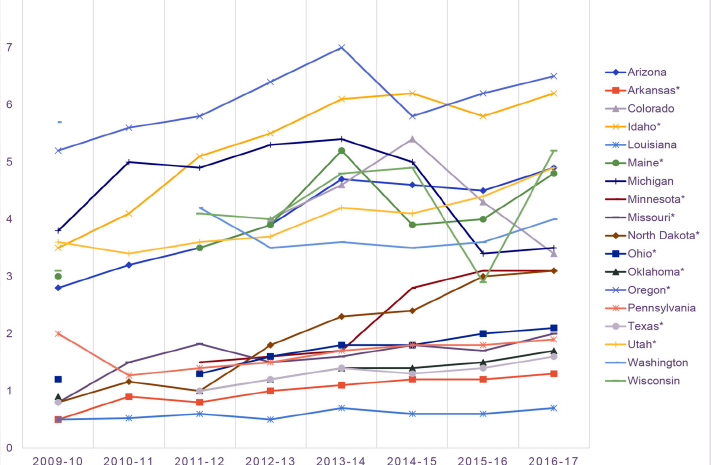
ACEP Now: Vol 38 – No 02 – February 2019(click for larger image) Figure 1: Nonmedical Vaccine Exemption Rates in Kindergarten Students
Increasing nationwide trend in kindergarten nonmedical exemption rates (NMEs out of the total kindergarten enrollments) from 2009–2017. *= states demonstrating upward trend.
Credit: Olive JK, et al. PLoS Med. 2018;15(6):e1002578. (CC BY 4.0)
Countering Anti-Vax Misconceptions
Let’s take on some common misconceptions about immunizations:
“Vaccines cause autism.” Although the onset of autism coincides with the time of childhood vaccinations, not only is there no evidence they are correlated, substantial affirmative evidence exists that dispels this notion. A meta-analysis of 10 studies involving 1.2 million children found no relationship between autism and immunizations, or specifically to mercury and thimerosal-containing vaccines.2 In fact, autism societies, such as Autism Speaks, actively encourage autistic children to get vaccinated. You may also recall the disgraced British doctor Andrew Wakefield, who was found to have published fraudulent research in The Lancet suggesting this association. The article was retracted quite some time after its publication.
“Vaccines cause sudden infant death syndrome (SIDS).” A meta-analysis of nine case-control studies involving 2,065 cases and 6,594 controls found that vaccinated children are actually protected against SIDS, with vaccination reducing the risk by half.3
“Vaccines cause Guillain-Barré syndrome.” Again, a meta-analysis of cases at Kaiser from 1995 to 2005 involving observation of more than 30 million patient years found no association between vaccination and Guillain-Barré syndrome.4 It was estimated that if any risk even existed, it would be on the order of 1 in 1 to 2 million vaccinations, far less common than the risk of a fatal penicillin reaction (1 to 5 in 10,000 patients). Unlike the mother in the above case, many anti-vax parents paradoxically demand antibiotics for their child with a febrile illness even when unnecessary for a presumed viral illness, probably acknowledging on some level the risk they’ve created.
“Vaccines don‘t work.” Although it’s true the efficacy of the seasonal flu vaccine lately has been low, it’s not nothing. Its current efficacy measures around 40 percent, and most seasons it’s higher (roughly 60 percent). In addition, it’s not fully appreciated that vaccinated individuals, if they do contract the flu, experience milder illness than the unvaccinated.
Flu vaccination has also been shown to reduce the risk of: 1) flu-associated pediatric intensive care unit (ICU) admission; 2) cardiac events, hospitalization, and ICU-level care in adults; and 3) hospitalization of pregnant mothers and their newborns. If this is not enough, a 2017 Centers for Disease Control and Prevention (CDC) study showed flu shots decrease the risk of a child dying of flu by about half.5 Considering that as many as 20 percent of the US population gets the flu each year, that’s nothing to sneeze at. You can find educational material from the CDC.
“Most people who get a disease have been vaccinated.” This is true, but it’s a math thing, resulting from the fact that 95 percent of the US population has been vaccinated and that there is a nonresponse rate to vaccines, though it’s rare. For example, if 1,000 people at Disneyland are exposed to a highly contagious measles case from a visitor from the Philippines (as actually occurred in 2014) and there are five unvaccinated kids present, all five will get infected, and so will seven vaccinated kids because the vaccine is only 99 percent effective. Remember, it’s a small world after all, which will only get more dangerous if more and more kids in the United States do not get immunized.
“It’s my right not to vaccinate my child.” Except, by getting vaccinated, you also protect society as well as immune-compromised people who can’t get live vaccines or mount an immune response. The expectation for vaccination is like the taxes that maintain civil protections (such as our military, fire departments, etc.) and car insurance. These individual “sacrifices” are for the common good—and remember, vaccines are safe.
Pages: 1 2 3 | Single Page


10 Responses to “How Emergency Physicians Can Advocate for Vaccination”
March 10, 2019
Corey SlovisDavid, thank you for this. Greatly appreciate the summary table along with your insights.
Corey Slovis
March 11, 2019
Dave TalanThanks for the shout out, Corey. I hope you are well and taking care of our UCLA grad faculty. Let me know when I can invite myself to come visit your program, never been to Nashville.
March 10, 2019
JeffThis a way more important topic for us to address in the ED than gun control (which we have inappropriately co-opted ACEP to lobby for). Thank you so much for the practical responses to parents unreasonable excuses.
March 10, 2019
Kerry ACEP ForrestalWas the suit successful?
March 11, 2019
Dave TalanI don’t know. I hope not. The plaintiff’s attorney contacted me and I told him that there was no case and that I thought it outrageous that the family would sue the doctors for a problem that they unfortunately imposed through first, deciding to have their child not get vaccinated, second, not being honest about the child’s vaccination history, and third, refusing antibiotics when they were advised.
March 11, 2019
ANN PayneWonderful !
March 12, 2019
Leo Alonso, D.O.DR.Talan,
Thanks for your timely and well researched article. Emotionally this group of parents causes me the most moral and ethical conflict….child abuse being straightforward illegal with criminal judicial societal repercussions…this cohort of parents are afforded a degree of “free speech/thought/religious” protection while the children and the immunocomprimised suffer the consequences of their ignorance. I try to educate them in a non-judgemental fashion but my experience has been a total shutdown…they have made up their mind. I struggle with the effective approach and your article shed some light. I believe only through legislation requiring vaccinations with minimal to no exemptions will the herd immunity numbers be preserved as we enter the digital era where so much misinformation can be circulated with no counter argument.
March 17, 2019
Erin BurnhamThanks for this nice summary David. I agree that we have a duty to encourage our patients to get vaccinated. I have been even more vocal about vaccinations since the EMTs I supervise had a case of tetanus in a child. Tetanus?!
March 28, 2019
Jack SpringerDave,
Thanks for your articulate summary.
I have found the issue of trying to educate parents to change their perspective on vaccination is like having a political or religious conversation with someone of the opposite “belief”. Mostly unshakeable. Even in the face of an argument that childhood vaccinations are likely the greatest ongoing scientific experiment in history, with an N in the billions, and that they are safer than driving the family car to the ER!
April 10, 2019
Michael Herron.I thought for sure the story was going to take a turn…… we called the department of family and children services, they contacted a judge who issued a restraining order and temporary custody to the state. Child was then given IV antibiotics to treat H.flu, then suddenly developed anaphylactic shock..and died….