Logo

Log In Sign Up |  An official publication of: American College of Emergency Physicians
Navigation
  • Home
  • Multimedia
    • Podcasts
    • Videos
  • Clinical
    • Airway Managment
    • Case Reports
    • Critical Care
    • Guidelines
    • Imaging & Ultrasound
    • Pain & Palliative Care
    • Pediatrics
    • Resuscitation
    • Trauma & Injury
  • Resource Centers
    • mTBI Resource Center
  • Career
    • Practice Management
      • Benchmarking
      • Reimbursement & Coding
      • Care Team
      • Legal
      • Operations
      • Quality & Safety
    • Awards
    • Certification
    • Compensation
    • Early Career
    • Education
    • Leadership
    • Profiles
    • Retirement
    • Work-Life Balance
  • Columns
    • ACEP4U
    • Airway
    • Benchmarking
    • Brief19
    • By the Numbers
    • Coding Wizard
    • EM Cases
    • End of the Rainbow
    • Equity Equation
    • FACEPs in the Crowd
    • Forensic Facts
    • From the College
    • Images in EM
    • Kids Korner
    • Medicolegal Mind
    • Opinion
      • Break Room
      • New Spin
      • Pro-Con
    • Pearls From EM Literature
    • Policy Rx
    • Practice Changers
    • Problem Solvers
    • Residency Spotlight
    • Resident Voice
    • Skeptics’ Guide to Emergency Medicine
    • Sound Advice
    • Special OPs
    • Toxicology Q&A
    • WorldTravelERs
  • Resources
    • ACEP.org
    • ACEP Knowledge Quiz
    • Issue Archives
    • CME Now
    • Annual Scientific Assembly
      • ACEP14
      • ACEP15
      • ACEP16
      • ACEP17
      • ACEP18
      • ACEP19
    • Annals of Emergency Medicine
    • JACEP Open
    • Emergency Medicine Foundation
  • About
    • Our Mission
    • Medical Editor in Chief
    • Editorial Advisory Board
    • Awards
    • Authors
    • Article Submission
    • Contact Us
    • Advertise
    • Subscribe
    • Privacy Policy
    • Copyright Information

History of the Emergency Medicine Foundation

By Brooks F. Bock, MD, FACEP; Jordan Celeste, MD, FACEP; and Jana Nelson | on September 13, 2018 | 0 Comment
Uncategorized
  • Tweet
  • Click to email a link to a friend (Opens in new window) Email
Print-Friendly Version

You Might Also Like
  • Emergency Medicine Foundation Hosts VIP Reception Sunday at ACEP17
  • Emergency Medicine Foundation Hosts Grantee Reception, Donor Lounge, Silent Auction at ACEP15
  • Last Day for Emergency Medicine Foundation Donor Lounge, Silent Auction at ACEP15

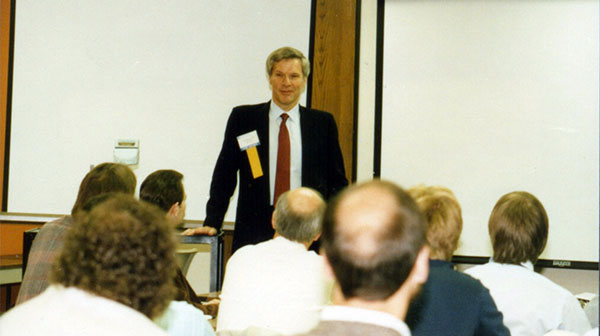
Dr. Brooks Bock at the 1989 Teaching Fellowship Program.

Despite the maverick nature of the early adapters to emergency medicine, most had a clear sense of the steps necessary to achieve acceptance into the house of medicine. From its inception, ACEP established an organizational goal of education, focused specifically on the emerging realities of the practice of emergency medicine. In contrast to their “outside the box” thinking, ACEP leadership was always attentive to the need for research in emergency medicine and related fields, knowing that this was a critical component of improving practice and guiding patient care.

In pursuit of that goal, the Emergency Medicine Foundation (EMF) was established by the ACEP Board of Directors on June 10, 1972. EMF’s sole function would be to fund emergency medicine research with the goal of educating the emerging specialty on best practices. ACEP’s Board would govern the activities of EMF until September 1977 when EMF adopted its own constitution and bylaws, allowing the foundation to stand on its own. At that time, the Board was expanded to include representation from the Emergency Department Nurses Association (EDNA) and the University Association for Emergency Medical Services (UA/EM).

Early on, EMF was almost singularly responsible for providing funds to individuals who identified themselves as “emergency physicians” and were beginning their careers. Because of that, EMF has played a pivotal role in the early work of some of the most significant researchers in the field of emergency medicine.

EMF Milestones

From 1972–1977, the EMF’s primary sources of income were from ACEP memorial contributions and the sales of PEER I. In 1977, a solicitation to the members of ACEP, EDNA, and UA/EM resulted in contributions of approximately $13,000.
By 1978, EMF had awarded six grants averaging approximately $4,000 each. In 1980, five awards were given totaling $22,560. Studies at the time were looking at new CPR techniques, developing criteria for cardiac drugs, and creating an EMS manual for agricultural emergencies.

In the early 1980s, a group of supporters formed the Research Associates in an effort to expand emergency medicine research; membership was open to anyone who contributed $100 or more to EMF.

In 1984, EMF reached a crossroads. Donations were being used primarily to offset costs for an annual fund raiser, leaving limited funding for research. At the time, EMF was governed by a joint board of representatives from ACEP, EDNA, UA/EM, and others. The ACEP Board boldly proposed that EMF be led by ACEP and governed by an ACEP-appointed Board. Further, ACEP promised to absorb all of EMF’s administrative costs, ensuring that 100 percent of donor dollars be directed to research. This singular change allowed EMF to flourish and achieve an exponential impact on the specialty.

Pages: 1 2 3 | Single Page

Topics: 50th AnniversaryAnniversary 70sEducationEMFHistoryResearch

Related

  • FACEPs in the Crowd: Dr. John Ludlow

    November 5, 2025 - 0 Comment
  • ACEP4U: the ACEP/CORD Teaching Fellowship

    November 4, 2025 - 0 Comment
  • Dr. Joe Sachs and “The Pitt” Redefine Public Health Education Through Storytelling

    July 3, 2025 - 0 Comment

Current Issue

ACEP Now: November 2025

Download PDF

Read More

No Responses to “History of the Emergency Medicine Foundation”

Leave a Reply Cancel Reply

Your email address will not be published. Required fields are marked *


*
*


Wiley
  • Home
  • About Us
  • Contact Us
  • Privacy
  • Terms of Use
  • Advertise
  • Cookie Preferences
Copyright © 2025 by John Wiley & Sons, Inc. All rights reserved, including rights for text and data mining and training of artificial technologies or similar technologies. ISSN 2333-2603
