
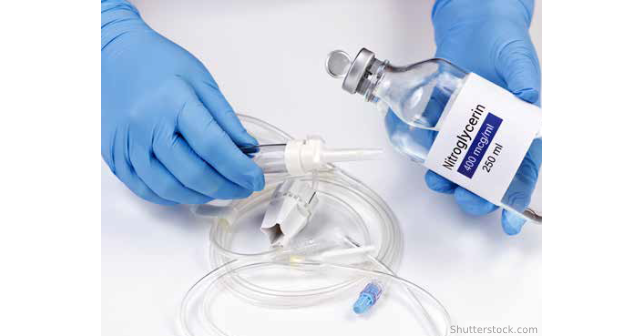
What is “high-dose” nitroglycerin?
The definition of “high-dose” nitroglycerin varies. Some may consider an infusion of 200-400 μg/min “high-dose,” while others consider boluses of 1-3 mg “high-dose” nitroglycerin. In the open-label, non-randomized study that forms the basis of the ACEP clinical policy recommendation, patients received a 2 mg bolus of nitroglycerin and a nitroglycerin drip was started at a low rate (0.3-0.5 μg/kg/min) with titration up to 400 μg/min. Additional 2 mg boluses of nitroglycerin could be given every 3-5 minutes.6 A 2021 study gave patients a bolus of 0.6 to 1 mg of nitroglycerin, depending on systolic blood pressure, and initiated an infusion at 100 μg/min that could be titrated based on blood pressure.7
Explore This Issue
ACEP Now: Vol 42 – No 02 – February 2023Who may be appropriate patient for high-dose nitroglycerin?
The studies of high-dose nitroglycerin typically include patients with clinical signs of ADHF with pulmonary edema, hypoxemia and/or dyspnea, and hypertension. The inclusion criteria vary with regard to minimum blood pressure threshold, but ≥160 mmHg is commonly used.6,8
What is the potential benefit?
Studies of high-dose nitroglycerin consistently suggest a trend towards reduced need for endotracheal intubation, non-invasive ventilation, and admissions to critical care units.6,8,9 This may be particularly important given strained hospital resources and critical care beds. Additionally, a short-term high-dose infusion or bolus doses of nitroglycerin can achieve rapid improvement in hemodynamics and symptoms, obviating the need for an infusion upon admission to the hospital. Unfortunately, most of these studies are small and not randomized; thus, the certainty of evidence regarding the magnitude of benefit is low.
What is the potential harm?
Two primary potential harms arise in the administration of nitroglycerin—hypotension and headache. Fortunately, hypotension is uncommon and transient, occurring in approximately two to three percent of patients in studies of high-dose nitroglycerin.6,7,10–12 Additionally, one of the benefits of nitroglycerin is the quick “on and off,” the half-life is about 3 minutes. As a result, the hypotension observed in these studies resolved within minutes.
How does one bolus nitroglycerin?
The delivery of nitroglycerin boluses can also vary, such that even if there is a reluctance to administer a bolus of nitroglycerin, the same dose can be effectively achieved. For example, a bolus can be administered as a slow intravenous push. Alternatively, one may encounter less resistance achieving a bolus of nitroglycerin by utilizing an infusion rate of 300-500 μg/min for a few minutes. “High-dose” or bolus dose nitroglycerin may seem like an outrageous dose compared to low-dose infusions; however, the dose may not be as high-dose as we think. We routinely administer 0.4 mg of sublingual nitroglycerin to patients with chest pain. Although the bioavailability may vary based on sublingual technique, this is approximately the same as 160 μg of intravenous nitroglycerin. Some prehospital services will administer 0.4–0.8 mg of sublingual nitroglycerin, sometimes repeated over 10–15 minutes to achieve an effective “bolus” of nearly 0.5 mg.7,11
Pages: 1 2 3 | Single Page



No Responses to “High Dose Nitroglycerin in Acute Heart Failure Goes Mainstream”