
Logo

Log In Sign Up |  An official publication of: American College of Emergency Physicians
Navigation
  • Home
  • Multimedia
    • Podcasts
    • Videos
  • Clinical
    • Airway Managment
    • Case Reports
    • Critical Care
    • Guidelines
    • Imaging & Ultrasound
    • Pain & Palliative Care
    • Pediatrics
    • Resuscitation
    • Trauma & Injury
  • Resource Centers
    • mTBI Resource Center
  • Career
    • Practice Management
      • Benchmarking
      • Reimbursement & Coding
      • Care Team
      • Legal
      • Operations
      • Quality & Safety
    • Awards
    • Certification
    • Compensation
    • Early Career
    • Education
    • Leadership
    • Profiles
    • Retirement
    • Work-Life Balance
  • Columns
    • ACEP4U
    • Airway
    • Benchmarking
    • Brief19
    • By the Numbers
    • Coding Wizard
    • EM Cases
    • End of the Rainbow
    • Equity Equation
    • FACEPs in the Crowd
    • Forensic Facts
    • From the College
    • Images in EM
    • Kids Korner
    • Medicolegal Mind
    • Opinion
      • Break Room
      • New Spin
      • Pro-Con
    • Pearls From EM Literature
    • Policy Rx
    • Practice Changers
    • Problem Solvers
    • Residency Spotlight
    • Resident Voice
    • Skeptics’ Guide to Emergency Medicine
    • Sound Advice
    • Special OPs
    • Toxicology Q&A
    • WorldTravelERs
  • Resources
    • ACEP.org
    • ACEP Knowledge Quiz
    • Issue Archives
    • CME Now
    • Annual Scientific Assembly
      • ACEP14
      • ACEP15
      • ACEP16
      • ACEP17
      • ACEP18
      • ACEP19
    • Annals of Emergency Medicine
    • JACEP Open
    • Emergency Medicine Foundation
  • About
    • Our Mission
    • Medical Editor in Chief
    • Editorial Advisory Board
    • Awards
    • Authors
    • Article Submission
    • Contact Us
    • Advertise
    • Subscribe
    • Privacy Policy
    • Copyright Information

Help Prevent Coronavirus Spread by Reevaluating ED Flow

By Shari Welch, MD, FACEP and James J. Augustine, MD, FACEP | on June 15, 2020 | 0 Comment
Special OPs
  • Tweet
  • Click to email a link to a friend (Opens in new window) Email
Print-Friendly Version

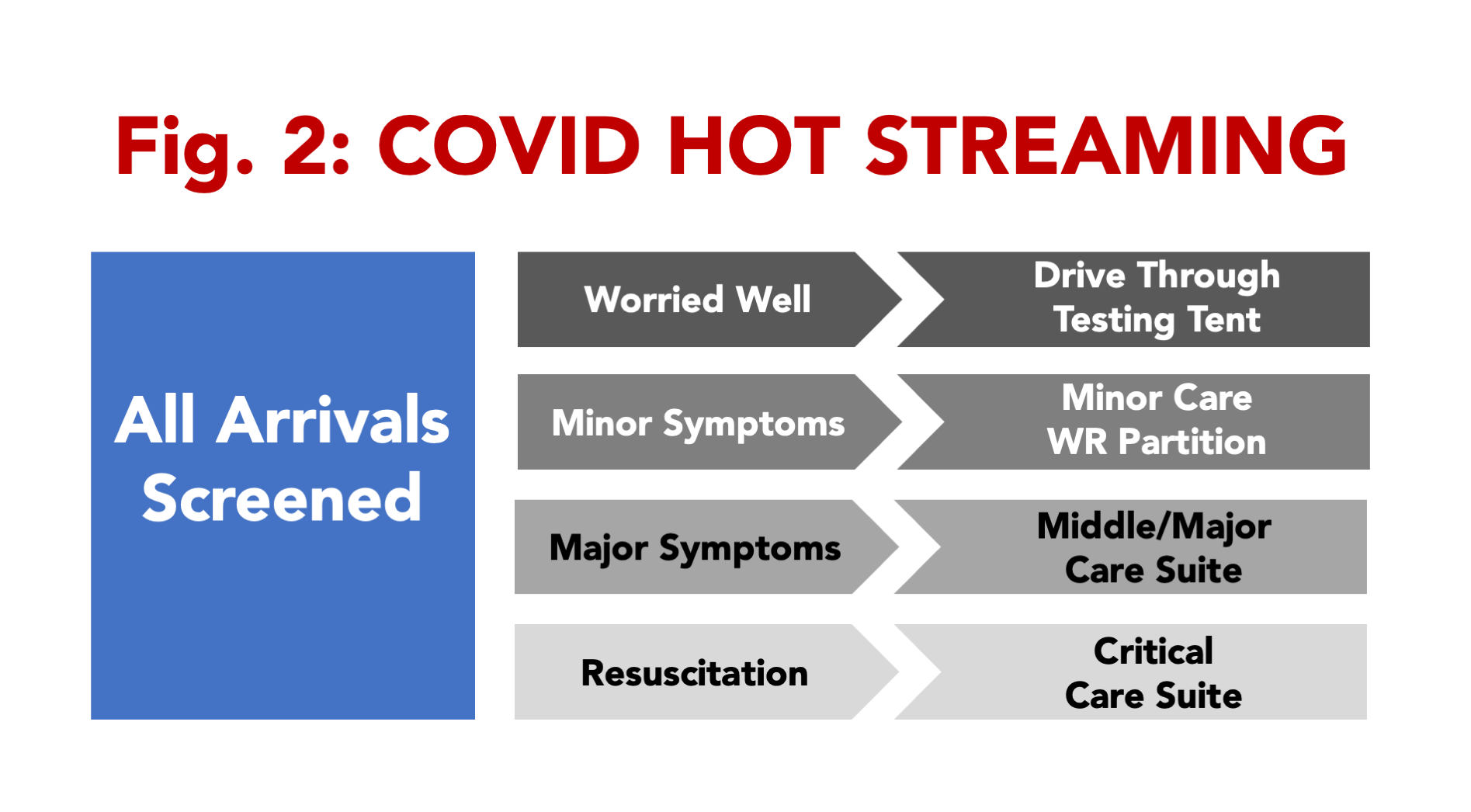
COVID HOT STREAMING

You Might Also Like
  • Becton Dickinson, BioMedomics Launch Test to Detect Past, Current Coronavirus Exposure
  • Two Generic Drugs Being Tested in U.S. in Race to Find Coronavirus Treatments
  • Summer Heat Unlikely to Halt Coronavirus, EU Body Says
Explore This Issue
ACEP Now: Vol 39 – No 06 – June 2020

Smaller emergency departments, or those with lower disease prevalence, might only have a small number of spaces for COVID-19 patients and one room designated for COVID critical care.

High-priority (eg, trauma, stroke, burn, or obstetric patients) and high-risk patients need to move through the screening process quickly and be transported to appropriate critical care areas. Resuscitation areas in COVID hot zones need to process all critically ill COVID-19 patients and any arriving patients with an unknown status. Patients are treated by staff in full PPE, including N95 masks or powered air-purifying respirator, eye shields, gowns, and gloves, who use strict donning and doffing procedures.8

Wearing PPE presents notable challenges. In addition to it being time-consuming to suit up, frontline workers report extreme difficulty in tolerating the warmth of PPE and most can’t withstand full protection from SARS-CoV-2 for more than four hours.

Another strategy includes not allowing staff to float back and forth between hot and cold zones, which exposes patients and staff members to the risk of infection. This will decrease staffing flexibility and impact staffing and workflow on the front lines.

A busy emergency department with higher volume that is part of the epicenter may be able to populate and staff a separate zone for middle- and higher-acuity noncritical patients who need testing and treatments. This will take place in a designated ED care space and may include a lounge chair area. The institution will have to decide whether to take infected patients into imaging suites. Radiology staff will have to provide guidance on appropriate use of plain imaging and high-level scans.

In some cases, having PPE-protected imaging staff take portable films and using plastic-covered portable units is more efficient than cleaning an imaging room between patients. This is even more important in scanning suites, where disinfecting scanners and gantries may take more than an hour. Ultrasound procedures are typically done bedside with disposable sheaths and PPE-protected staff. Health care workers in these areas should wear basic PPE including a surgical mask, eye shield, gown, and gloves.9

Other arriving patients will have risk factors for SARS-CoV-2 infection but may have low-acuity medical needs and little indication for diagnostic testing. These patients may be best served by evaluation and disposition directly from the intake or screening area. In many emergency departments that have forbidden visitors, the waiting room may serve as a convenient area for minor care.

Take advantage of opportunities to use outdoor spaces and adjacent parking lots, with or without tents, to manage the lowest acuity needs. This includes those who simply need a screening test, those needing a “COVID clearance” to return to work, and the “worried well.” Where drive-through operations can be developed, low-acuity patients could remain in their cars, with self-collected specimens evaluated in a timely manner.

Pages: 1 2 3 4 | Single Page

Topics: coronavirusCOVID-19Emergency Department VisitsPatient Flow

Related

  • Pediatric Patients in Acute Mental Health Crisis Face Long Waits

    August 29, 2025 - 0 Comment
  • Hospital at Home Is Here: An Opportunity EM Can’t Ignore

    August 25, 2025 - 0 Comment
  • ACEP Member Uses ED, Military Training To Set Standards at FEMA

    August 11, 2025 - 0 Comment

Current Issue

ACEP Now: November 2025

Download PDF

Read More

About the Authors

Shari Welch, MD, FACEP

Shari Welch, MD, FACEP, is a practicing emergency physician with Utah Emergency Physicians and a research fellow at the Intermountain Institute for Health Care Delivery Research. She has written numerous articles and three books on ED quality, safety, and efficiency. She is a consultant with Quality Matters Consulting, and her expertise is in ED operations.

View this author's posts »

James J. Augustine, MD, FACEP

James J. Augustine, MD, FACEP, is national director of prehospital strategy for US Acute Care Solutions in Canton, Ohio; clinical professor of emergency medicine at Wright State University in Dayton, Ohio; and vice president of the Emergency Department Benchmarking Alliance.

View this author's posts »

No Responses to “Help Prevent Coronavirus Spread by Reevaluating ED Flow”

Leave a Reply Cancel Reply

Your email address will not be published. Required fields are marked *


*
*


Wiley
  • Home
  • About Us
  • Contact Us
  • Privacy
  • Terms of Use
  • Advertise
  • Cookie Preferences
Copyright © 2025 by John Wiley & Sons, Inc. All rights reserved, including rights for text and data mining and training of artificial technologies or similar technologies. ISSN 2333-2603
