Logo

Log In Sign Up |  An official publication of: American College of Emergency Physicians
Navigation
  • Home
  • Multimedia
    • Podcasts
    • Videos
  • Clinical
    • Airway Managment
    • Case Reports
    • Critical Care
    • Guidelines
    • Imaging & Ultrasound
    • Pain & Palliative Care
    • Pediatrics
    • Resuscitation
    • Trauma & Injury
  • Resource Centers
    • mTBI Resource Center
  • Career
    • Practice Management
      • Benchmarking
      • Reimbursement & Coding
      • Care Team
      • Legal
      • Operations
      • Quality & Safety
    • Awards
    • Certification
    • Compensation
    • Early Career
    • Education
    • Leadership
    • Profiles
    • Retirement
    • Work-Life Balance
  • Columns
    • ACEP4U
    • Airway
    • Benchmarking
    • Brief19
    • By the Numbers
    • Coding Wizard
    • EM Cases
    • End of the Rainbow
    • Equity Equation
    • FACEPs in the Crowd
    • Forensic Facts
    • From the College
    • Images in EM
    • Kids Korner
    • Medicolegal Mind
    • Opinion
      • Break Room
      • New Spin
      • Pro-Con
    • Pearls From EM Literature
    • Policy Rx
    • Practice Changers
    • Problem Solvers
    • Residency Spotlight
    • Resident Voice
    • Skeptics’ Guide to Emergency Medicine
    • Sound Advice
    • Special OPs
    • Toxicology Q&A
    • WorldTravelERs
  • Resources
    • ACEP.org
    • ACEP Knowledge Quiz
    • Issue Archives
    • CME Now
    • Annual Scientific Assembly
      • ACEP14
      • ACEP15
      • ACEP16
      • ACEP17
      • ACEP18
      • ACEP19
    • Annals of Emergency Medicine
    • JACEP Open
    • Emergency Medicine Foundation
  • About
    • Our Mission
    • Medical Editor in Chief
    • Editorial Advisory Board
    • Awards
    • Authors
    • Article Submission
    • Contact Us
    • Advertise
    • Subscribe
    • Privacy Policy
    • Copyright Information

Health Care Professionals Share Insights on Challenges, Future of Emergency Medicine

By ACEP Now | on June 10, 2014 | 0 Comment
Features
  • Tweet
  • Click to email a link to a friend (Opens in new window) Email
Print-Friendly Version

Health Care Professionals Share Insights on Challenges, Future of Emergency Medicine

You Might Also Like
  • How Health Care Consolidation Is Changing Emergency Medicine
  • Health Care Future Discussed at Council Town Hall Meeting
  • ACEP President Dr. Michael J. Gerardi Shares Views on Challenges Facing Emergency Medicine
Explore This Issue
ACEP Now: Vol 33 – No 06 – June 2014

What Is the “Greatest of Three” (GOT) Interim Final Rule (IFR)?

In Section 2719A of the Public Health Service Act, the secretaries of the Departments of Health & Human Services, Labor, and the Treasury issued regulations that require the patient’s group health plan to reimburse out-of-network (OON) emergency service by paying “the greatest of three possible amounts: 1) the average amount negotiated with in-network providers for the emergency service furnished; 2) the amount for the emergency service calculated using the same method the plan generally uses to determine payments for out-of-network services (such as the usual, customary, and reasonable charges); or 3) the amount that would be paid under Medicare for the emergency service.”

The main goals of the IFR are to protect the patient who obtains OON ED services. Under the IFR, prior authorization is prohibited and balance billing is not prohibited. While the IFR states that patient protections would be defeated if the health plans pay an “unreasonably low amount to the provider,” the GOT formula essentially leaves it up the plans to establish a Medicare-related method to reimburse emergency physicians for OON services, as per part two of GOT. If the patient is in a state that prohibits balance billing or the plan states that it will cover the amount of the balance bill for the patient, then the GOT rule does not apply. Several large plans use third-party entities such as DataiSight to communicate with patients, not to pay their balance bill, and to suggest (but not commit) that they will communicate with the providers regarding the balance bill. Since the passage of the ACA, ACEP and other stakeholders continue to be in dialogue with CMS regarding health plan abuses under the GOT and to advocate for clearer objective standards for fair and appropriate OON reimbursement.

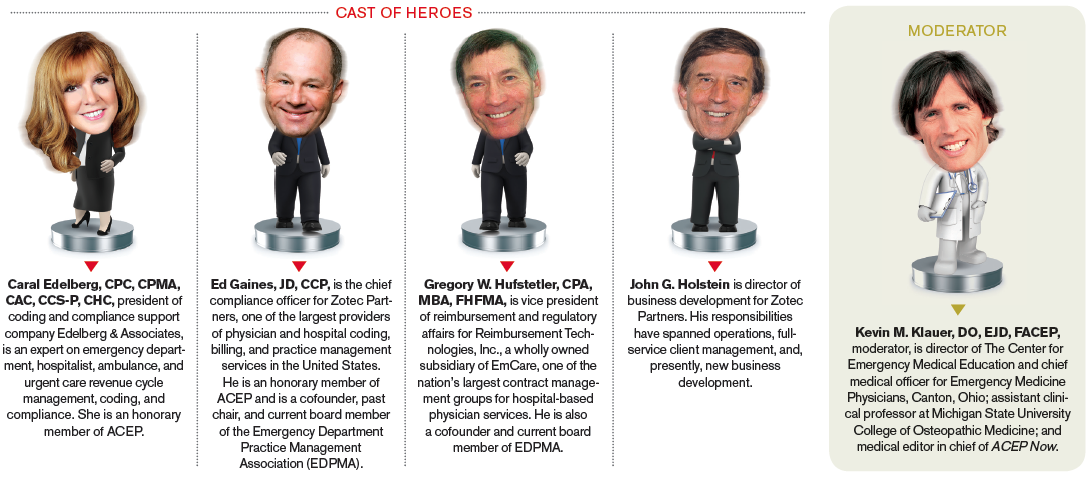
Kevin M. Klauer, DO, EJD, FACEP: What are top challenges in 2014 for health care? Where do we see health care going in 2014? What do you see as non-physicians and executive leaders in emergency medicine?

Ed Gaines, JD, CCP: I think the single biggest challenge we have in health care overall, and specific to emergency medicine, is this “Greatest of Three” formula (GOT) and interim final rules that we have under the Affordable Care Act (ACA) and the Centers for Medicare & Medicaid Services (CMS) regulations. What the commercial health plans are doing, in essence, is using those interim final rules to drive out-of-network (OON) reimbursement to approximately 125 percent of Medicare. Greg Hufstetler has analyzed the EmCare data and found that three of the major health plans—Aetna, Cigna, and UnitedHealthcare— have shifted more then $600 million from the plans to the patients in 2013 using the GOT formula. It really ties to a theme that our CEO and founder Scott Law has talked about. He calls it the great fleecing of the American patient. The plans are paying Medicare plus 20 to 30 percent of the charge, which leaves a significant “balance bill” due from the patient. The balance of the provider charges less the unreasonably low reimbursement by the health plans is being transferred to the patient, and the patient’s having to pay that in states where there isn’t a restriction on balance billing, and that’s a real problem for emergency medicine and all hospital-based specialties. So if we look out over the next five to 10 years, can the emergency medicine specialty exist on a Medicaid- or Medicare-style reimbursement methodology? I don’t think it can exist in the way it does today with independent ED group practices. The recently published Health Affairs study showed reimbursements set to Medicare and Medicaid would produce double-digit losses for most EDs and that historically privately insured patients have subsidized all other ED payer classes.1 With the states that do not have Medicaid expansion, there’s simply not enough reimbursement in the system to pay for the moral imperative, the Emergency Medical Treatment & Labor Act (EMTALA) imperative, and the imperative of emergency medicine to care for all comers to the ED. I think that’s the single biggest challenge we have in EM.

Pages: 1 2 3 4 5 6 7 8 9 | Single Page

Topics: ACEPAmerican College of Emergency PhysiciansCareer DevelopmentCost of Health CareEmergency DepartmentEmergency MedicineEmergency PhysicianHealth InsurancePractice ManagementPractice TrendsProcedures and SkillsQualityRoundtable

Related

  • Florida Emergency Department Adds Medication-Dispensing Kiosk

    November 7, 2025 - 1 Comment
  • Q&A with ACEP President L. Anthony Cirillo

    November 5, 2025 - 0 Comment
  • ACEP4U: the ACEP/CORD Teaching Fellowship

    November 4, 2025 - 0 Comment

Current Issue

ACEP Now: November 2025

Download PDF

Read More

About the Author

ACEP Now

View this author's posts »

No Responses to “Health Care Professionals Share Insights on Challenges, Future of Emergency Medicine”

Leave a Reply Cancel Reply

Your email address will not be published. Required fields are marked *


*
*


Wiley
  • Home
  • About Us
  • Contact Us
  • Privacy
  • Terms of Use
  • Advertise
  • Cookie Preferences
Copyright © 2025 by John Wiley & Sons, Inc. All rights reserved, including rights for text and data mining and training of artificial technologies or similar technologies. ISSN 2333-2603
