Logo

Log In Sign Up |  An official publication of: American College of Emergency Physicians
Navigation
  • Home
  • Multimedia
    • Podcasts
    • Videos
  • Clinical
    • Airway Managment
    • Case Reports
    • Critical Care
    • Guidelines
    • Imaging & Ultrasound
    • Pain & Palliative Care
    • Pediatrics
    • Resuscitation
    • Trauma & Injury
  • Resource Centers
    • mTBI Resource Center
  • Career
    • Practice Management
      • Benchmarking
      • Reimbursement & Coding
      • Care Team
      • Legal
      • Operations
      • Quality & Safety
    • Awards
    • Certification
    • Compensation
    • Early Career
    • Education
    • Leadership
    • Profiles
    • Retirement
    • Work-Life Balance
  • Columns
    • ACEP4U
    • Airway
    • Benchmarking
    • Brief19
    • By the Numbers
    • Coding Wizard
    • EM Cases
    • End of the Rainbow
    • Equity Equation
    • FACEPs in the Crowd
    • Forensic Facts
    • From the College
    • Images in EM
    • Kids Korner
    • Medicolegal Mind
    • Opinion
      • Break Room
      • New Spin
      • Pro-Con
    • Pearls From EM Literature
    • Policy Rx
    • Practice Changers
    • Problem Solvers
    • Residency Spotlight
    • Resident Voice
    • Skeptics’ Guide to Emergency Medicine
    • Sound Advice
    • Special OPs
    • Toxicology Q&A
    • WorldTravelERs
  • Resources
    • ACEP.org
    • ACEP Knowledge Quiz
    • Issue Archives
    • CME Now
    • Annual Scientific Assembly
      • ACEP14
      • ACEP15
      • ACEP16
      • ACEP17
      • ACEP18
      • ACEP19
    • Annals of Emergency Medicine
    • JACEP Open
    • Emergency Medicine Foundation
  • About
    • Our Mission
    • Medical Editor in Chief
    • Editorial Advisory Board
    • Awards
    • Authors
    • Article Submission
    • Contact Us
    • Advertise
    • Subscribe
    • Privacy Policy
    • Copyright Information

How to Handle a Medical Mistake

By Catherine A. Marco, MD, FACEP | on April 13, 2016 | 1 Comment
What I Wish I Knew
  • Tweet
  • Click to email a link to a friend (Opens in new window) Email
Print-Friendly Version

Error in judgment must occur in the practice of an art which consists largely of balancing probabilities.—William Osler

You Might Also Like
  • Are shorter work hours for medical interns harming patients?
  • Revised Joint Commission Standard Addresses Medical Staff, Hospital Leadership
  • Opinion: Institute of Medicine Report on Medical Misdiagnoses Overly Critical of Emergency Medicine
Explore This Issue
ACEP Now: Vol 35 – No 04 – April 2016
Nathaniel Mann, MD, is a resident in the department of emergency medicine at the University of Cincinnati in Ohio. Jordan Celeste, MD, is an emergency physician in Florida.

Nathaniel Mann, MD, is a resident in the department of emergency medicine at the University of Cincinnati in Ohio. Jordan Celeste, MD, is an emergency physician in Florida.

As emergency physicians, we strive for perfection. We strive for quality medical care, diagnostic accuracy, patient safety, and patient satisfaction. However, medical errors are an inevitable reality in the practice of medicine. We focus attention on education and systems to reduce the incidence of medical errors and to manage outcomes after a medical error. Increased attention to medical errors resulted from the Institute of Medicine landmark report “To Err Is Human: Building a Safer Health System” in 2000.1 In this report, an error is defined as failure of a planned action to be completed as intended (error of execution) or use of a wrong plan to achieve an aim (error of planning). Errors may be classified as serious errors (errors that cause permanent injury or transient but potentially life-threatening harm), minor errors (errors that cause harm that is neither permanent or potentially life-threatening), and near-miss errors (errors that could have caused harm but did not either by chance or by timely intervention).

Errors occur commonly in the ED environment.2–4 A recent study showed that 56 percent of U.S. physicians have been involved with a serious error, 74 percent have been involved with a minor error, and 66 percent have been involved with a near-miss error.5

Patients strongly prefer disclosure of medical errors (up to 98 percent of patients).6–8 It has been demonstrated that disclosure of errors to patients resulted in increased patient satisfaction, reduced likelihood of changing physicians, lower rate of seeking legal advice, reduced litigation, lower legal expenses, and lower jury awards.7,9,10 At least 35 states have adopted apology/disclosure laws, which protect providers who disclose medical errors.

According to the American Medical Association ethics opinion “Ethical Responsibility to Study and Prevent Error and Harm,” “physicians must strive to ensure patient safety and should play a central role in identifying, reducing, and preventing health care errors.”11 Physicians should be active in error reporting and disclosure to patients, but they should do so in collaboration with hospital risk management. In addition, The Joint Commission has required multiple safety standards including requirements of attention to safety, staff safety education, reporting systems, and disclosure of errors.

Pages: 1 2 3 | Single Page

Topics: ACEPAmerican College of Emergency PhysicianscareerEarly CareerEmergency DepartmentEmergency MedicineLitigationMalpracticeMedical ErrorMedical MistakePatient SafetyPractice ManagementQuality

Related

  • Florida Emergency Department Adds Medication-Dispensing Kiosk

    November 7, 2025 - 1 Comment
  • Q&A with ACEP President L. Anthony Cirillo

    November 5, 2025 - 0 Comment
  • How Does Emergency Medicine Navigate Consolidation Trends in Health Care?

    October 29, 2025 - 0 Comment

Current Issue

ACEP Now: November 2025

Download PDF

Read More

One Response to “How to Handle a Medical Mistake”

  1. May 21, 2016

    Charles A. Pilcher MD FACEP Reply

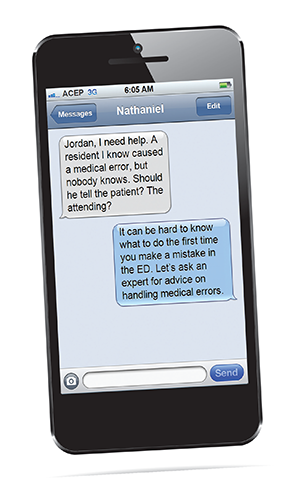
    This article and the smartphone image need better correlation.

    The question is really “How do I tell my patient NOW, in real time, when I just gave him/her the wrong drug/dose – or some other error?”

    I suggest that honesty and transparency are needed at all stages of the event. Early, we tell what we know. We apologize. “Sorry” is a good word. We tell what we are doing and why. And we tell what we WILL do. We do not discuss things we don’t know, like why the error happened. That is more complex and requires time, usually through an RCA. We promise to update everyone concerned as soon as we know anything certain. We follow through. And whenever possible, we include the affected patient/family in our process.

    Fears of malpractice are overblown. An egregious error will (and in our system probably should) result in litigation/negotiation. Apologizing doesn’t change that and in fact reduces exposure, time, stress and expense.

Leave a Reply Cancel Reply

Your email address will not be published. Required fields are marked *


*
*


Careers Center
  • Lee Health - Golisano Children’s Hospital of SWFL Seeks a Pediatric Emergency Medicine Physician!

    Position Information: Lee Health / Golisano Children’s Hospital – Pediatric Emergency Medicine is seeking a full-time physician BC/BE in Pediatric ...

    Fort Myers, Florida

    Competitive compensation package- sign on bonus and relocation!

    Lee Health physician group

    Read More
  • Director, Undergraduate Medical Education

    Penn State Health Milton S. Hershey Medical Center seeks a BC/BE Emergency Medicine Physician to serve as Director, Undergraduate Medical Education.

    Hershey, Pennsylvania

    Competitive salary & benefits at prestigious Pennsylvania health system

    Penn State Health

    Read More
  • Pediatric Emergency Medicine

    Akron Children's Hospital is seeking a Physician to join the Emergency Department out of the Boardman, Ohio location.

    Boardman, Ohio

    N/A

    Akron Children's Hospital

    Read More
More Jobs
Wiley
  • Home
  • About Us
  • Contact Us
  • Privacy
  • Terms of Use
  • Advertise
  • Cookie Preferences
Copyright © 2025 by John Wiley & Sons, Inc. All rights reserved, including rights for text and data mining and training of artificial technologies or similar technologies. ISSN 2333-2603

