Logo

Log In Sign Up |  An official publication of: American College of Emergency Physicians
Navigation
  • Home
  • Multimedia
    • Podcasts
    • Videos
  • Clinical
    • Airway Managment
    • Case Reports
    • Critical Care
    • Guidelines
    • Imaging & Ultrasound
    • Pain & Palliative Care
    • Pediatrics
    • Resuscitation
    • Trauma & Injury
  • Resource Centers
    • mTBI Resource Center
  • Career
    • Practice Management
      • Benchmarking
      • Reimbursement & Coding
      • Care Team
      • Legal
      • Operations
      • Quality & Safety
    • Awards
    • Certification
    • Compensation
    • Early Career
    • Education
    • Leadership
    • Profiles
    • Retirement
    • Work-Life Balance
  • Columns
    • ACEP4U
    • Airway
    • Benchmarking
    • Brief19
    • By the Numbers
    • Coding Wizard
    • EM Cases
    • End of the Rainbow
    • Equity Equation
    • FACEPs in the Crowd
    • Forensic Facts
    • From the College
    • Images in EM
    • Kids Korner
    • Medicolegal Mind
    • Opinion
      • Break Room
      • New Spin
      • Pro-Con
    • Pearls From EM Literature
    • Policy Rx
    • Practice Changers
    • Problem Solvers
    • Residency Spotlight
    • Resident Voice
    • Skeptics’ Guide to Emergency Medicine
    • Sound Advice
    • Special OPs
    • Toxicology Q&A
    • WorldTravelERs
  • Resources
    • ACEP.org
    • ACEP Knowledge Quiz
    • Issue Archives
    • CME Now
    • Annual Scientific Assembly
      • ACEP14
      • ACEP15
      • ACEP16
      • ACEP17
      • ACEP18
      • ACEP19
    • Annals of Emergency Medicine
    • JACEP Open
    • Emergency Medicine Foundation
  • About
    • Our Mission
    • Medical Editor in Chief
    • Editorial Advisory Board
    • Awards
    • Authors
    • Article Submission
    • Contact Us
    • Advertise
    • Subscribe
    • Privacy Policy
    • Copyright Information

Goal-Oriented, Bundled Care For Intracerebral Hemorrhage Improves Outcomes

By Ken Milne, MD | on October 10, 2023 | 0 Comment
Skeptics' Guide to EM
  • Tweet
  • Click to email a link to a friend (Opens in new window) Email
Print-Friendly Version

2. Medications used to lower BP are also important. The majority of patients’ BP was lowered with urapidil (61 percent) with a minority being treated with nicardipine (8 percent). How would this data extrapolate to North America, where nicardipine is a commonly used medication, while urapidil is not available in the United States or Canada?

You Might Also Like
  • Platelets and Antiplatelet Therapy in Patients with Nontraumatic Intracerebral Hemorrhage
  • Five Tips for Managing Intracerebral Hemorrhage
  • Intracerebral Hemorrhage Outcome Doesn’t Differ by Anticoagulant
Explore This Issue
ACEP Now: Vol 42 – No 10 – October 2023

3. Bundle: The bundle treatment included addressing hypertension, hyperglycemia, pyrexia, and hypercoagulability. Which part of the intervention caused the benefit? We have seen other bundles, in conditions like sepsis, that did not ultimately turn out to be better than usual care (ARISE, ProMISe and ProCESS).4 There could also be a Hawthorne Effect because this was unmasked trial and participants and clinicians knew whether they were receiving bundled care or usual care.

4. Outcome Assessment: The primary outcome in this trial was an ordinal analysis of the mRS score. Concerns have been raised about ordinal analyses. Dr. Rory Spiegel, who does the podcast for Annals of Emergency Medicine with Dr. Ryan Radecki, has written about this issue of ordinal analyses.5,6

There are also the issues with the mRS score itself for inter-rater reliability. Scoring of mRS, even by a neurologist, is only moderately reliable at best when done face-to-face.7 Similar issues with the mRS have been reported by others.7

In INTERACT-3 the outcome assessment is done via caregiver over the phone (79 percent of the time) or with the patient over the phone (7 percent of the time) and not face-to-face (less than 1 percent of the time). (See table) This should decrease our confidence in the primary outcome of mRS at six months.
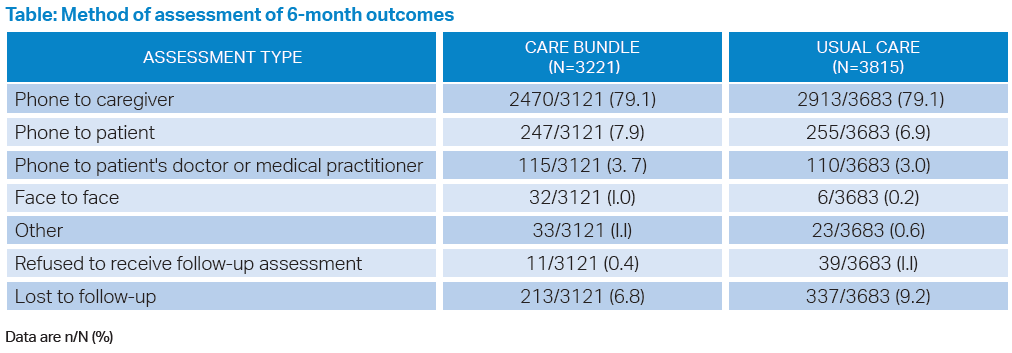
Click to enlarge.

Bottom Line

Intense blood pressure lowering in patients with ICHs continues to seem safe if we do not overshoot our target BP and cause hypotension, but we are still uncertain if it provides a patient-oriented outcome of benefit.

Case Resolution

The patient has severe disease with a poor prognosis. There is no definitive evidence to inform our management. You have a conversation with the neurological critical-care team and discuss what will be a mutually agreeable treatment plan.

Thank you to Dr. Mike Pallaci who is both a professor of emergency medicine for the Northeast Ohio Medical University, and an adjunct clinical professor of emergency medicine for the Ohio University Heritage College of Osteopathic Medicine, for his help with this critical appraisal.

Pages: 1 2 3 4 | Single Page

Topics: ClinicalCritical CareIntracerebral HemorrhageStroke

Related

  • Why the Nonrebreather Should be Abandoned

    December 3, 2025 - 0 Comment
  • PCC versus Andexanet Alfa for Factor Xa Reversal

    October 9, 2025 - 0 Comment
  • Non-Invasive Positive Pressure Ventilation in the Emergency Department

    October 1, 2025 - 0 Comment

Current Issue

ACEP Now: November 2025

Download PDF

Read More

No Responses to “Goal-Oriented, Bundled Care For Intracerebral Hemorrhage Improves Outcomes”

Leave a Reply Cancel Reply

Your email address will not be published. Required fields are marked *


*
*


Wiley
  • Home
  • About Us
  • Contact Us
  • Privacy
  • Terms of Use
  • Advertise
  • Cookie Preferences
Copyright © 2025 by John Wiley & Sons, Inc. All rights reserved, including rights for text and data mining and training of artificial technologies or similar technologies. ISSN 2333-2603