Logo

Log In Sign Up |  An official publication of: American College of Emergency Physicians
Navigation
  • Home
  • Multimedia
    • Podcasts
    • Videos
  • Clinical
    • Airway Managment
    • Case Reports
    • Critical Care
    • Guidelines
    • Imaging & Ultrasound
    • Pain & Palliative Care
    • Pediatrics
    • Resuscitation
    • Trauma & Injury
  • Resource Centers
    • mTBI Resource Center
  • Career
    • Practice Management
      • Benchmarking
      • Reimbursement & Coding
      • Care Team
      • Legal
      • Operations
      • Quality & Safety
    • Awards
    • Certification
    • Compensation
    • Early Career
    • Education
    • Leadership
    • Profiles
    • Retirement
    • Work-Life Balance
  • Columns
    • ACEP4U
    • Airway
    • Benchmarking
    • Brief19
    • By the Numbers
    • Coding Wizard
    • EM Cases
    • End of the Rainbow
    • Equity Equation
    • FACEPs in the Crowd
    • Forensic Facts
    • From the College
    • Images in EM
    • Kids Korner
    • Medicolegal Mind
    • Opinion
      • Break Room
      • New Spin
      • Pro-Con
    • Pearls From EM Literature
    • Policy Rx
    • Practice Changers
    • Problem Solvers
    • Residency Spotlight
    • Resident Voice
    • Skeptics’ Guide to Emergency Medicine
    • Sound Advice
    • Special OPs
    • Toxicology Q&A
    • WorldTravelERs
  • Resources
    • ACEP.org
    • ACEP Knowledge Quiz
    • Issue Archives
    • CME Now
    • Annual Scientific Assembly
      • ACEP14
      • ACEP15
      • ACEP16
      • ACEP17
      • ACEP18
      • ACEP19
    • Annals of Emergency Medicine
    • JACEP Open
    • Emergency Medicine Foundation
  • About
    • Our Mission
    • Medical Editor in Chief
    • Editorial Advisory Board
    • Awards
    • Authors
    • Article Submission
    • Contact Us
    • Advertise
    • Subscribe
    • Privacy Policy
    • Copyright Information

Get Your Emergency Department Ready for COVID-19

By Sachita Shah, MD, DTM&H; Nicholas J. Johnson, MD, FACEP; Steven Mitchell, MD, FACEP; Susan Stern, MD; and Jenelle Badulak, MD | on April 1, 2020 | 0 Comment
Uncategorized
  • Tweet
  • Click to email a link to a friend (Opens in new window) Email
Print-Friendly Version
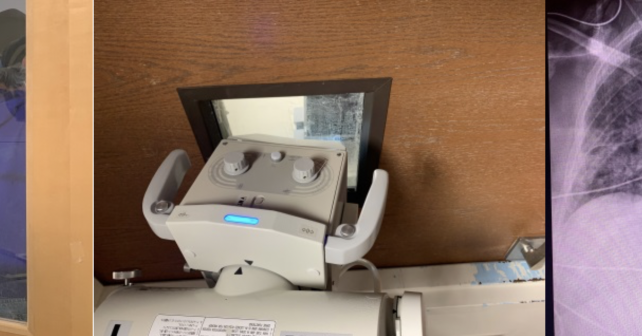
Figure 1: Radiology teams from our institution have minimized staff and equipment exposure by performing single-view portable radiographs through the windows on doors to isolation rooms. A) The patient is positioned standing or sitting in front of the door inside the isolation room with a nurse/staff wearing a lead shield, holding the plate to the patient’s chest. B) The portable machine camera is brought close to the glass, and adjustments are made to the machine to optimize the film. The film is passed by the gowned nurse outside the room with removal of the plastic sheet while passing to the X-ray staff outside the room, keeping the plate clean. C) While artifact from the window is sometimes present on the film, our radiologists have been able to read from these for multi-focal pneumonia and tube placement. Credit: University of Washington

Consider how mobile ECMO retrieval teams may be used to maximize ICU care at referral facilities. Once patients have failed conventional hypoxemia therapies, they will be too unstable for transport without ECMO. Coordinate with neighboring ECMO centers to exchange experience and knowledge, and potentially develop care guidelines for this patient population.

You Might Also Like
  • COVID-19 for the Emergency Physicians: What You Need to Know
  • Coping with COVID-19: The Puget Sound Experience
  • Diabetes, Lung, and Heart Disease Common in U.S. COVID-19 Patient
Explore This Issue
ACEP Now: Vol 39 – No 04 – April 2020

Intubation and Respiratory Support

Personnel from critical care, respiratory therapy, and anesthesiology should convene to develop approaches to support for suspected or confirmed COVID-19 patients with respiratory failure. Controversy exists about the use of noninvasive positive pressure ventilation and high-flow nasal cannula, which may disperse secretions and therefore virus.

We have opted to perform early tracheal intubation for these patients with placement on mechanical ventilation with a viral filter. Intubation should occur ideally in negative pressure rooms using airborne precautions.

  • The intubating clinician should use a PAPR with shroud and follow donning/doffing procedures.
  • Additional staff should be minimized (ideally, one nurse and one respiratory therapist).
  • We favor the use of video laryngoscopy to increase the distance between the intubating clinician and patient’s aerodigestive tract along with the rapid sequence intubation technique to minimize coughing or dispersion of secretions during bag-mask ventilation.
  • Viral filters can be placed in-line with bag-valve masks.
  • If sidestreamwaveform capnography devices are used, make sure a viral filter is placed in-line proximal to the end-tidal CO2 adapter (ie, directly on the end of the endotracheal tube, mask, or laryngeal mask airway). Otherwise, contaminated secretions may theoretically leak into the end-tidal CO2 tubing and perhaps back to the monitoring module.

Code Blue/Clinical Emergency Response

A dedicated plan for response to clinical emergencies should be created for patients with suspected or confirmed COVID-19. The plan should include limiting responding personnel, ensuring isolation precautions are maintained, and limiting aerosolizing procedure.

Consider appointing a dedicated isolation “captain” to ensure only essential staff enter the room, appropriate PPE are used, and equipment is decontaminated appropriately. The plan should include early discussions about “do not resuscitate” status with next of kin for critically ill infected patients.

Resources

  • ACEP’s COVID-19 Resource Page
  • PPE Video for Pre-training and “Just in Time” Review
  • Watching the video does NOT qualify as appropriate refresher training. We recommend that you review the pre-training video before your training session.
  • CDC Website for Current Literature
  • National Academy of Medicine: Duty to Plan: Health Care, Crisis Standards of Care, and Novel Coronavirus SARS-CoV-2
  • University of Washington Medicine COVID-19 Resources

The authors are in the department of emergency medicine at the University of Washington, Harborview Medical Center in Seattle.

Pages: 1 2 3 4 5 6 | Single Page

Topics: AirwaycoronavirusCOVID-19IntubationPersonal Protective EquipmentPPE

Related

  • Why the Nonrebreather Should be Abandoned

    December 3, 2025 - 0 Comment
  • Non-Invasive Positive Pressure Ventilation in the Emergency Department

    October 1, 2025 - 0 Comment
  • ACEP Member Uses ED, Military Training To Set Standards at FEMA

    August 11, 2025 - 0 Comment

Current Issue

ACEP Now: November 2025

Download PDF

Read More

No Responses to “Get Your Emergency Department Ready for COVID-19”

Leave a Reply Cancel Reply

Your email address will not be published. Required fields are marked *


*
*


Wiley
  • Home
  • About Us
  • Contact Us
  • Privacy
  • Terms of Use
  • Advertise
  • Cookie Preferences
Copyright © 2025 by John Wiley & Sons, Inc. All rights reserved, including rights for text and data mining and training of artificial technologies or similar technologies. ISSN 2333-2603
