Logo

Log In Sign Up |  An official publication of: American College of Emergency Physicians
Navigation
  • Home
  • Multimedia
    • Podcasts
    • Videos
  • Clinical
    • Airway Managment
    • Case Reports
    • Critical Care
    • Guidelines
    • Imaging & Ultrasound
    • Pain & Palliative Care
    • Pediatrics
    • Resuscitation
    • Trauma & Injury
  • Resource Centers
    • mTBI Resource Center
  • Career
    • Practice Management
      • Benchmarking
      • Reimbursement & Coding
      • Care Team
      • Legal
      • Operations
      • Quality & Safety
    • Awards
    • Certification
    • Compensation
    • Early Career
    • Education
    • Leadership
    • Profiles
    • Retirement
    • Work-Life Balance
  • Columns
    • ACEP4U
    • Airway
    • Benchmarking
    • Brief19
    • By the Numbers
    • Coding Wizard
    • EM Cases
    • End of the Rainbow
    • Equity Equation
    • FACEPs in the Crowd
    • Forensic Facts
    • From the College
    • Images in EM
    • Kids Korner
    • Medicolegal Mind
    • Opinion
      • Break Room
      • New Spin
      • Pro-Con
    • Pearls From EM Literature
    • Policy Rx
    • Practice Changers
    • Problem Solvers
    • Residency Spotlight
    • Resident Voice
    • Skeptics’ Guide to Emergency Medicine
    • Sound Advice
    • Special OPs
    • Toxicology Q&A
    • WorldTravelERs
  • Resources
    • ACEP.org
    • ACEP Knowledge Quiz
    • Issue Archives
    • CME Now
    • Annual Scientific Assembly
      • ACEP14
      • ACEP15
      • ACEP16
      • ACEP17
      • ACEP18
      • ACEP19
    • Annals of Emergency Medicine
    • JACEP Open
    • Emergency Medicine Foundation
  • About
    • Our Mission
    • Medical Editor in Chief
    • Editorial Advisory Board
    • Awards
    • Authors
    • Article Submission
    • Contact Us
    • Advertise
    • Subscribe
    • Privacy Policy
    • Copyright Information

Get Your Emergency Department Ready for COVID-19

By Sachita Shah, MD, DTM&H; Nicholas J. Johnson, MD, FACEP; Steven Mitchell, MD, FACEP; Susan Stern, MD; and Jenelle Badulak, MD | on April 1, 2020 | 0 Comment
Uncategorized
  • Tweet
  • Click to email a link to a friend (Opens in new window) Email
Print-Friendly Version
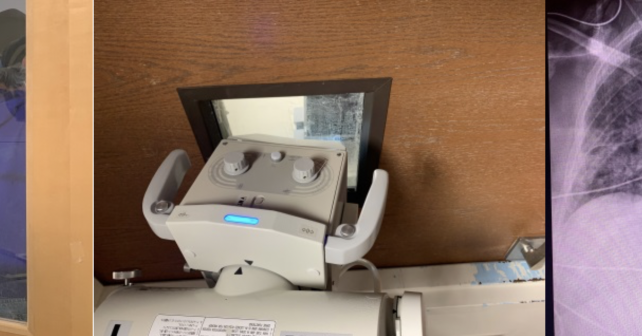
Figure 1: Radiology teams from our institution have minimized staff and equipment exposure by performing single-view portable radiographs through the windows on doors to isolation rooms. A) The patient is positioned standing or sitting in front of the door inside the isolation room with a nurse/staff wearing a lead shield, holding the plate to the patient’s chest. B) The portable machine camera is brought close to the glass, and adjustments are made to the machine to optimize the film. The film is passed by the gowned nurse outside the room with removal of the plastic sheet while passing to the X-ray staff outside the room, keeping the plate clean. C) While artifact from the window is sometimes present on the film, our radiologists have been able to read from these for multi-focal pneumonia and tube placement. Credit: University of Washington

Communication

You Might Also Like
  • COVID-19 for the Emergency Physicians: What You Need to Know
  • Coping with COVID-19: The Puget Sound Experience
  • Diabetes, Lung, and Heart Disease Common in U.S. COVID-19 Patient
Explore This Issue
ACEP Now: Vol 39 – No 04 – April 2020

Incident command structure should be followed, with centralized communication, messaging, and task delegation, including:

  • Identify a liaison to communicate regularly with the local DOH.
  • Identify a liaison for communications with the media.
  • Identify a COVID-19 hospitalist lead for admissions that are not to the ICU and an intensivist lead for those to the ICU.
  • Identify outreach leads for EMS, the homeless and shelter community, SNFs, and jails if your hospital receives these patients.

Stuff

Inventory current amounts of sanitation supplies (especially alcohol-based hand gel and bleach wipes); pulse oximeters; masks, powered air-purifying respirators (PAPRs), and shrouds for PAPR; mirrors for doffing stations; and disposable stethoscopes to anticipate increased needs. We have run short of flu swabs and personal protective equipment (PPE). Consider storing these supplies in ways that prevent hospital personnel and guests from removing them for personal use.

Assess supplies of key medications including antibiotics, sedation, analgesia, neuromuscular blockade, and crystalloid. Plan for use of metered dose inhalers with spacers instead of nebulizers to reduce infectivity.

Establish protocols for handling patient specimens (blood, urine, respiratory viral testing, etc.).

Hospitals should determine how many ventilators are available, including noninvasive positive pressure devices and anesthesia machines; reach out to ambulatory surgery centers for the possibility of using anesthesia machines; and assess the number of extracorporeal life support pumps and circuits available.


Space

Develop a department plan designating which areas of the emergency department will be dedicated to droplet precautions and which areas are negative pressure rooms appropriate to airborne precautions. For areas without an antechamber, consider creating a taped “warm zone” outside of the room for proper doffing. Ensure donning/doffing stations are set up with all needed supplies. Consider taking a photo of the station to post to ensure proper setup. How will you secure these supplies (especially the hand gel and wipes)?

Consider cohorting patients with mild illness who are “patients under investigation” in internal waiting rooms away from well patients or those who could be immunocompromised.

Patient Presentation

In general, patients have presented with a wide variety of symptoms, including fever, cough, upper respiratory infection symptoms, and hypoxemia. Rapid decompensation was seen in several patients. Generally, those who died were elderly, and some were immunocompromised.

Syndrome

  • Some afebrile, some with high fevers lasting more than one week
  • Shortness of breath, dry cough, some with gastrointestinal symptoms (although uncommon)
  • Risk factors: older patients, comorbidities
  • Respiratory failure: acute respiratory distress syndrome (ARDS)/pneumonitis, varying presentations on radiography
  • Cardiomyopathy, including elevated creatine kinase, has been seen

Use phones in the patient rooms to interview noncritically ill patients to reduce trips in and out of the room and to coordinate with nursing or respiratory therapy when they are at the bedside.

Pages: 1 2 3 4 5 6 | Single Page

Topics: AirwaycoronavirusCOVID-19IntubationPersonal Protective EquipmentPPE

Related

  • Why the Nonrebreather Should be Abandoned

    December 3, 2025 - 0 Comment
  • Non-Invasive Positive Pressure Ventilation in the Emergency Department

    October 1, 2025 - 0 Comment
  • ACEP Member Uses ED, Military Training To Set Standards at FEMA

    August 11, 2025 - 0 Comment

Current Issue

ACEP Now: November 2025

Download PDF

Read More

No Responses to “Get Your Emergency Department Ready for COVID-19”

Leave a Reply Cancel Reply

Your email address will not be published. Required fields are marked *


*
*


Wiley
  • Home
  • About Us
  • Contact Us
  • Privacy
  • Terms of Use
  • Advertise
  • Cookie Preferences
Copyright © 2025 by John Wiley & Sons, Inc. All rights reserved, including rights for text and data mining and training of artificial technologies or similar technologies. ISSN 2333-2603
