Logo

Log In Sign Up |  An official publication of: American College of Emergency Physicians
Navigation
  • Home
  • Multimedia
    • Podcasts
    • Videos
  • Clinical
    • Airway Managment
    • Case Reports
    • Critical Care
    • Guidelines
    • Imaging & Ultrasound
    • Pain & Palliative Care
    • Pediatrics
    • Resuscitation
    • Trauma & Injury
  • Resource Centers
    • mTBI Resource Center
  • Career
    • Practice Management
      • Benchmarking
      • Reimbursement & Coding
      • Care Team
      • Legal
      • Operations
      • Quality & Safety
    • Awards
    • Certification
    • Compensation
    • Early Career
    • Education
    • Leadership
    • Profiles
    • Retirement
    • Work-Life Balance
  • Columns
    • ACEP4U
    • Airway
    • Benchmarking
    • Brief19
    • By the Numbers
    • Coding Wizard
    • EM Cases
    • End of the Rainbow
    • Equity Equation
    • FACEPs in the Crowd
    • Forensic Facts
    • From the College
    • Images in EM
    • Kids Korner
    • Medicolegal Mind
    • Opinion
      • Break Room
      • New Spin
      • Pro-Con
    • Pearls From EM Literature
    • Policy Rx
    • Practice Changers
    • Problem Solvers
    • Residency Spotlight
    • Resident Voice
    • Skeptics’ Guide to Emergency Medicine
    • Sound Advice
    • Special OPs
    • Toxicology Q&A
    • WorldTravelERs
  • Resources
    • ACEP.org
    • ACEP Knowledge Quiz
    • Issue Archives
    • CME Now
    • Annual Scientific Assembly
      • ACEP14
      • ACEP15
      • ACEP16
      • ACEP17
      • ACEP18
      • ACEP19
    • Annals of Emergency Medicine
    • JACEP Open
    • Emergency Medicine Foundation
  • About
    • Our Mission
    • Medical Editor in Chief
    • Editorial Advisory Board
    • Awards
    • Authors
    • Article Submission
    • Contact Us
    • Advertise
    • Subscribe
    • Privacy Policy
    • Copyright Information

Get Your Emergency Department Ready for COVID-19

By Sachita Shah, MD, DTM&H; Nicholas J. Johnson, MD, FACEP; Steven Mitchell, MD, FACEP; Susan Stern, MD; and Jenelle Badulak, MD | on April 1, 2020 | 0 Comment
Uncategorized
  • Tweet
  • Click to email a link to a friend (Opens in new window) Email
Print-Friendly Version
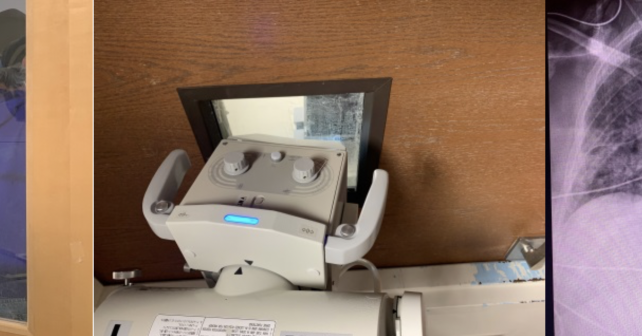
Figure 1: Radiology teams from our institution have minimized staff and equipment exposure by performing single-view portable radiographs through the windows on doors to isolation rooms. A) The patient is positioned standing or sitting in front of the door inside the isolation room with a nurse/staff wearing a lead shield, holding the plate to the patient’s chest. B) The portable machine camera is brought close to the glass, and adjustments are made to the machine to optimize the film. The film is passed by the gowned nurse outside the room with removal of the plastic sheet while passing to the X-ray staff outside the room, keeping the plate clean. C) While artifact from the window is sometimes present on the film, our radiologists have been able to read from these for multi-focal pneumonia and tube placement. Credit: University of Washington

Editors’ Note: This article was accepted on March 13, 2020, and was accurate at that time. Because information about SARS-CoV-2 and COVID-19 is evolving rapidly, please verify these recommendations and information.

You Might Also Like
  • COVID-19 for the Emergency Physicians: What You Need to Know
  • Coping with COVID-19: The Puget Sound Experience
  • Diabetes, Lung, and Heart Disease Common in U.S. COVID-19 Patient
Explore This Issue
ACEP Now: Vol 39 – No 04 – April 2020

Over the course of these past several weeks, our area hospitals have been crafting a set of rapidly evolving protocols to combat the spread of SARS-CoV-2, the novel coronavirus that causes COVID-19, and develop best practices to care for our COVID-19 patients.

Since the outbreak began, our colleagues locally and nationally have been reaching out to us for assistance as they start to see cases. We hope that by sharing our work, we can assist your teams and facilities to prepare and move more quickly.

Though protocols are frequently being revised as we learn more, there are several ways to ready your emergency departments for these patients. These include creative approaches to staff training, improvements in the physical space for isolation capacity, equipment to procure/inventory, and systems for providing patient care to minimize staff exposure.

We hope you can benefit from these recommendations while you have the time to prepare yourselves and your departments. The most important and time-critical component of COVID-19 response protocol is communication.


Consider Activating Your Incident Command System

Your incident command system should include communication early and often between emergency departments, hospitalist services, ICUs, local and state departments of health (DOHs), emergency medicine services (EMS), leads, and outreach leads to vulnerable populations (eg, local skilled nursing facilities [SNFs], jails, homeless shelters). In our experience, SNFs have been particularly vulnerable and have been the source of most patients and fatalities.

Developing communication links with local SNFs for the purpose of creating a transportation and hospital disposition plan prevents proximately located hospitals from being overwhelmed by a single SNF experiencing an outbreak.

The following cheat sheet is in the staff/stuff/space/systems format of simple ideas to consider for preparing.


Staff

Initiation of Staff Preparations

Fit testing for airborne precautions should be up-to-date within the last month for all staff, including radiology, maintenance, housekeeping, and other ancillary staff. Every physician and nurse should attest to watching the proper donning/doffing technique recommended by the Centers for Disease Control and Prevention (CDC) in the links in the “Resources” sidebar, and in-person training should be considered.

Staff should update their own home personal safety plans, including creating backup child care plans and stocking household supplies so that when work gets busy, their home plans and supplies are ready and they can concentrate on work.

Pages: 1 2 3 4 5 6 | Single Page

Topics: AirwaycoronavirusCOVID-19IntubationPersonal Protective EquipmentPPE

Related

  • Why the Nonrebreather Should be Abandoned

    December 3, 2025 - 0 Comment
  • Non-Invasive Positive Pressure Ventilation in the Emergency Department

    October 1, 2025 - 0 Comment
  • ACEP Member Uses ED, Military Training To Set Standards at FEMA

    August 11, 2025 - 0 Comment

Current Issue

ACEP Now: November 2025

Download PDF

Read More

No Responses to “Get Your Emergency Department Ready for COVID-19”

Leave a Reply Cancel Reply

Your email address will not be published. Required fields are marked *


*
*


Wiley
  • Home
  • About Us
  • Contact Us
  • Privacy
  • Terms of Use
  • Advertise
  • Cookie Preferences
Copyright © 2025 by John Wiley & Sons, Inc. All rights reserved, including rights for text and data mining and training of artificial technologies or similar technologies. ISSN 2333-2603
