
While Antarctica offers expansive landscapes and intense drama, for one week, my mind was focused only on breathing through my nose and trying not to cough all night. This counts as a memorable, but not lively, experience. I had, as we say down here, the “McMurdo Crud.” Given that our small population lives, eats, and works together, nearly everyone has the joy of experiencing the Crud, hopefully only once per season. Thankfully, we don’t have massive influenza outbreaks since everyone is required to have a flu shot before deploying to the station. We will have some personnel rotations this winter, potentially exposing us to new flu strains, so we’ll be updating everyone’s flu shot in June with New Zealand’s annual formulation, which is the same as that used in the United States.
Explore This Issue
ACEP Now: Vol 35 – No 05 – May 2016Lab Work
In the days before federal Clinical Laboratory Improvement Amendments (CLIA) regulations, I routinely did simple tests in our ED physician laboratory. During my Arctic sojourn for a research fleet, I employed additional simple lab tests. Here at McMurdo, however, we have CLIA-approved machines to run complete blood counts (CBCs), multiple blood chemistries, troponins, etc. The challenge is to keep unexpired tests and quality-control materials on hand since we’re at the end of a very long supply chain. Of course, I still do the urines the old-fashioned way, with a dipstick and microscope. Luckily, our newest CBC machine does its own centrifuging since people forget that failing to secure capillary tubes before spinning them destroys the machine.
Driving
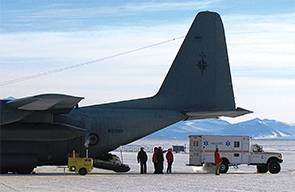
An ambulance delivers a patient to a medevac plane.
Everyone here has more than one job, with your secondary position designed to assist the whole base. I volunteered to drive one of our 12-person vans to shuttle people around. This required learning the special driving rules for the station (go very, very slowly and cede the road to everyone else), learning how to check maintenance, learning the complex method of gassing the vehicle (multiple codes and key insertions), as well as proving that I could drive on ice and snow; it’s no different than driving on ice and snow anywhere else. After I became an official driver, I was allowed to shuttle McMurdo residents to one of the popular “American Nights” at New Zealand’s nearby Scott Base, where both their bar and store, with very nice souvenirs, are open for business.
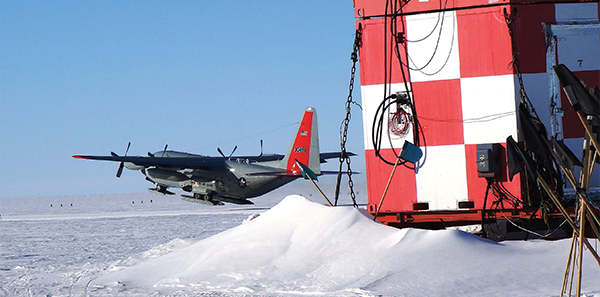
My next stint as a driver was totally unexpected: I was needed to drive an ambulatory medevac patient to the airfield. The outgoing summer physician and our US Air Force flight medic were his attendants. We got into the van and began our trip to the “skier” airfield, where the LC-130s use skis to land and take off. Because our patient was a New Zealander and we were passing by Scott Base, we followed tradition and stopped at the base so that his many compatriots, including a bagpiper, could wish him farewell. The whole experience was awesome. It’s not every day that I have the chance to drive onto an active airfield and up to an airplane getting ready for takeoff.
We assumed that once he got back to civilization, his dentist could determine if a root canal was possible or if he would need an extraction. When told of these options, the patient unexpectedly chose immediate extraction. He’d had enough problems with that tooth, and he just wanted it gone.
Life as a Dentist
I was deep in administrative duties when my first real dental patient walked in. The middle-aged man explained that he’d long had problems with a molar (#14, for those into dentistry). His dentist had previously considered extracting it but thought that it would be too difficult, so she elected to clean out the large carie and fill it. For two days, the tooth had been causing him excruciating pain that prevented him from sleeping. After taking a dental history (heat caused pain, he didn’t feel cold, and the pain came without any provocation) and performing a dental exam with a mirror, probe, “tooth sleuth,” and Endo Ice, I took dental films. Luckily, our dental film system is now digital. I don’t have to go through the laborious process of trying to develop films inside a small box as our prior dentists had to do.
Pages: 1 2 3 | Single Page


One Response to “Fun, Friends, Flexible Hours Part of Providing Medical Care in Antarctica”
November 27, 2019
Lori PartonMy name is Lori Parton. I am ardms registered in ultrasound in abdomen, OB, high risk OB, cardiac, vascular, and I am a registered Radiology technologist. I have 25 + years experience and have my own ultrasound machine … Seimens Antares XP. How do I serve a term in Antarctica?