Logo

Log In Sign Up |  An official publication of: American College of Emergency Physicians
Navigation
  • Home
  • Multimedia
    • Podcasts
    • Videos
  • Clinical
    • Airway Managment
    • Case Reports
    • Critical Care
    • Guidelines
    • Imaging & Ultrasound
    • Pain & Palliative Care
    • Pediatrics
    • Resuscitation
    • Trauma & Injury
  • Resource Centers
    • mTBI Resource Center
  • Career
    • Practice Management
      • Benchmarking
      • Reimbursement & Coding
      • Care Team
      • Legal
      • Operations
      • Quality & Safety
    • Awards
    • Certification
    • Compensation
    • Early Career
    • Education
    • Leadership
    • Profiles
    • Retirement
    • Work-Life Balance
  • Columns
    • ACEP4U
    • Airway
    • Benchmarking
    • Brief19
    • By the Numbers
    • Coding Wizard
    • EM Cases
    • End of the Rainbow
    • Equity Equation
    • FACEPs in the Crowd
    • Forensic Facts
    • From the College
    • Images in EM
    • Kids Korner
    • Medicolegal Mind
    • Opinion
      • Break Room
      • New Spin
      • Pro-Con
    • Pearls From EM Literature
    • Policy Rx
    • Practice Changers
    • Problem Solvers
    • Residency Spotlight
    • Resident Voice
    • Skeptics’ Guide to Emergency Medicine
    • Sound Advice
    • Special OPs
    • Toxicology Q&A
    • WorldTravelERs
  • Resources
    • ACEP.org
    • ACEP Knowledge Quiz
    • Issue Archives
    • CME Now
    • Annual Scientific Assembly
      • ACEP14
      • ACEP15
      • ACEP16
      • ACEP17
      • ACEP18
      • ACEP19
    • Annals of Emergency Medicine
    • JACEP Open
    • Emergency Medicine Foundation
  • About
    • Our Mission
    • Medical Editor in Chief
    • Editorial Advisory Board
    • Awards
    • Authors
    • Article Submission
    • Contact Us
    • Advertise
    • Subscribe
    • Privacy Policy
    • Copyright Information

Forensic Photography Tips

By Ralph J. Riviello, MD, MS, FACEP, and Heather V. Rozzi, MD, FACEP | on November 11, 2022 | 0 Comment
Forensic Facts
  • Tweet
  • Click to email a link to a friend (Opens in new window) Email
Print-Friendly Version

You Might Also Like
  • Tips for Taking Forensic Photographic Evidence in the Emergency Department
  • The Clinical Forensic Evaluation of Gunshot Wounds in the ED
  • EPs Should Continue to Improve Forensic Skills
Explore This Issue
ACEP Now: Vol 41 – No 11 – November 2022

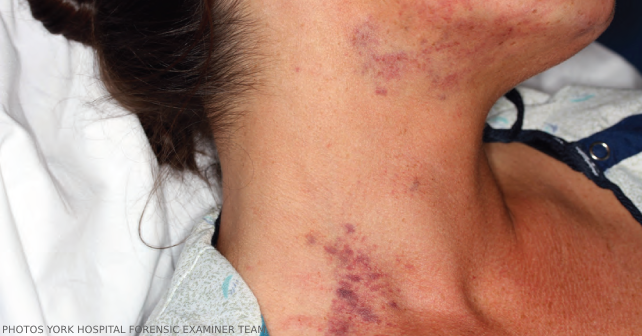
Figure 1: Strangulation bruises on the neck. (Click to enlarge.)

Basic Principles

As forensic photographs may be used in court, it is important to show that the photographed injuries were sustained by the patient in question. This may be done by including patient identifiers in the photographs or by “bookending” the series of photographs with patient identifiers. Forensic images, once taken, should not be altered, and no image should be deleted.

The goal of forensic photography is to provide a clear and accurate depiction of the patient’s injuries. The background of the photographs should be as uncluttered as possible and provide good contrast with the body part being photographed. The blue or green surgical drapes available in most emergency departments are ideal for this purpose.
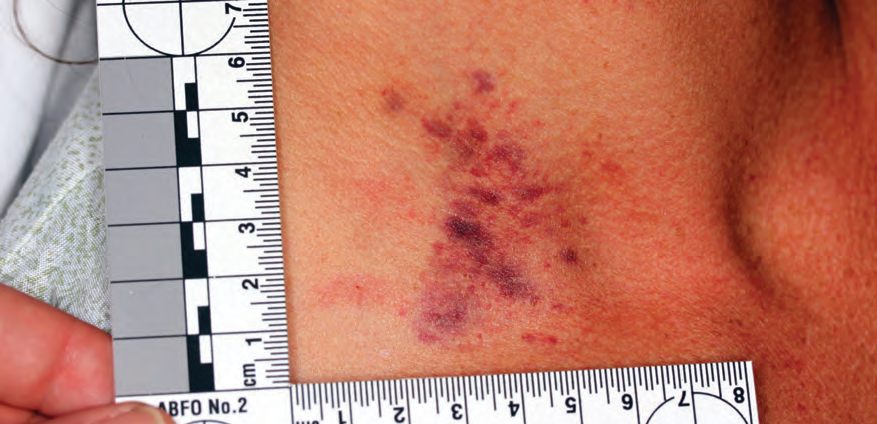
Figure 3: Correct sizing is needed when photographing bruising on the neck. (Click to enlarge.)

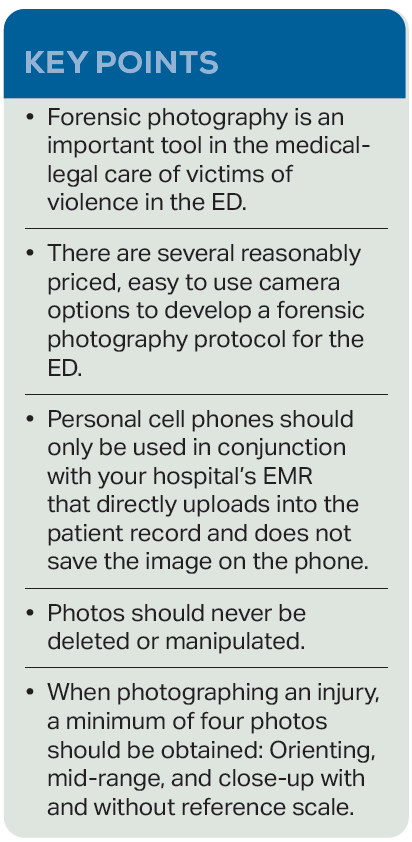
Each injury should be photographed from varying distances. An orienting photo shot from a distance should show the injury in relation to anatomic landmarks; it should be clear from this photo where on the patient’s body the injury is located. A mid-range photo taken closer to the injury provides further detail of the injury and ideally includes an anatomic landmark. Close-up photos should be taken of each injury to show further details. These should be taken with and without a reference scale. While an American Board of Forensic Odontology scale is commonly used, any common object of standard size can be used if this scale is not available (i.e., a coin or ruler). The reference scale should be in the same plane as the injury, and the camera should be perpendicular to the injury and the scale.
Click to enlarge.

Legal Issues

While many ED general consent forms do include consent for medical photography, forensic photography requires separate consent from that obtained for medical treatment. The consent form should clearly state the intended use of the photographs and if they are able to be released to a law enforcement agency or district attorney’s office.

Depending upon how the images are stored, investigators may be required to obtain a subpoena or an authorization for release of medical records. These protocols should be established with the hospital’s medical records department.

Case Resolution

As the patient is stable, you have time to properly document the gunshot wound. In your chart, you describe the wound, including its size, shape, and location with respect to anatomic landmarks.

Pages: 1 2 3 | Single Page

Topics: Electronic Medical Recordsforensic photosLegalTrauma & InjuryViolence

Related

  • Drug-Facilitated Sexual Assault Presentation Varies

    August 25, 2025 - 0 Comment
  • The AI Legal Trap in Medicine

    August 14, 2025 - 0 Comment
  • May 2025 News from the College

    May 6, 2025 - 0 Comment

Current Issue

ACEP Now: November 2025

Download PDF

Read More

No Responses to “Forensic Photography Tips”

Leave a Reply Cancel Reply

Your email address will not be published. Required fields are marked *


*
*


Wiley
  • Home
  • About Us
  • Contact Us
  • Privacy
  • Terms of Use
  • Advertise
  • Cookie Preferences
Copyright © 2025 by John Wiley & Sons, Inc. All rights reserved, including rights for text and data mining and training of artificial technologies or similar technologies. ISSN 2333-2603
