Logo

Log In Sign Up |  An official publication of: American College of Emergency Physicians
Navigation
  • Home
  • Multimedia
    • Podcasts
    • Videos
  • Clinical
    • Airway Managment
    • Case Reports
    • Critical Care
    • Guidelines
    • Imaging & Ultrasound
    • Pain & Palliative Care
    • Pediatrics
    • Resuscitation
    • Trauma & Injury
  • Resource Centers
    • mTBI Resource Center
  • Career
    • Practice Management
      • Benchmarking
      • Reimbursement & Coding
      • Care Team
      • Legal
      • Operations
      • Quality & Safety
    • Awards
    • Certification
    • Compensation
    • Early Career
    • Education
    • Leadership
    • Profiles
    • Retirement
    • Work-Life Balance
  • Columns
    • ACEP4U
    • Airway
    • Benchmarking
    • Brief19
    • By the Numbers
    • Coding Wizard
    • EM Cases
    • End of the Rainbow
    • Equity Equation
    • FACEPs in the Crowd
    • Forensic Facts
    • From the College
    • Images in EM
    • Kids Korner
    • Medicolegal Mind
    • Opinion
      • Break Room
      • New Spin
      • Pro-Con
    • Pearls From EM Literature
    • Policy Rx
    • Practice Changers
    • Problem Solvers
    • Residency Spotlight
    • Resident Voice
    • Skeptics’ Guide to Emergency Medicine
    • Sound Advice
    • Special OPs
    • Toxicology Q&A
    • WorldTravelERs
  • Resources
    • ACEP.org
    • ACEP Knowledge Quiz
    • Issue Archives
    • CME Now
    • Annual Scientific Assembly
      • ACEP14
      • ACEP15
      • ACEP16
      • ACEP17
      • ACEP18
      • ACEP19
    • Annals of Emergency Medicine
    • JACEP Open
    • Emergency Medicine Foundation
  • About
    • Our Mission
    • Medical Editor in Chief
    • Editorial Advisory Board
    • Awards
    • Authors
    • Article Submission
    • Contact Us
    • Advertise
    • Subscribe
    • Privacy Policy
    • Copyright Information

First Look: Emergency Department Operations in the Pandemic Year 2021

By James J. Augustine, MD, FACEP; Nicholas J. Jouriles, MD, FACEP | on January 6, 2023 | 0 Comment
Benchmarking
  • Tweet
  • Click to email a link to a friend (Opens in new window) Email
Print-Friendly Version

You Might Also Like
  • The Big Recovery: Emergency Department Operations in 2021
  • Emergency Department Inefficiency Drives Poor Quality
  • Where Will Emergency Department Volumes Go Post-Pandemic?
Explore This Issue
ACEP Now: Vol 42 – No 01 – January 2023

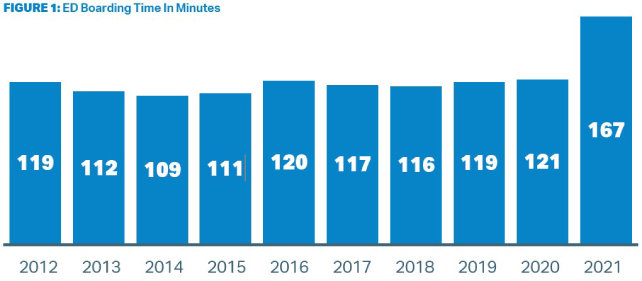
Figure 1. Click to enlarge.

ED leaders must work with hospital leaders to shorten boarding time. In CMS’s language, boarding time is the median time (in minutes) from admit decision time to time of departure from the ED for patients admitted to inpatient status. Figure 1 shows that truly little progress had been made in reducing boarding time in the nine years ending in 2020. Then, in 2021, boarding times increased markedly by 39 percent (46 minutes).

Boarding time directly correlates with LBTC rates and ED length of stay. EDBA uses the “Left Before Treatment Complete (LBTC)” as the single statistic that counts all patients who present to the ED for care and leave before they are supposed to. This provides the most complete accounting for all patients who leave the ED, and includes those patients who leave before or after the medical screening exam, those that leave against medical advice (AMA), and those that elope.

The percentage of patients who left the ED prior to the completion of treatment increased to 4.0 percent, from 2.8 percent in 2020 (Figure 2).

Figure 2. Click to enlarge.

LBTC tracks closely and worsens with increasing ED volume (Figure 3). Every cohort had record-high LBTC rates in 2021, higher than in any year since the EDBA began collecting data in 2004. Even Freestanding EDs saw a jump in LBTC rates. In 2019, FSEDs had a LBTC rate of 1.6 percent. In 2021, that rate increased to 2.3 percent.

How dramatic was the increase in patients who walked away from the ED?

The overall LBTC rate of four percent in 2021 also represents far more patients than any prior year. In 2020, 3.8 million patients walked away from the ED before their evaluation was complete. In 2021, that amounted to about 6 million patients. 2.2 million more ED patients left before their ED treatment was complete than in 2020.

Figure 3. Click to enlarge.

Working Forward: Restoring Flow Through the ED and Reducing LBTC Volumes

At the present time, ED and hospital leaders should anticipate that ED volumes have returned to the trend of stable increases.

KEY POINTS

  • Emergency department (ED) volume loss was dramatic from March 2020 through September 2020.
  • The percentage of patients who left the ED prior to the completion of treatment increased to 4.0 percent, from 2.8 percent in 2020.
  • In 2020, 3.8 million patients walked away from the ED before their evaluation was complete.
  • Operational challenges are now layered onto the 2022 volume of patients that are about the same, if not higher, than 2019.

Emergency department operations in 2021 were significantly impacted by many factors which reduced flow, increased walkaway rates, and greatly stressed ED staff. These operational challenges are now layered onto the 2022 volume of patients that are about the same, if not higher, than 2019. Increasing patient acuity also further strains ED operations.

Pages: 1 2 3 | Single Page

Topics: BoardingLeft Before Treatment CompleteOperations

Related

  • November 2025 News from the College

    November 4, 2025 - 0 Comment
  • Pediatric Patients in Acute Mental Health Crisis Face Long Waits

    August 29, 2025 - 0 Comment
  • Hospital at Home Is Here: An Opportunity EM Can’t Ignore

    August 25, 2025 - 0 Comment

Current Issue

ACEP Now: November 2025

Download PDF

Read More

No Responses to “First Look: Emergency Department Operations in the Pandemic Year 2021”

Leave a Reply Cancel Reply

Your email address will not be published. Required fields are marked *


*
*


Wiley
  • Home
  • About Us
  • Contact Us
  • Privacy
  • Terms of Use
  • Advertise
  • Cookie Preferences
Copyright © 2025 by John Wiley & Sons, Inc. All rights reserved, including rights for text and data mining and training of artificial technologies or similar technologies. ISSN 2333-2603
